
Why game three is harder on your feet than game one
The research on pickleball injuries keeps pointing to the same place: the legs, the lunge and the hours you put in. Here is what it says, a 60-second check you can do tonight, and the one piece of gear our reviewers keep in every court shoe.
- 01What the injury research shows
- 02The 60-second foot check
- 03The insole our reviewers keep
- 04Pick your arch

Your paddle gets all the attention. Your feet do the harder job.
Every split step, kitchen shuffle, wide dink, lunge and emergency stop starts at the floor. In game one, that load feels like nothing. By game three, you start reaching instead of moving. Your first step to the ball gets a half beat slower. You stop chasing the lob you would have run down an hour ago.
That is not a lack of grit. It is load, and it adds up faster than most of us admit.
What the injury research actually shows
Three studies, three different methods, one consistent picture: pickleball’s injuries live in the lower body, and they skew toward players over 50.
Sources: Forrester, NEISS emergency department data 2000 to 2019; Kingston et al., Foot & Ankle Orthopaedics, 2024 (198 patients, 2015 to 2023); Lee et al., Frontiers in Public Health, 2026 (383 players). Full list at the end.
The same orthopedic study found injuries rose 6.5 times between 2019 and 2023, and most of them happened in one of three movements:
- 30%Running or lunging forward. The drop shot you sprint for, the dink you reach for. This is where most Achilles and calf injuries in the study started.
- 15%Rolling the ankle. Usually on a quick lateral change of direction, often late in a session.
- 8%Moving backward. Backpedaling for a lob is still one of the riskiest things you can do on a court.
Notice what is not on that list: bad luck. These are load-and-movement problems. Which means most of the fix is in your warm-up, your footwork and how much you play, not in a product. We will get to the product. First, the part that costs nothing.
The 60-second foot check
This is the check from our September foot story. It is not a diagnosis. It is a comparison: you are looking for a big difference between your left and right side.
- 1Flip your shoes over. Compare the soles of the pair you play in most. Dramatically more wear on one inside edge, one outside edge, or one shoe breaking down faster is a clue worth noting.
- 2Let a photo do the looking. Stand barefoot and relaxed, and have someone snap your feet from behind, or prop your phone on the floor a few feet back and use the timer. Does one heel or ankle lean inward more than the other?
- 3Five slow single-leg mini squats. Watch for the arch collapsing, the knee diving inward or the ankle wobbling. Is one side much harder?
- 4A small lateral push. From an athletic stance, push gently right, reset, push left. Which foot feels more stable when you load it? Which side makes you hesitate?
One clue means little. Several pointing the same way, or anything that reproduces pain, is a reason to talk to a physical therapist or podiatrist before your next tournament.
What an insole can do, and what it can’t
We are going to be straight with you here, because most insole marketing isn’t.
What it can do
- Replace the thin factory insole most court shoes ship with
- Match your arch, so the shoe fits the foot you actually have
- Add cushioning under the heel and forefoot for long sessions
- Keep your foot from sliding inside the shoe on hard cuts
What it can’t do
- Prevent injuries. No insole has shown that for pickleball
- Fix pain you already have. That needs a professional
- Replace a warm-up, strength work or a rest day
- Rescue a shoe that is worn out
The research backs that line. A review of 18 trials found that simple shock-absorbing insoles did not reduce injuries. Foot orthoses did better in the same review, but trial quality varied widely and none of the trials involved pickleball. So when a brand promises fewer injuries, ask for the study. What a good insole does is make the shoe you already own fit and feel better through the hours the research says matter most.
The insole our reviewers keep in every court shoe
Drew McCartt tested the CURREX PICKLEBALLPRO in January 2025 and scored it 4.75 out of 5. Eighteen months later, they are in three pairs of his court shoes. That is the review that matters to us: not the first session, but whether a product survives a season and a half of being swapped between shoes.

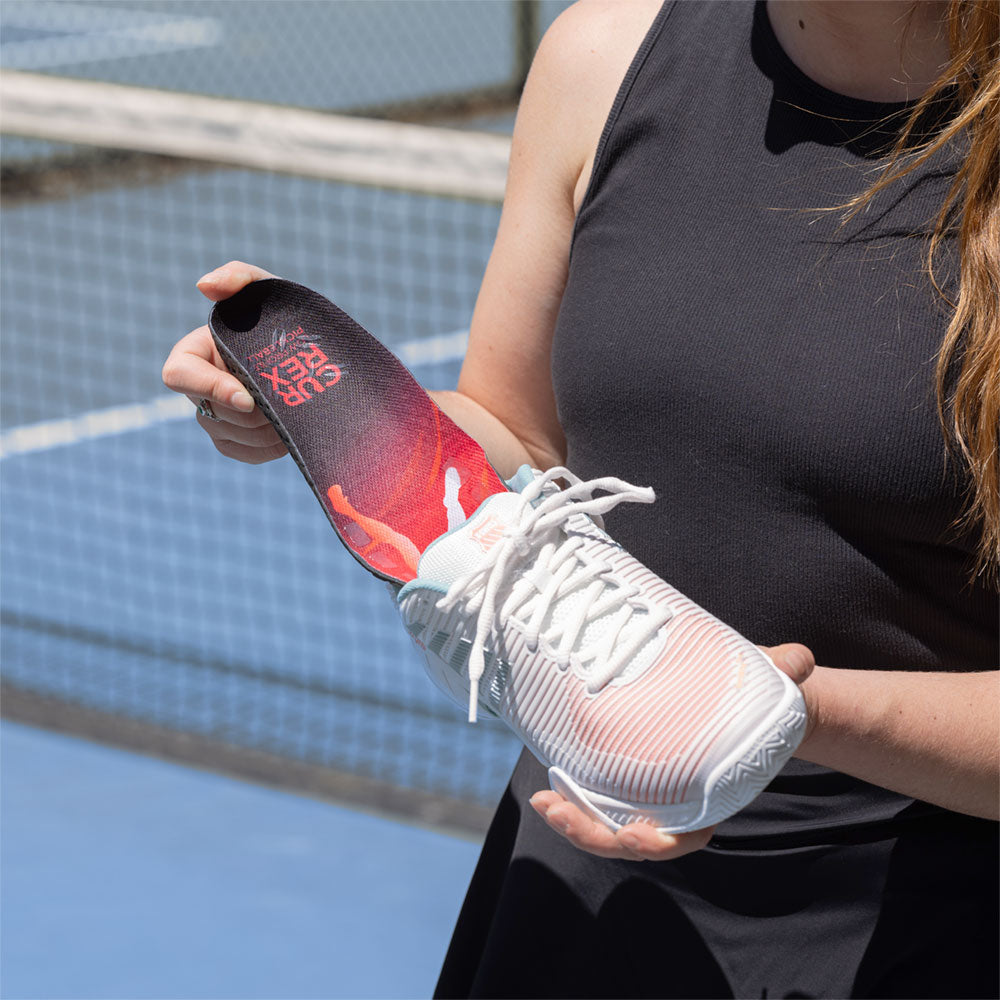
“They felt natural and comfortable.”
Drew McCartt, after nearly two hours on court in his first session
What is in it:
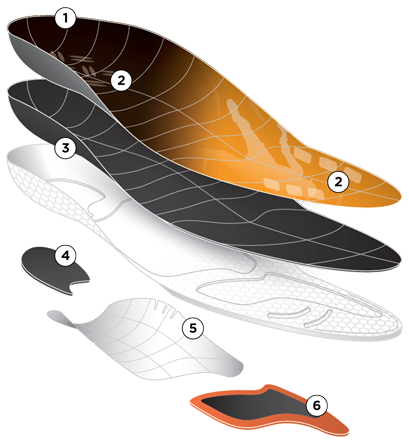
- 1Decoupled heel. Heel and forefoot move independently on quick cuts.
- 2Super Grip top layer. Anti-slip surface that keeps your foot from sliding.
- 3Dual-layer cushioning. Comfort for long sessions, with a vented top cover.
- 4Heel cushioning. Extra padding for hard stops and landings.
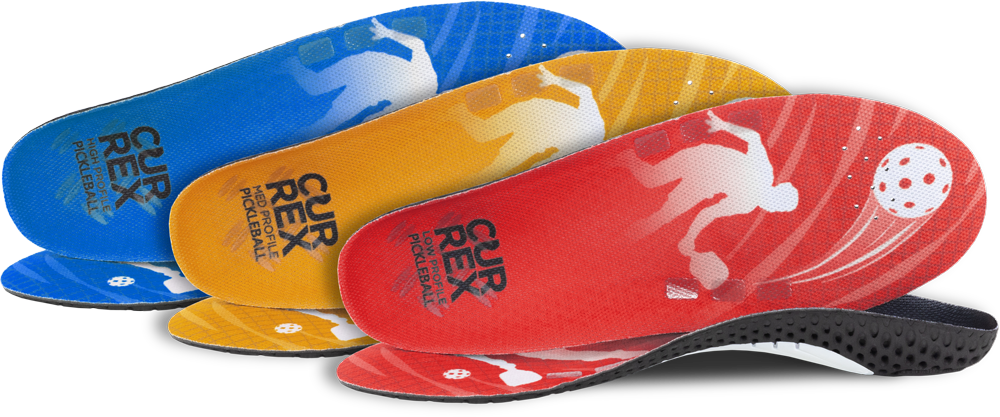
- 5Dynamic Arch Technology. Flexes with your arch. Low, medium or high profile.
- 6Forefoot cushioning. Responsive padding for pivots and push-offs.
Trim to fit. Fits most court shoes, widths up to 2E.
Drew’s honest notes: they felt snug in his shoes for the first 30 minutes, then settled. And at $59.95 they cost more than a drugstore insole. CURREX rates them for about 12 months or 500 miles of use.
Pick your arch in 30 seconds

Low
Your wet footprint shows most of your midfoot. Your arch nearly touches the floor when you stand.


High
Your footprint shows a thin strip, or none, between heel and forefoot.
Pickleball Union reader offer
CURREX PICKLEBALLPRO
20% off with our code at checkout.
Clicking copies the code for you. Paste it at checkout.
List price $59.95. Code applies on Amazon. Prices and availability change; check at checkout. Pickleball Union earns a commission on purchases through these links.
Questions readers ask
Will an insole stop me from getting hurt?
No, and be wary of anyone who says so. The injury research points to load, warm-up, conditioning and movement. An insole improves fit and comfort in the shoe; it is not a medical device for injury prevention.
I already have foot or heel pain. Should I try these?
See a podiatrist or physical therapist first. Pain that shows up during play is worth a professional opinion, and they can tell you whether an over-the-counter insole or a custom orthotic makes more sense.
Will they fit my court shoes?
Most likely. You trim them to match your shoe’s original insole, and they fit widths up to 2E. Low-volume shoes can feel snug for the first session.
How long do they last?
CURREX says about 12 months or 500 miles, whichever comes first. If you play four days a week, plan on replacing them yearly.
Before your next session
Do the foot check tonight. Warm up properly tomorrow. And if your court shoes still have the insole they came with, start there.
Code PBUNION20 is copied when you click. 60-second checkout on Amazon.
Sources
- Forrester MB. Pickleball-related injuries involving the lower extremity treated in emergency departments. Lower Extremity Review, 2021. NEISS data, 2000 to 2019: lower-extremity injuries were 26.7% of an estimated 39,368 pickleball injuries; 78.7% of patients were 60 or older; sprains and strains were 76.3%.
- Kingston K, Parker EB, Higgins A, Smith JT. Epidemiology of pickleball-related foot and ankle injuries (2015 to 2023). Foot & Ankle Orthopaedics, 2024. 198 patients; Achilles rupture 39.4%; mean age 58.3; injuries up 6.5 times from 2019 to 2023; mechanisms: running or lunging forward 29.7%, ankle inversion 14.8%, moving backward 8.0%.
- Lee KJ, Jeong B, Nam SH, Lee RS, Heo J, Kim KM. Prevalence and associated factors of pickleball-related injuries among Korean recreational players. Frontiers in Public Health, 2026. 383 players; 38.1% injured in the past year; knee 21.4% and ankle/foot 15.8% of injured sites; odds ratio 1.06 per weekly hour of play.
- Bonanno DR, Landorf KB, Munteanu SE, Murley GS, Menz HB. Effectiveness of foot orthoses and shock-absorbing insoles for the prevention of injury: a systematic review and meta-analysis. British Journal of Sports Medicine, 2017. Shock-absorbing insoles: no significant reduction in injuries across 7 trials.
- CURREX product specifications, currex.com, checked October 30, 2026.