
To get more out of pickleball lessons, show up with one specific problem, ask for one priority correction, and leave with a simple practice plan. A good lesson should not overload you with tips — it should help you understand the mistake, fix the pattern, and know exactly what to practice next.
A pickleball lesson can be great. It can also be a very expensive way to hear five tips you forget by Tuesday.
Here is my honest opinion: most rec players do not waste money on lessons because the coach is bad. They waste money because they show up with no problem to solve, accept too many corrections, then go right back to open play and hope the lesson somehow “sticks.”
That is not how improvement works.
A good lesson should give you one clear priority, one measurable goal, and one practice plan. Coaches who set clear expectations help players focus better and make faster progress because the player knows what the session is actually trying to accomplish.
Stop Buying “General Improvement”
The worst lesson request is: “Can you just look at my game?”
That usually turns into a sampler platter: a little serve, a little third shot, a little dink, a little footwork, a little strategy. It feels productive because you covered a lot.
But you probably fixed nothing.
Go into the lesson with a specific court problem:
“My drops float when I’m moving.”
“I speed up too early in dink rallies.”
“I lose transition points because my resets sit up.”
“I don’t know when to drive versus drop.”
That gives the coach something real to diagnose.
Ask for the Pattern, Not Just the Stroke
Intermediate players do not need more random technique tips. They need to understand why the mistake keeps showing up in games.
A good coach should be able to explain the pattern:
Your reset pops up because your contact is late.
Your contact is late because your feet stop in transition.
Your feet stop because you are watching your third instead of expecting the fourth.
That chain is more valuable than “soften your grip.”
Pickleball improvement is rarely one isolated correction. It is usually a decision, spacing, timing, or recovery problem hiding inside a stroke.
The One-Correction Rule
If you leave a lesson with eight things to remember, you did not get coached. You got overloaded.
Ask the coach: “What is the one thing I should focus on this week?”
One thing.
Not five.
If the coach says, “Well, your grip, backswing, paddle face, knees, follow-through, spacing, and shot selection all need work,” that may be true. But it is not a practice plan.
A useful lesson ends with a priority.
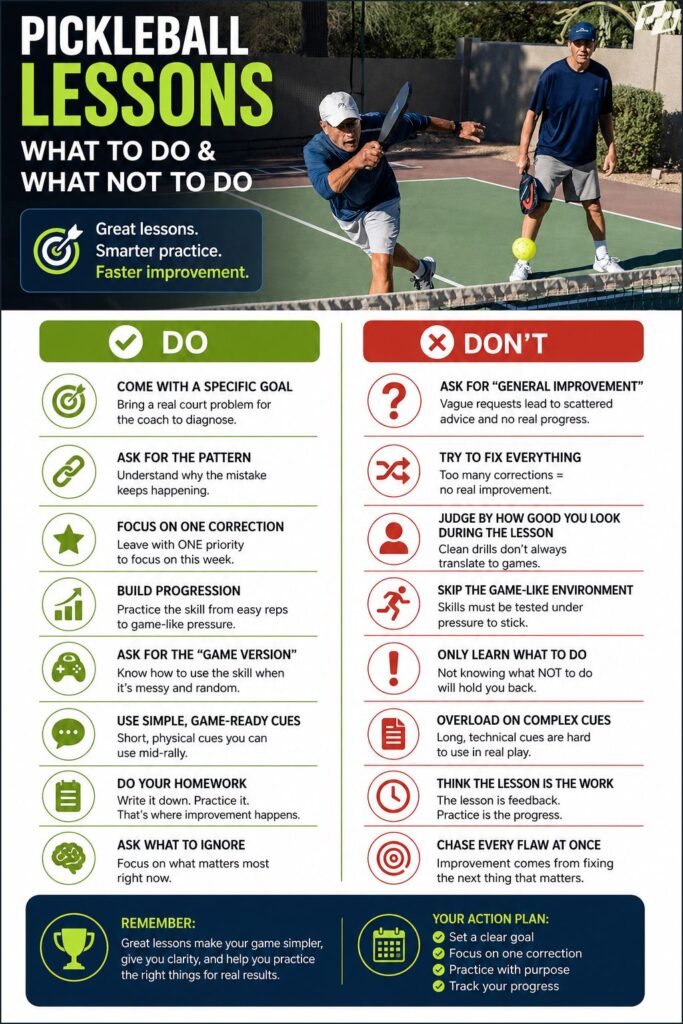
Don’t Judge the Lesson by How Good You Look During It
This is a trap.
A coach can feed perfect balls, give immediate reminders, and make you look amazing for 45 minutes. Then you play open play and everything disappears.
That does not mean the lesson failed.
It means you only practiced the skill under clean conditions.
You need progression: cooperative reps, movement, random feeds, then game-like pressure. Good coaching resources often emphasize progressions, drills, structure, and tracking rather than simply hitting balls and hoping improvement transfers.
The real test is not: “Did I hit it well with the coach?”
It is: “Can I use it when the ball is random and I’m under pressure?”
Ask for a “Game Version” of the Skill
Every lesson skill needs a game version.
If you worked on thirds, ask: “What should I do when the return is deep and I’m late?”
If you worked on dinks, ask: “Which dink should I use when I’m pulled wide?”
If you worked on speedups, ask: “What ball should I not attack yet?”
That last question is gold.
Many rec players improve faster when they learn what not to do. Intermediate mistakes often come from over-attacking, poor shot selection, and trying to win from positions that should be reset or neutralized.
The Best Coaches Give You Fewer Cues
A good cue is short, physical, and usable mid-rally.
Bad cue: “Use your legs, soften your hand, keep your paddle face stable, and finish toward the target.”
Good cue: “Catch, don’t punch.”
Bad cue: “Move your feet earlier and create better spacing.”
Good cue: “Arrive before you swing.”
If the cue only makes sense while standing still, it is not game-ready.
Your Homework Matters More Than the Lesson
One hour with a coach cannot undo ten hours of open-play habits. After the lesson, write down three things:
The problem: “My transition resets float.”
The cause: “I’m contacting too deep and pushing.”
The homework: “Ten minutes of midcourt reset reps before games.”
That is enough.
If you do not practice between lessons, you are not really taking lessons. You are renting feedback.
My Honest Advice
Take lessons when you have a real question. Not when you are vaguely frustrated.
A great lesson should make your game simpler, not busier. You should leave knowing exactly what to practice, when the correction applies, and what mistake tells you that you slipped back into the old habit.
The best question to ask at the end is: “What should I ignore for now?”
That answer protects you from chasing every flaw at once.
Because improvement does not come from knowing everything wrong with your game. It comes from fixing the next thing that matters.