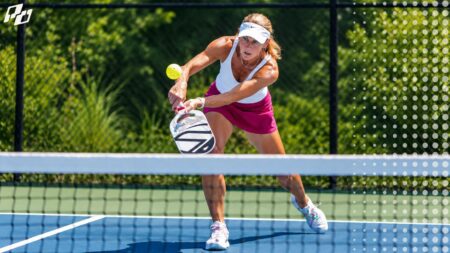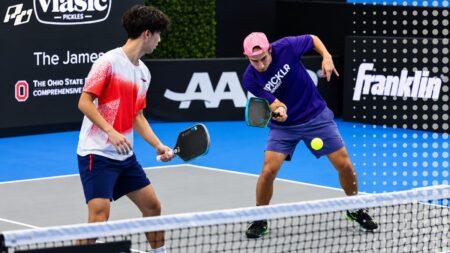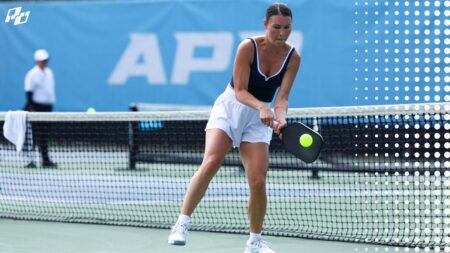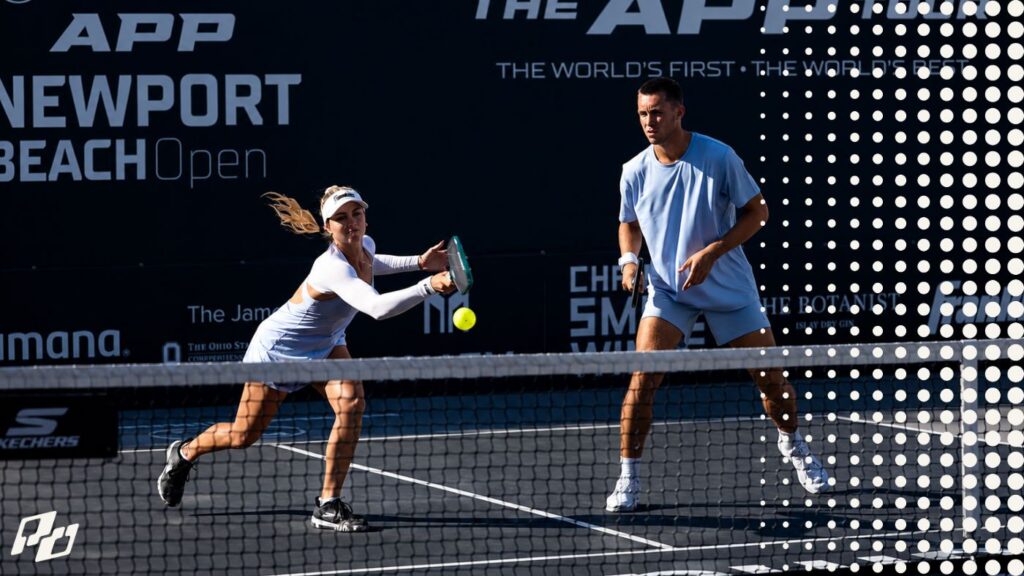
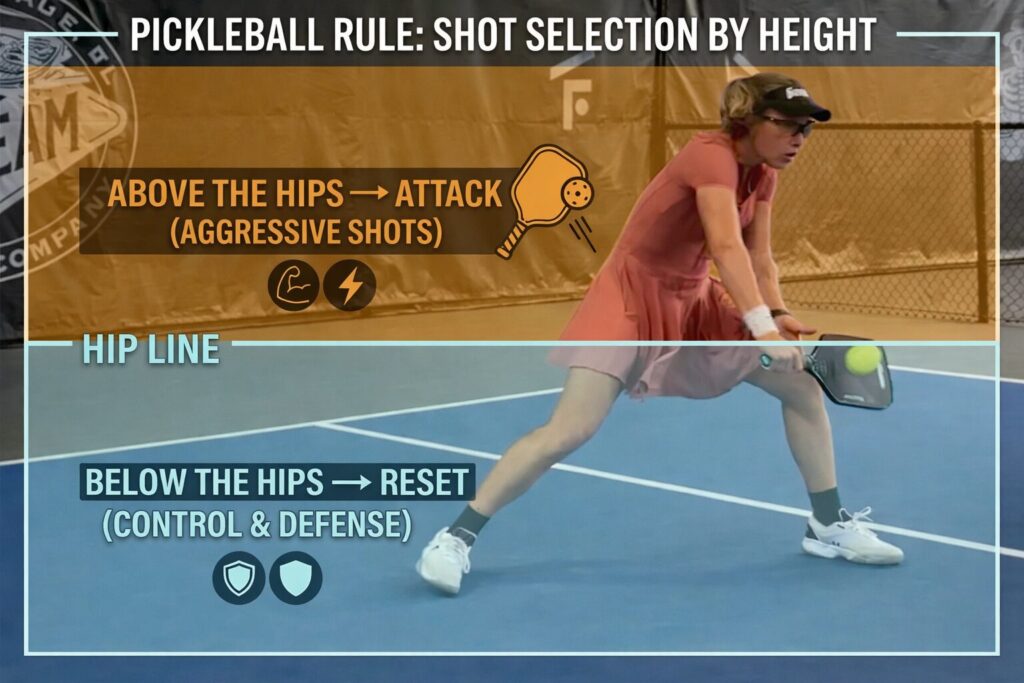
Attack from midcourt in pickleball only when the ball is high, in front, and you’re balanced. Use a compact punch, roll volley, or controlled putaway toward the feet or middle. If you must lift the ball, are moving backward, or feel off balance, reset instead.
Most rec players treat the midcourt like a danger zone. They sprint through it, panic when the ball comes at their feet, and assume the only “safe” place to attack is the kitchen line.
That is partly true.
The kitchen line is still home base.
But stronger players know something intermediate players often miss:
You do not have to be at the kitchen to punish a bad ball.
If the ball sits up in the midcourt, you can attack. The trick is knowing which balls are attackable, which ones are traps, and how to finish without turning a good opportunity into a wild swing.
The Real Midcourt Problem
Most missed midcourt putaways are not power problems. They are permission problems.
Players attack balls they should reset, then reset balls they should punish. So the first upgrade is not your swing. It is your decision trigger.
Ask this before you attack:
Is the ball above net height?
Is it in front of my body?
Am I stopped or balanced enough to control the paddle face?
Can I hit down or through the feet instead of lifting?
If the answer is yes, attack.
If the answer is no, reset and keep moving.
That is the difference between a midcourt weapon and a midcourt donation.
The Green-Light vs. Red-Light Test
| Ball You Get | Better Choice | Why |
|---|---|---|
| Chest-high and in front | Attack | You can hit through or down without lifting |
| Above net height but slightly off-center | Controlled punch/roll | Pressure, but with margin |
| At hip height and balanced | Maybe attack | Depends on target and opponent position |
| Below net height | Reset | You are likely hitting up |
| At your feet | Half-volley reset | Putaway attempt usually pops up |
| Behind your body | Reset or block | You are late |
| While moving backward | Reset | Your base does not support offense |
The most useful rule for rec players: if you have to lift the ball, it is probably not a putaway.
That one sentence prevents a lot of errors.
Think in stages, not winners
One of the biggest misconceptions in recreational pickleball is that every attack should finish the point. Professional players rarely think that way. Instead, they create pressure one shot at a time.
A typical sequence looks like this:
| Shot | Goal |
|---|---|
| First attack | Force a defensive block. |
| Second attack | Create a higher, weaker reply. |
| Third attack | Finish the point. |
Sometimes you skip straight to the putaway. Most of the time, you don’t. That’s completely normal. Trying to end the rally too early usually leads to unforced errors.
Every quality attack makes the next ball slightly easier — that’s why you’ll often see three offensive shots before the point finally ends. Rec players try to skip directly to the third one. Don’t.
Why Midcourt Attacks Feel So Awkward
At the kitchen, your feet are usually set and the ball is close.
At the baseline, you have time.
Midcourt gives you neither.
You are often moving forward, trying to decide whether to keep coming in, and handling a ball that may be too high to reset but too low to crush.
That is why body control matters more than swing speed here.
A good midcourt attack usually feels like a short punch, roll, or controlled press, not a full slap. Coaches who teach transition-zone offense emphasize that the midcourt can become an attacking area, but only when the player uses balance, paddle position, and ball height to choose the right shot.
Should you volley it or let it bounce?
One more decision matters before you attack: should you take the ball out of the air, or let it bounce?
Many intermediate players automatically reach for the volley, but that’s not always the highest-percentage play.
If reaching for the volley forces you to extend too far or lose balance, you’ve actually made the shot more difficult.
In those situations, letting the ball bounce can be the better offensive option.
Why? Because now you can:
- contact the ball from a stronger position
- rotate through the shot naturally
- generate more pace
- choose your target instead of simply reacting
The best attackers don’t just take the ball early. They take it at the best possible contact point.
Where to Aim Midcourt Putaways
Do not aim for the sideline first. That is the rec-player trap. From midcourt, your best targets are usually:
| Target | Why It Works |
|---|---|
| Opponent’s feet | Forces a lift or awkward block |
| Middle seam | Creates hesitation between partners |
| Paddle-side hip | Jams the counter |
| Behind a player moving forward | Works if they overcommit |
| Open court | Use only when you are balanced and the ball is clearly high |
My favorite target for rec players: hard through the middle or down at the feet.
Those targets give you pressure without needing perfect precision.
Quick decision checklist
Before you speed up from mid-court, ask yourself four questions.
| Question | If the answer is “No”… |
|---|---|
| Am I balanced? | Don’t force the attack. |
| Can I swing through the ball instead of lifting it? | Reset or stay neutral. |
| Do I have an awkward target? | Wait for a better opportunity. |
| Will this likely create a weaker reply? | Build the point instead of trying to finish it. |
If you answer “yes” to all four, you’re probably looking at a high-percentage attack.
The Three Midcourt Attack Types
1. The Punch Volley
Best when the ball is high and coming with pace.
Short motion. Firm face. Target feet or middle. Do not backswing. The ball already has speed.
Cue: “Firm face, short finish.”
2. The Roll Volley
Best when the ball is high enough to shape but not high enough to smash.
Brush forward and slightly up, but keep the target low. This is great against players moving in because the ball dips at their feet.
@tanner.pickleball 4.0 Level Pickleball Players NEED This Shot for Mid Court Attacks! 🏆🥇 👉 When you get a ball you’re looking to attack in the transition zone.. ✅ ROLL IT ❌ Don’t FLICK it ✅ Rolling the ball is locking the wrist and using your shoulder. 👉 This is much more consistent and allows you to attack from all heights. #pickleball #pickleballtiktok #pickleballlife #pickleballaddict #pickleballtips ♬ original sound – Tanner.pickleball
Cue: “Roll it down, not up.”
3. The Controlled Putaway
Best when the ball is clearly above net height and you are balanced.
This is where you can be more aggressive, but the target still matters. Down through the feet beats swinging for the fence.
Cue: “Finish the point with direction, not drama.”
The Footwork Detail That Changes Everything
Do not attack while your body is still rushing forward. That is where balls sail. Before a midcourt attack, you need some version of a brake:
- split step
- small hop-stop
- outside-leg load
- stable plant before contact
You do not need to be frozen. But your paddle face needs a quiet body underneath it. If your chest is still drifting forward at contact, the paddle usually opens and the ball climbs.
Cue: “Brake before you break them.”
Don’t Keep Moving After the Attack
This is something many coaches emphasize.
Rec players attack…
…then admire the shot.
Or they attack…
…and keep running forward no matter what.
Better:
Attack. Read the reply. Then decide whether to continue moving to the kitchen or stop and reset again.
Sometimes your attack earns an easy volley.
Sometimes it doesn’t.
The attack doesn’t remove the need to read the next ball.
Common Midcourt Putaway Mistakes
| Mistake | Better Fix |
|---|---|
| Swinging big from midcourt | Use a compact punch or roll |
| Attacking below net height | Reset instead |
| Aiming for sidelines | Start with feet and middle |
| Drifting forward while hitting | Brake before contact |
| Trying to end every ball | Use attacks to create the next easier ball |
| Ignoring opponent position | Attack moving players, reset against set players |
My Honest Advice
The midcourt is not “no man’s land” if you know what you are looking for. It is a decision zone.
Bad players rush through it.
Nervous players swing from it.
Smart players read from it.
That is the upgrade.
Do not become a player who attacks everything from midcourt. That is just chaos with confidence.
Become the player who knows exactly when the ball has crossed the line from survive to punish.
When it is low, reset.
When it is high, in front, and your body is stable, attack with purpose.
That is how midcourt putaways become a weapon instead of a gamble.