A smart pickleball speed-up often goes straight at the player in front of you, not into open court. Aim for a cramped body zone—like the hip or elbow—so they have less time and less room to counter cleanly. Avoid feeding a ready paddle.
You get an attackable dink and immediately see the open court. So naturally, you aim there. But what if the smarter attack is actually the player standing right in front of you?
That’s the idea behind one of the simplest—and most useful—speed-up patterns in doubles. A straight-ahead attack travels a shorter distance, arrives sooner, and can jam the defender before they have room to organize a clean counter.
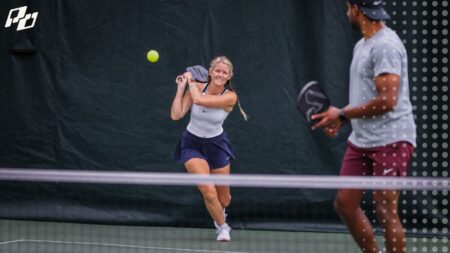
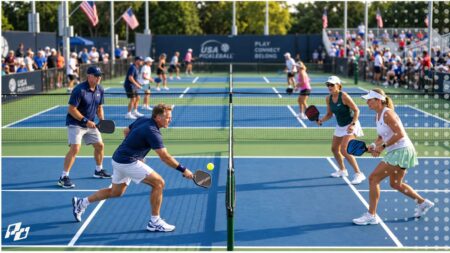
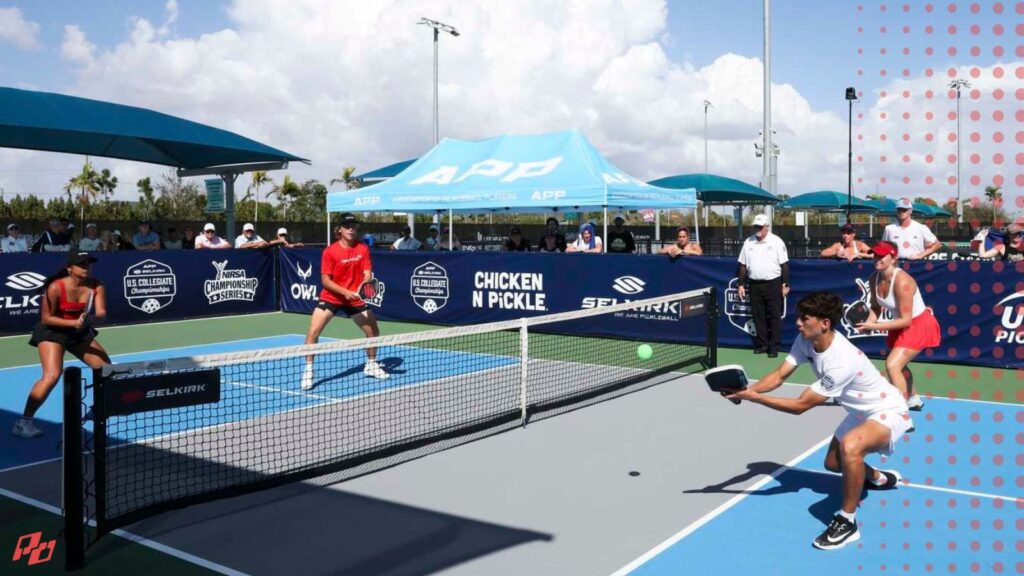
Watch this PPA pro doubles point and notice how much of it is built around simple, smart attacks at the player directly in front—and the weak, predictable returns those attacks create:
Now watch it again with one question in mind: what did the first attack make the opponent hit next?
That’s the part rec players often miss.
The goal isn’t always to blast a clean winner on Ball 1. A well-placed jam can force a cramped counter, weak block, or popup—and suddenly the next ball becomes the easy one.
In this article, we’ll break down where to aim, why straight-ahead attacks arrive so fast, what return you should expect, and how to turn one controlled speed-up into a simple three-ball pattern.
Straight Ahead Is the Short Route
Imagine speeding the ball diagonally across the court. The ball has farther to travel. That extra distance can give the defender slightly more time to see the direction, organize the paddle, and counter.
Now send the same attack toward the opponent directly across from you.
The route is shorter.
The ball reaches them sooner.
That’s one reason straight-ahead attacks can feel surprisingly fast even when you’re not swinging at maximum power. You don’t necessarily need a harder speed-up. You can make the ball arrive sooner.
A controlled attack on the shorter route can rush a player more than a harder ball sent farther across the court.
Don’t Hit the Body—Hit the Awkward Part of the Body
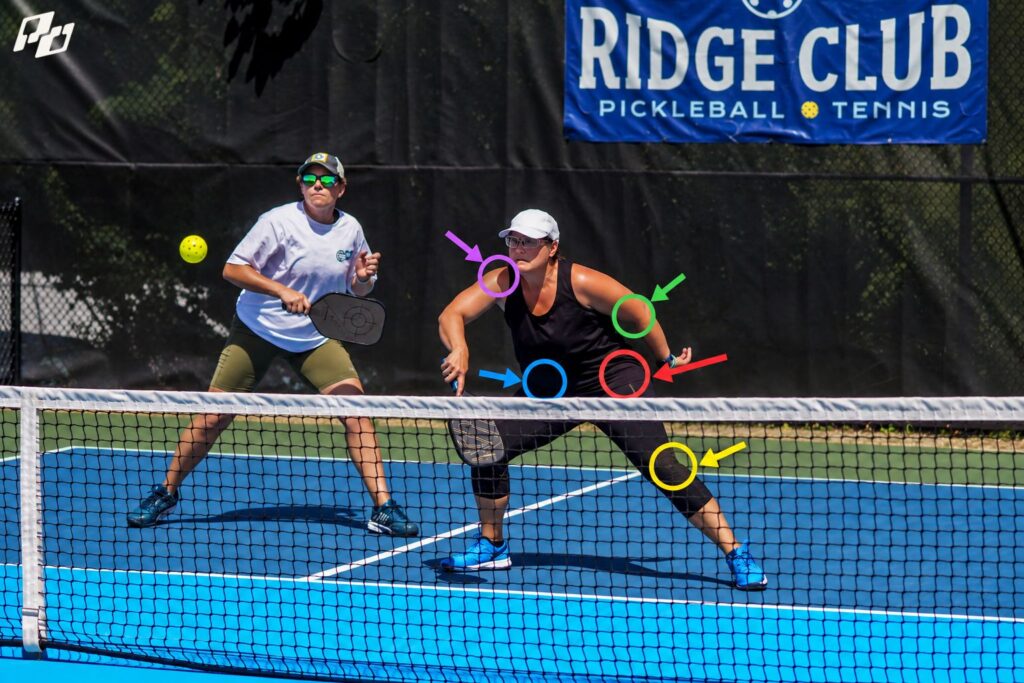
“Attack the player in front of you” does not mean aim blindly at their chest. The goal is to jam the part of their body where the paddle has the least room to work.
Good targets can include:
✔ inside hip
✔ paddle-side hip
✔ elbow or chicken-wing area
✔ paddle-side shoulder
✔ thigh or knee when contacting the ball higher
But the best target changes with the defender’s paddle position.
If their paddle is already sitting comfortably on the backhand side, firing straight into that zone may simply feed them an easy punch counter.
If the paddle is low, the shoulder or upper body may be more exposed.
If they’re cheating forehand, the inside hip or backhand-side space may become uncomfortable.
So don’t memorize one universal body target. Instead, ask: Where does this player have the least room to make a clean swing right now?
That is the jam zone.
A ball into a cramped hip or elbow can force an awkward counter. A ball directly into a ready paddle is not a jam.
It’s a feed.
Don’t Try to End the Rally With Ball One
This may be the biggest upgrade for rec players.
You see the speed-up.
You swing hard.
You expect the point.
Good players expect another ball.
PPA pro Catherine Parenteau has described smart offense as controlled aggression—using the attack to set up the next ball rather than treating every speed-up like an attempted winner.
Most attacks are opening shots in a sequence, and the quality of the target matters partly because it limits what the opponent can do on the counter.
That’s exactly why a jam works. You aren’t necessarily trying to beat their paddle. You’re trying to make their paddle produce something predictable.
The Best Part May Be the Ball That Comes Back
This is where Catherine’s tip becomes more advanced than it first appears. A speed-up shouldn’t always be judged by whether you hit a winner, but by the counter you created.
When you attack directly in front of you, the opponent’s simplest reflex counter often comes back through roughly the same lane.
That means you can attack and immediately recover your paddle behind your own shot.
A straight-ahead speed-up often brings the counter back on a similar line, while a diagonal attack can create a more complicated crosscourt response. It’s not guaranteed, but it gives you a useful first read.
So the sequence becomes: jam → recover → expect the counter.
Not: speed up → admire → react late.
Pace Matters Less Than Most Players Think
If your target is right, you often don’t need 100%. In fact, swinging harder can make the tactic worse. More effort can produce:
- a bigger backswing
- earlier visual warning
- poorer accuracy
- and slower recovery for the counter
A compact speed-up into an inside hip at 60–70% effort may create more trouble than a full-speed shot directly into the defender’s ready backhand.
Think: rush them, don’t impress them.
Ball Height Changes the Jam Target
Your contact height should influence where on the opponent you attack.
Low or Below-Net Contact
When the ball is below net height, you have to lift it.
That makes the hip and mid-body more natural jam targets because the ball can follow its necessary upward trajectory without forcing you to thread an extremely low window.
Think: hip → belly button → lower torso
You still need control and topspin because you’re attacking upward.
Higher Contact
Once the ball sits at or above net height, the geometry changes. Now you can hit flatter—or even slightly downward.
That opens up lower targets such as: thighs → knees → feet
without having to manufacture extra lift.
A higher ball also gives you more freedom to attack the shoulder or other exposed body zones if the defender’s paddle position makes them vulnerable.
So the better rule is: Low contact = jam the body. High contact = more of the body becomes available.
Don’t force the same target from every ball height. Let the contact point determine which jam is easiest to execute safely.
Try the “Jam, Don’t Win” Drill
Stand straight across from a partner at the kitchen. Dink cooperatively. Any attackable ball can be sped up, but there’s one rule: you cannot aim for open court.
Your only legal targets are:
- hip
- elbow/chicken wing
- shoulder
- or low body
And don’t score the attack as successful just because the opponent misses. Give yourself a point when the attack creates:
✔ a cramped counter
✔ weak block
✔ popup
✔ or predictable ball you can attack next
This changes what you’re training. You’re no longer practicing how hard you can hit the speed-up—you’re practicing whether you can make their next contact uncomfortable.
That is much closer to the real purpose of the shot.
The Three-Ball Pattern
For beginner to intermediate doubles, I’d simplify the whole concept into this:
✅ Ball 1: Jam
Speed up straight ahead into an uncomfortable body zone.
✅ Ball 2: Expect
Recover your paddle immediately into the likely counter lane.
✅ Ball 3: Finish
If the jam produces a popup or weak counter, attack the next ball harder.
That gives your speed-up a job. You’re not trying to end the rally with Ball 1—you’re trying to make Ball 2 easier.
The next time you get an attackable dink, don’t automatically look for open court. Look at the player in front of you.
If you can take away their swing room, a controlled straight-ahead attack may do more damage than a harder ball into space.
Jam → recover → expect → finish.