To play well with a banger in pickleball, stop moving forward on autopilot. Read the quality of their drive, protect the middle, expect fast counters, and look to finish the next ball. The key is not changing their style — it is organizing your game around it more intelligently.
Playing with a banger is a very different problem from playing against one.
Against a banger, the game is usually pretty straightforward: block, reset, make them hit one more ball, and let their impatience create errors. But when the banger is your partner, things get weird fast. Your normal timing changes. Your court position changes. Your expectations change. And suddenly you are trying to play organized doubles next to someone who wants to turn every rally into a firefight.
That is why this is such a good rec-player topic.
A lot of players run into the same frustration: the partner with the stronger soft game feels caught in between, because the banger drives balls that change the pace of the rally, stays back longer than expected, speeds up shaky balls, and makes it hard to move forward in a normal rhythm.
At the same time, experienced players and coaches keep pointing out something important: this can work for stretches, especially in rec or lower-advanced games, but only if the non-banger partner understands how to organize around it.
And that is the real key.
If your partner is a true banger, your job is not to pretend they are a drop-and-dink player. Your job is to build a game plan around what they actually do well, while protecting the holes that style creates.
First: know what kind of “banger” you actually have
This matters more than people think.
Not all bangers are the same. Some are just reckless players who drive everything and hope. Some are former tennis players with legitimately heavy, accurate drives that create weak counters. Some are transition attackers who still come in eventually. Some stay back way too long and leave you stranded at the kitchen line.
That distinction changes everything.
A lot of coaching on partner positioning comes back to the same bigger principle: doubles works best when both players move with some kind of shared logic, even if they do not play the exact same style.
Most strategy guidance still emphasizes getting to the NVZ as a major objective because teams at the kitchen generally control more points, but it also acknowledges that players can arrive there in different ways and at different tempos.
So before you fix anything, ask:
- Is my partner’s drive actually producing weak balls?
- Do they stay back forever, or just a beat longer than I expect?
- Are they speeding up bad balls, or smart dead balls?
- Are they chaos-good, or just chaos?
That is the first diagnosis.
Because if their drives are genuinely dangerous, you can work with that. If they are just blasting attackable balls and refusing to adjust, the partnership problem gets much harder.
The biggest mistake: moving up on autopilot
This is one of the clearest patterns coaches warn about.
A lot of players who like drops and kitchen control are used to moving forward on rhythm: third, fifth, seventh, work in, settle, win from the line. That rhythm gets broken when your partner drives more often or hangs back looking for another rip.
The better adjustment is to stop crashing “on schedule” and start moving up based on what ball was actually hit and what reply is likely coming back.
That matches modern coaching too. Good doubles positioning is not about blindly rushing the kitchen. It is about reading whether the shot in front of you actually earned your next step.
So if you are playing with a banger, this is the first adjustment:
Do not move in because it is “supposed to be time.” Move in because the ball earned it.
That means if your partner hits a big drive, you should usually be thinking one of three things:
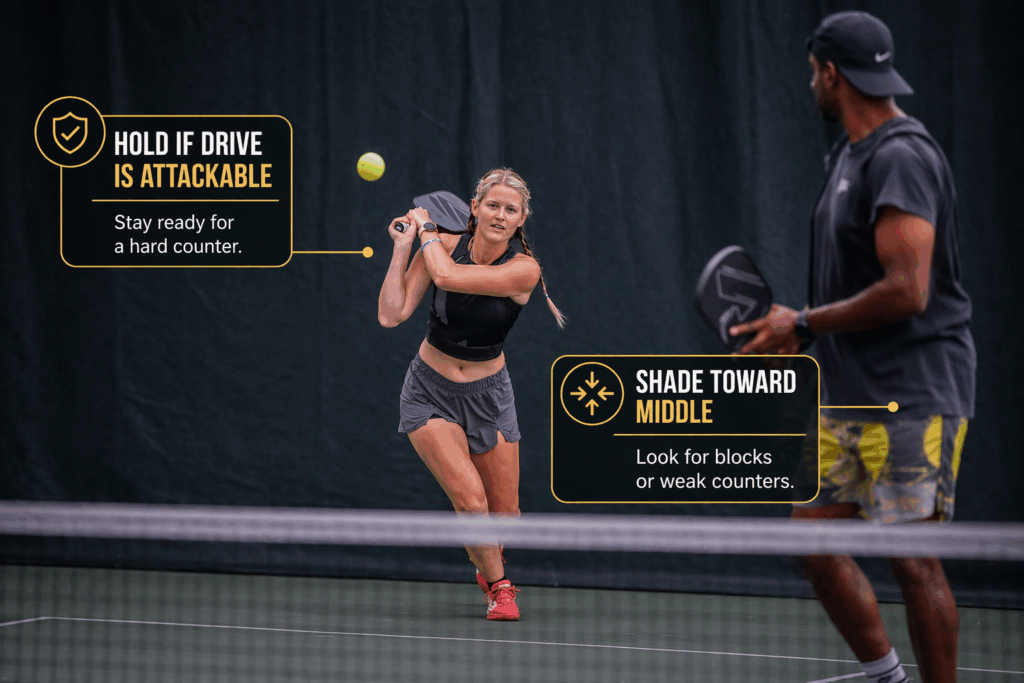
- Crash if the drive is strong and likely to create a pop-up
- Hold if the drive is attackable and likely to come back hard
- Split and read if you are not sure yet
That one change alone makes playing with a banger much less awkward.
Your real job: become the second-ball organizer
This is probably the most useful mindset shift in the whole article.
If your partner is the player creating pace, your value often comes from what happens after that pace gets returned.
A lot of good advice on this topic comes back to the same idea: if the banger’s drive is good, your chance is often on the next ball. Some players describe it as “embrace the chaos,” some describe it as poaching, some describe it as shake-and-bake logic, but the basic principle is the same: assume the drive might create something attackable, and be ready to take advantage of it.
That is also consistent with mainstream strategy teaching around aggressive doubles patterns. If a drive produces a high or weak reply, the partner should be in position to finish or pressure the next ball.
So if you are the more structured player partnered with a banger, think of yourself as:
- the middle-ball hunter
- the pop-up finisher
- the chaos stabilizer
- and the partner who turns random pace into actual point construction
That is a much better role than standing there getting annoyed that your teammate is not playing your preferred style.
Where should you stand?
This is the question most rec players actually want answered.
The honest answer is: a little more central, a little more reactive, and a little less committed to textbook symmetry.
If your partner is driving straight and hard, especially through the middle, your best poach or fifth-ball opportunity is often there too. If the drive is likely to force a block or weak counter, middle is often the place to look first, especially if opponents are not great at redirecting sharp angles off the drive.
So when your partner drives, you usually want to:
- shade a bit toward middle
- keep your paddle up and ready
- split early enough to handle a hard counter
- and be ready to either poach, block, or finish
What you do not want to do is stand so far committed to your normal drop-and-dink spacing that you get surprised by the faster rally your own partner created.
A banger partner changes the geometry. Accept that early.
Do you go to the kitchen if they stay back?
Usually yes — but more intelligently than usual.
This is where a lot of players get frustrated. You hit a nice drop, start moving in, and your partner stays back, ready for another drive. Now the team is split. One up, one back. That is not ideal, and against stronger teams, the open lane and exposed middle often get punished.
That concern is valid. Coaches consistently teach that doubles teams need to move together and avoid leaving giant seams, especially when one player is stranded deep.
But in rec play, and especially with a true banger, you do not always get ideal structure. So the practical answer is:
- If your ball truly earns forward movement, still go.
- But once you are up alone, become much more aware of:
- middle counters
- feet-level drives
- and balls coming back hard through your partner’s zone
In other words, if you are the only one at the line, you are not playing standard doubles anymore. You are temporarily playing a strange hybrid shape where your priorities are:
- protect the middle
- avoid getting body-bagged by a counter
- finish anything weak
- survive until your partner either joins you or the point ends
That is less elegant than textbook pickleball.
But it is realistic.
The best tactical adjustment: feed the kind of rally your partner likes
This does not mean becoming a reckless hitter yourself.
It means understanding what kind of ball tends to make your banger partner more effective.
A good way to do that is to keep some balls lower to the opponent’s backhand, use crosscourt dinks or soft shots that are more likely to bring the ball back into a predictable lane, and look for setups that produce a higher, more attackable next shot for your partner.
That also fits broader strategic advice: lower contacts reduce opponents’ ability to drive effectively, and patterns that force weaker replies make your team more dangerous even if the two of you do not play the same style.
So instead of thinking,
“How do I make my banger partner play like me?”
ask,
“What kind of rally gives them a cleaner next swing — without putting us both in a terrible spot?”
That question is much more productive.
What should you say to them?
If this is a real partner and not a one-game open-play problem, communication matters.
The good news is that you do not need a five-minute TED Talk. You just need a couple of simple agreements.
Try things like:
- “If you drive it clean, I’m looking middle.”
- “If I drop well, let’s both go.”
- “If you’re staying back, I’m protecting seam first.”
- “On your drives, I’m assuming something is coming back fast.”
- “If you want to keep ripping thirds, let’s at least agree on who owns middle after.”
This works much better than:
- “You need to stop banging.”
- “That’s not real pickleball.”
- “Just come to the kitchen like a normal person.”
Some bangers are not going to become soft-game artists overnight, especially if they came from tennis or if this is a fun event where they are leaning into their identity. In those situations, the smart move is not always to reform them. Sometimes it is just to organize around them better.
What if their drives are on?
Then lean into it.
When the banger is having a good day and the drives are heavy, dipping, and forcing weak contact, the non-banger partner can do a lot of damage by fully committing to the next ball.
That is not crazy. It is just high-risk partnership adjustment.
If your partner’s drives are truly creating:
- pop-ups
- weak counters
- floating blocks
- or balls through the middle
then your job is to pounce.
That means:
- trust the pace
- move with purpose
- expect the next shot
- and do not stand there admiring the drive like a spectator
Good aggressive doubles teams do this all the time.
The difference is just that your version may be more chaotic.
What if they are off?
This is where the partnership gets exposed.
If the banger has an off day, the whole team can become hostage to it, because a player who only knows one speed often cannot easily switch into patient, soft, percentage pickleball.
That is exactly why playing with a banger can feel so volatile.
⮕ On a good day, they can overwhelm people.
⮕ On a bad day, they can lose you six points in six swings.
So if you know your partner is that kind of player, your secondary job is often headspace management:
- keep them loose
- keep the energy light
- avoid visible frustration
- and help them stay committed without spiraling
That may sound soft, but it matters. If they are a rhythm-and-confidence player, your body language can make the day better or worse.
The hard truth: some partnerships are structurally limited
This is worth saying clearly.
If a player truly refuses to come forward, never learns to reset, or leaves you permanently in a one-up/one-back mess, that partnership has a ceiling. Even people who defend banger-style play usually admit that stronger teams will exploit the space, angles, and exposed feet that come with staying back too long.
Current strategy teaching points in the same direction. Kitchen control, coordinated movement, and transition competence remain core doubles principles because backcourt teams give opponents more time and more open space.
So yes, you can absolutely play better with a banger.
But no, that does not mean every banger partnership has no ceiling.
Sometimes the right answer is:
- adapt for this event
- enjoy the chaos
- use it as a skill-building challenge
- and be honest about what it can and cannot become
That honesty helps a lot.
The most useful skills for the non-banger partner
If you regularly play with this kind of partner, these are the skills that matter most:
Your hands matter because counters come back faster.
Your middle coverage matters because the seam gets weird.
Your poaching timing matters because many points are won on the next ball, not the first one.
Your split-step discipline matters because you cannot just glide forward on autopilot.
Your transition reads matter because you need to know when to come and when to hold.
And your emotional steadiness matters because chaotic players are easier to partner with when they feel trusted, not judged.
That bundle of skills can actually make you a stronger all-around doubles player.
The bottom line
If your partner is a banger, stop trying to play a completely normal rhythm around them.
That is usually the source of the frustration.
A better approach is to accept what their style changes, organize yourself around the likely next ball, protect the middle more intelligently, move in based on the quality of the shot instead of habit, and be ready to turn their pace into your opportunity.
That does not mean every banger is an ideal partner.
It does mean you can become a much better partner for a banger.
And in rec pickleball, that is often the difference between feeling lost next to chaos and actually using it.