
The sport was named “pickleball” by Joan Pritchard in 1965 because its mix-and-match rules reminded her of a pickle boat in crew — where leftover rowers are thrown together. The Pritchards’ dog Pickles came later and was actually named after the game, not the other way around.
Who Actually Named Pickleball? The Real Story Behind the Sport’s Strange Name
Pickleball has one of the weirdest names in sports, which is exactly why so many players eventually ask the same question:
Where did that name even come from?
If you’ve been around the game for a while, you’ve probably heard the popular version: the sport was named after a dog called Pickles. It’s a fun story, and honestly, it sounds so perfectly random that people love repeating it.
But according to the founders and the people closest to the game’s creation, that is probably not how pickleball got its name.
The more credible version points to Joan Pritchard, the wife of co-inventor Joel Pritchard. And if that version is right, pickleball was not named after a dog at all. It was named after a pickle boat.
So, Who Gets Credit for the Name?
If you are asking who actually named pickleball, the answer is generally Joan Pritchard.
As the story goes, after the game began taking shape during a weekend of improvised play on Bainbridge Island, Joan looked at the mix of borrowed rules, repurposed equipment, and backyard experimentation and compared it to a pickle boat in crew.
In rowing, a pickle boat refers to a crew made up of leftover or mismatched rowers. That felt fitting for this new game, which borrowed from badminton, ping-pong, and tennis without being exactly any of them.
The name stuck.
What started as a family joke or casual nickname around the Pritchard property soon spread to friends, neighbors, and eventually the sport itself.
The Big Confusion: Pickle Boat or Pickles the Dog?
This is where the story gets messy.
There are really two versions of the naming story that keep circulating.
Version 1: The Dog Story
This is the version many casual players know best. The Pritchard family had a dog named Pickles, and the dog supposedly chased stray Wiffle balls around the yard. According to that version, the sport got its name from the dog.
It is memorable, charming, and easy to tell. That is probably one reason it spread so well.
Version 2: The Pickle Boat Story
This is the version most closely tied to Joan Pritchard and the founders’ own explanations. In that telling, the sport was named after the pickle boat idea first, because the game itself felt like a mix-and-match creation made from leftover pieces of other sports.
In this version, the dog came later and was actually named after the game, not the other way around.
That distinction matters, because it flips the entire story.
Which Story Is Most Likely True?
The dog story is fun, but the pickle boat explanation is generally the more credible one.
Why? Because most first-hand accounts from the founders’ side point back to Joan’s description of the game as a kind of sporting leftover mix. That explanation also makes a lot more sense once you understand how the game was created.
Pickleball did not emerge as a polished, fully planned sport. It started as a backyard solution. A badminton court was already there. The players improvised with paddles and a plastic ball. Rules were adjusted as they went. The whole thing was part invention, part adaptation, part family experiment.
In other words, it really did resemble a “leftover crew.”
That is why the pickle boat story has more staying power once you dig into the history.
What Is a Pickle Boat, Anyway?
If you are not from a rowing background, this term can sound completely random.
In crew, a pickle boat refers to a boat made up of leftover rowers, often grouped together when the main lineups are already set. It is a mixed, patched-together crew rather than a carefully built first-choice one.
That is exactly why Joan Pritchard thought it fit. The early version of pickleball was a mash-up:
- a badminton court
- ping-pong-style paddles
- a plastic ball
- tennis-like exchanges
- homemade rules
The sport was not born from one clean concept. It was assembled from whatever was available.
That is what makes the name make sense.
A Quick Timeline of How the Name Stuck
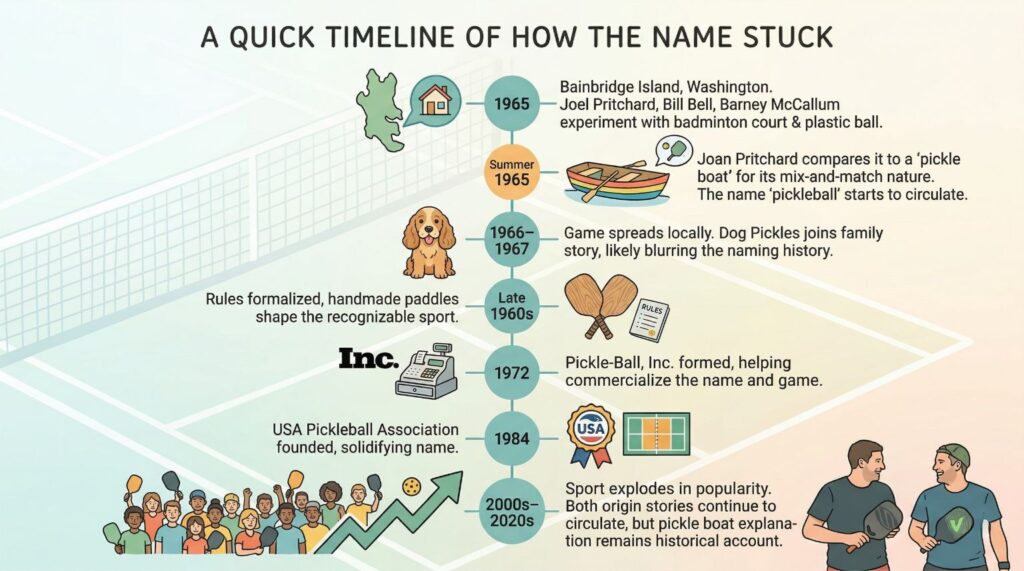
1965 – Bainbridge Island, Washington
Joel Pritchard, Bill Bell, and Barney McCallum began experimenting with a new paddle-and-ball game using a badminton court and a plastic ball.
Summer 1965
Joan Pritchard reportedly compared the game to a pickle boat because of its mix-and-match nature. The name “pickleball” began circulating around the family and their friends.
1966–1967
The game spread locally. Around this time, the Pritchards’ dog Pickles became part of the family story, which likely helped blur the naming history later.
Late 1960s
Rules became more formalized, and handmade paddles helped shape the sport into something more recognizable.
1972
Pickle-Ball, Inc. was formed, helping commercialize the name and the game.
1984
The USA Pickleball Association was founded, helping solidify pickleball as the sport’s official name.
2000s–2020s
The sport exploded in popularity, and both origin stories continued to circulate, even as the pickle boat explanation remained the stronger historical account.
Why the Dog Story Took Off Anyway
Even if it is not the original naming story, the dog version is easy to understand.
It is visual. It is cute. It is memorable. And honestly, it sounds exactly like the kind of oddball detail people expect from pickleball.
A dog named Pickles chasing a ball around a backyard is simply a better party story than an obscure rowing term.
That does not make it more accurate. But it does explain why so many people still believe it.
Did the Weird Name Actually Help the Sport?
At first glance, “pickleball” sounds like the kind of name that might hold a sport back.
It is quirky. It is easy to joke about. And for years, some people probably dismissed the game partly because the name sounded too silly to be taken seriously.
But in the long run, the unusual name may have helped more than it hurt.
It is hard to forget. It sparks curiosity. It makes people ask questions. And once the sport started growing, the name became part of its identity rather than a weakness.
Now the weirdness is part of the charm.
In a crowded sports world, being memorable matters.
The Real Story Fits the Sport Perfectly
In some ways, the pickle boat explanation is a better origin story anyway.
Because pickleball itself was a mash-up. It was improvised. It was practical. It was built out of what was there. And it slowly became something much bigger than anyone expected.
So yes, the dog story is cute. But the likely real answer is even better.
Pickleball seems to have gotten its name the same way it got its start: through a little creativity, a little humor, and a game made from leftover pieces that somehow turned into something special.