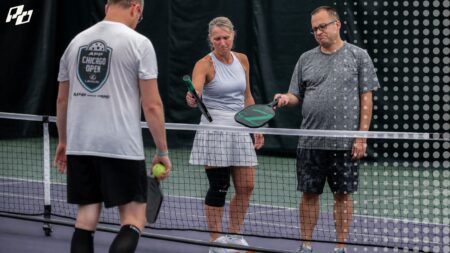


If you’ve ever watched a pro pickleball match, you’ve probably noticed something odd: players muttering to themselves after a point, sometimes even talking loud enough for the crowd (and cameras) to hear.
“Come on, stay with it.”
“Reset, reset, reset.”
“Good shot, shake it off.”
It might sound like they’re losing their minds mid-rally, but this is actually one of the most powerful mental tools in sport: self-talk.
And yes—believe it or not—rec players can benefit from it too. Let’s break down what’s happening, why it works, and whether you can pull it off without looking like the “crazy person at court three.”
The Psychology Behind Talking to Yourself
Sports psychologists have studied self-talk for decades, and the research is clear: what you say to yourself shapes your performance.
- Instructional self-talk (“bend your knees,” “follow through”) helps with technical execution.
- Motivational self-talk (“you got this,” “keep pushing”) boosts effort and resilience.
- Neutral or calming self-talk (“breathe,” “reset”) lowers anxiety and keeps focus sharp.
A 2022 meta-analysis in the Perspectives on Psychological Science (2011) found that athletes using structured self-talk improved both motor skills and mental toughness compared to controls.
The reason? Saying things out loud engages both auditory and kinesthetic learning channels, reinforcing the message more than silent thought alone.
In pickleball—where points are short, momentum swings fast, and mistakes can snowball—this is huge.
Why Pros Do It Out Loud (Not Just in Their Heads)
- Pattern Interrupts: Saying “reset” or “next ball” out loud breaks the emotional loop after a mistake. Instead of spiraling, the player anchors back to the present.
- Body Language Cue: Talking to yourself signals confidence—not just to you, but to your opponent. Even if you’re rattled, you project composure.
- Accountability: Out-loud words make it harder to ignore your own advice. If you say “patience” before a dink rally, you’re more likely to actually wait for the right ball.
- Ritual & Rhythm: Verbal cues act like mini routines, helping pros regulate tempo between points. Think of it as hitting the mental “reset button.”
Should Rec Players Talk to Themselves Too?
Short answer: Yes—if you do it right.
Rec pickleball is social, and nobody wants to be the player muttering angrily after every point. But the science-backed benefits are real, and you can adopt them in a way that helps you and keeps the court vibe fun.
The trick is to keep it short, positive, and purposeful. Think “breathe,” “reset,” or “next ball.” Used between points—not during opponents’ shots—it can boost confidence, calm nerves, and sharpen focus without distracting anyone.
Some players even make it playful: “C’mon, future Hall-of-Famer,” or “Congratulations, you just invented the lob into the fence.”
But Won’t People Think I’m Crazy?
Let’s be honest: the first time you do it, your partner might raise an eyebrow. A few opponents might smirk.
But here’s the thing: once you own it, they’ll get used to it. In fact, many players will admire the focus—and some might even copy you.
Worried about being “that guy/gal” who sounds overbearing? Then frame it lightheartedly:
- Say it with a smile.
- Keep it self-directed, not external (“reset” vs. “you always speed up too early!”).
- If your partner looks unsure, tell them: “Don’t mind me, I’m just doing my pro impersonation.”
The truth is, plenty of rec players already talk to themselves—usually negatively (“I’m such an idiot!”). You’ll stand out in a good way if you flip it positive.
Of course, not all self-talk is created equal. Some versions will sharpen your game, others will just irritate everyone around you.
The Do’s and Don’ts of Self-Talk in Rec Play
Self-talk works—but like anything in pickleball, context and delivery matter. Do it the wrong way and you’ll just annoy everyone. Do it the right way and you’ll look focused, not flaky.
✅ Do’s
- Keep it short. One- or two-word cues (“reset,” “patience,” “breathe”) are powerful.
- Make it positive or neutral. Saying “next ball” keeps momentum moving forward.
- Use it between points. Talking mid-rally is distracting and poor etiquette.
- Pair it with body language. Stand tall, breathe deeply, and your words carry even more weight—for you and your partner.
❌ Don’ts
- Don’t rant. Long muttering monologues (“Why do I always miss that stupid shot…”) drag down the whole court’s energy.
- Don’t aim it at others. “Come on, partner!” is criticism, not self-talk.
- Don’t shout every rally. Occasional vocal resets are fine; constant commentary is irritating.
- Don’t fake negativity. Joking “you’re terrible” still reinforces failure—your brain doesn’t know it’s a joke.
Why Negative Self-Talk Backfires
Plenty of players already talk to themselves—they just do it in the worst way possible. Saying “don’t miss” or “you’re so slow” feels like venting, but research shows it actually increases stress hormones and narrows your attention. That makes errors more likely.
In contrast, positive or instructional self-talk widens focus and improves fine-motor control. Think: “smooth swing” or “see the ball.” You’re literally coaching yourself in real time.
Pro Tips for Self-Talk on the Court
- Pick 2–3 Go-To Phrases
- Reset → after a mistake.
- Patience → before long rallies.
- Next ball → to shake off errors.
- Anchor it to Breathing
Say “breathe” as you exhale between points. This doubles as a stress reset. - Use Humor as a Tool
Light, funny comments keep nerves down: “Okay champ, let’s see if you can keep the ball in play this time.” - Practice It Off-Court
Say your phrases in drills. When game tension rises, it’ll feel natural instead of forced.
Talk Yourself Into Better Play
Pros don’t talk to themselves out loud because they’re quirky—they do it because it works. It interrupts negativity, boosts confidence, and resets focus in the fastest-paced sport on two feet.
For rec players, self-talk isn’t just allowed—it’s a secret weapon. Do it with positivity, sprinkle in humor, and you’ll not only improve your own game but keep your court vibe fun.
So next time you mutter “reset” after a bad dink or tell yourself “patience” before a speed-up, remember: you’re not crazy—you’re just playing like a pro.