
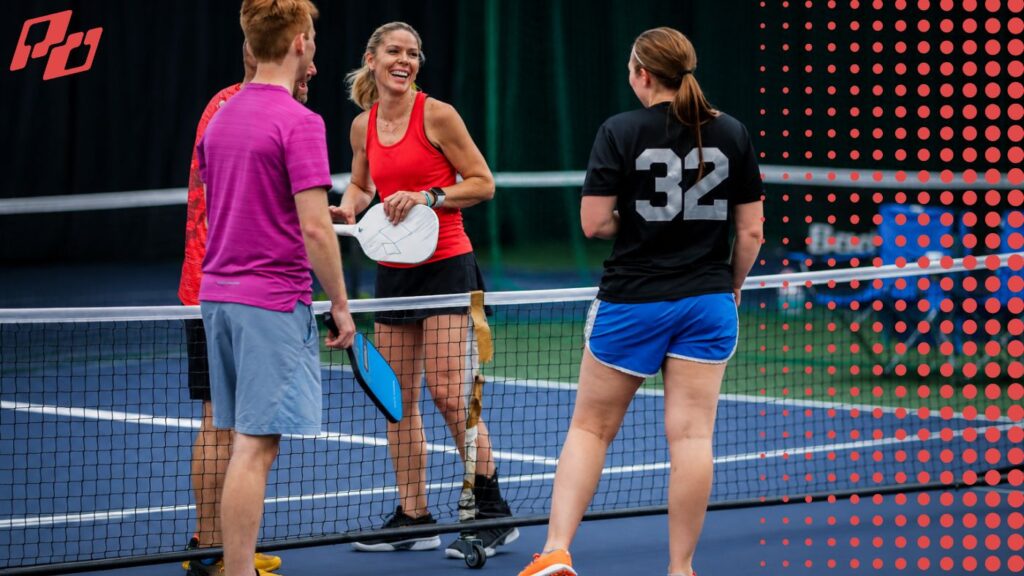
Open play gets distracting because social chatter breaks your point routine. Stay focused by using a simple pre-point cue, tracking the score yourself, choosing one theme per game, and switching back into “ball time” before each serve while still keeping the court friendly.
Open play is one of the best things about pickleball. It is also one of the easiest places to lose your brain.
You show up to get games in, work on a few things, maybe sharpen your doubles instincts — and then suddenly you are chatting about paddles, vacations, court drama, weekend plans, who brought the new balls, who is stacking paddles wrong, and whether that one guy is secretly a 4.2 pretending to be a 3.5.
And somewhere in the middle of all that, you start playing fuzzy pickleball.
You forget the score.
You miss easy returns.
You serve before your partner is ready.
You stop noticing opponent patterns.
You laugh off one sloppy point, then another, then another.
By the end, you had fun — but you also leave thinking, “Why did I play so loose today?”
That is the open-play focus problem.
It is not that social pickleball is bad. It is not. The social part is why many people keep coming back. The trick is learning how to stay friendly without letting your attention leak all over the court.
Because if you want to improve, open play cannot just be a social hour with a paddle in your hand. It has to become a better practice environment.
The Real Problem: Open Play Keeps Breaking Your Rhythm
In a tournament or league match, the structure helps you focus.
Same partner. Same opponents. Clear stakes. Longer emotional thread. More reason to track patterns.
Open play is different.
You rotate partners. Skill levels change every game. One court is intense, another is goofy. Someone is telling stories between points. Someone else is trying way too hard. Then you sit for 12 minutes and jump into a totally different game.
Your brain has to keep restarting.
That is why open play focus is not just “concentrate more.” The real skill is learning how to re-enter the point quickly after distractions.
The best rec players do this better than people realize. They can joke between points, then snap back into a clear pre-serve state. They can be friendly without playing sleepy. They can enjoy the group without giving away the first three rallies of every game.
That is the goal. Just knowing when to socialize and when to switch back on.
Build a Small “On-Court Switch”
Most players try to focus by using effort.
They tell themselves:
- Focus.
- Pay attention.
- Stop messing around.
- Lock in.
That rarely works for long because it is too vague. Instead, build a physical switch — something small you do before every point that tells your body, “We are back now.”
It might be:
- wiping your paddle face,
- touching your paddle to your non-dominant hand,
- taking one slow breath,
- checking your feet,
- looking at the returner’s paddle,
- or saying the score clearly in your head.
The action does not need to be dramatic. It just needs to be repeatable.
Here is why it works: open play pulls your attention outward socially. A pre-point switch pulls it back into the rally.
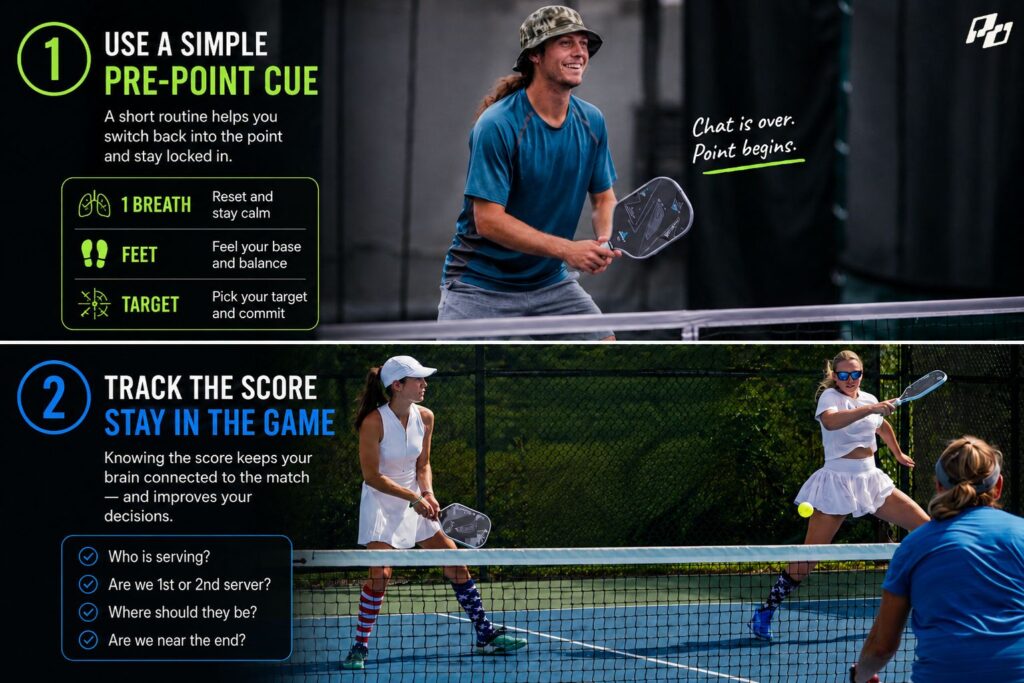
It gives you a clean boundary. Chat is over. Point begins.
A good switch should take one or two seconds. If it takes longer, you will not use it consistently in casual games.
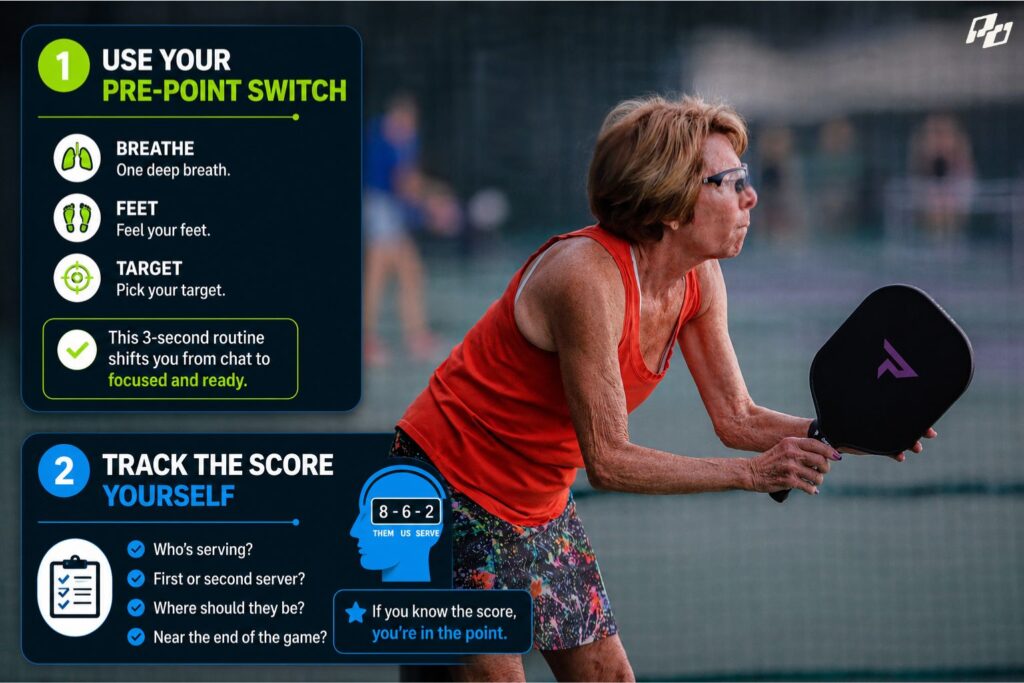
Try this: Breathe. Feet. Target.
- One breath.
- Feel your feet.
- Pick your target.
- That is enough.
Stop Letting the Score Be Someone Else’s Job
One of the first signs you are mentally drifting is score confusion. And no, this is not just about embarrassment.
When you do not know the score, it usually means you are not tracking the game state. You are playing points as isolated little rallies instead of as part of a match.
That matters because score changes shot selection.
⮕ At 0-0 in open play, maybe you experiment with a new third-shot drop.
⮕ At 9-9, maybe you choose a higher-percentage return.
When you do not know the score, you lose that layer of decision-making.
So give yourself a private rule: Even if someone else calls the score, I know it before they say it.
That one habit keeps your brain attached to the game. You do not need to be annoying about it. You do not need to correct everyone instantly. Just track it.
- Who is serving?
- Where should they be?
- Are we first server or second server?
- Are we near the end of the game?
That tiny bit of scoreboard awareness makes you more present than half the court.
Cue: If I know the score, I am in the point.
Use One “Theme” Per Game
Open play gets messy because players try to improve everything at once.
One point, you’re working on drops.
Next point, you’re thinking about drives.
Then you remember your backhand dink.
Then you try a new speedup.
Then someone cracks a joke… and the whole improvement plan disappears.
A better way?
Choose one theme for the game.
Not five.
One.
For example:
- This game, I’m watching opponent contact height.
- This game, I’m returning deep middle and getting set.
- This game, I’m not speeding up unless my feet are still.
- This game, I’m resetting every ball that reaches my feet.
A theme gives your focus a home.
You can still play normally. You can still compete. You can still laugh. But between points, your brain has one job to return to.
That is what keeps open play from becoming random reps.
The best themes are not outcome-based.
“Win this game” is not useful. You already want to win.
Better themes are behavior-based:
- watch earlier
- split before contact
- choose safer fourth shots
- track who attacks from low balls
- make every return buy time
Those actually train your game.
Cue: One game, one lens.
Learn the Difference Between Social Time and Ball Time
This sounds simple, but it is the core of the whole issue. There are two types of time in open play:
Social time is between games, during paddle stacking, water breaks, side chatter, and waiting rotations.
Ball time is from the moment the server starts the routine until the rally ends.
Many rec players let social time bleed into ball time.
- They are still laughing while receiving.
- Still talking while their partner is serving.
- Still thinking about the last joke while the return is coming.
- Still finishing a conversation while the point has already started.
- That is where easy errors come from.
You do not need to stop being social. You just need cleaner borders.
A simple rule: Talk fully between games. Talk lightly between points. Stop talking when the server sets.
That does not make you intense. It makes you respectful to the point. It also helps your partner.
If your partner is trying to serve and you are still mid-conversation with the opponent, you are not just distracting yourself. You are changing the emotional tempo of your side.
There is a way to be warm and locked in. Smile. Say nice shot. Keep the vibe good.
Then when the ball is ready, be ready.
Use the Walk-Back Reset
One of the best focus tools in open play is the short walk after a rally. Most players waste it.
They either replay the miss emotionally or drift back into chatting. Instead, use that walk-back as your reset space.
After each point, ask one simple question: Was that a decision error or an execution error?
That’s it.
If it was an execution error — you chose the right shot but missed — let it go and keep the plan.
If it was a decision error — you attacked from the wrong spot, forgot to move, rushed the return, or ignored the obvious target — make one quick adjustment.
This keeps you from overreacting to every miss.
A missed drop is not always a problem.
A bad decision repeated four times is a problem.
Example:
Missed third-shot drop into the net?
Probably execution. Stay with the plan.
Sped up from below net height and got countered?
Decision error. Adjust now.
That is a much better use of mental energy than thinking, “I’m playing terrible today.”
Cue: Name it once. Fix it once. Move on.
Protect the First Three Points of Every Game
Open play players often waste the start of games.
They are getting used to a new partner.
Figuring out the opponents.
Still talking from the last rotation.
Checking who is on deck.
Then suddenly, it is 0-4.
The first few points are where focus leaks most, so give yourself a simple start-game protocol.
Before the first serve, quickly ask:
- Who looks steadier?
- Who has the stronger drive?
- Who might lob?
- Is my partner aggressive, passive, mobile, or new to me?
- What is my safest return target?
You do not need a scouting report. You just need a first read. Then play the first three points with simpler choices:
- deep returns
- clean serves
- safer fourth shots
- no silly speedups
- no experimenting too early
This gets your brain engaged before the score gets away from you. It also prevents the classic open-play mistake: casually donating points before you have even started thinking.
Cue: First three points: collect information, don’t donate it.
Don’t Let Friendly Partners Make You Mentally Lazy
This one is sneaky. Sometimes your focus drops because the vibe is too comfortable.
You like your partner.
The opponents are fun.
Nobody is judging.
The game feels easy.
So you start freelancing.
You stop moving your feet.
You stop watching the paddle.
You serve casually.
You take a silly speedup.
You laugh because it is “just open play.”
And yes, it is just open play. But your habits are still being trained. Every casual mistake is still a rep.
That does not mean you need to be intense or joyless. It just means you should know what kind of player you are practicing being.
Use friendly games to sharpen the invisible stuff:
- early ready position
- better partner spacing
- cleaner return footwork
- smarter shot selection
- calmer resets
- better score awareness
Those things do not ruin the fun. They make the fun more useful. The best players can enjoy the court and still respect the point.
Have a “Re-Entry Cue” After Long Conversations
The hardest moment in social open play is not during the rally. It is after a long pause.
Someone asks about your paddle. Someone tells a story. Someone changes balls. Someone disputes the rotation. Someone’s phone rings. You stand around for two minutes.
Then the game restarts — and your first shot is awful. You were physically on the court, but mentally in the parking lot.
Use a re-entry cue. Before play resumes after any long break, do three things:
- Look at the server.
- Check the score.
- Pick your first responsibility.
If you are returning, your responsibility might be deep middle and move.
If you are the server’s partner, it might be watch the return and prepare for the third.
If you are the returner’s partner, it might be get to the line and protect middle.
This turns the lights back on.
Cue: Long pause? Re-enter before the ball does.
Keep Your Partner Connection Short and Useful
Open play partners change constantly, which can make focus harder.
Some partners talk a lot. Some barely talk. Some apologize after every miss. Some coach you without permission. Some take over the whole court.
You cannot control all of that. But you can keep your own partner communication simple and useful.
Between points, try short phrases that help the next rally:
- “Let’s keep them back.”
- “I’ll cover middle if you get pulled wide.”
- “Deep return here.”
- “Let’s slow one down.”
- “Good idea — same target.”
- “Next one, reset and move.”
Avoid long technical corrections during games. They usually create more tension and less focus.
The goal is not to turn your partner into your student. The goal is to give your team one shared idea. A shared idea beats two separate brains.
Cue: One sentence. One plan. Play.
Use Open Play as a Lab, Not a Lounge
This is the biggest mindset shift.
Open play can still be fun, social, relaxed, and community-driven. But if you want it to improve your game, you need a little structure.
Not tournament intensity.
Just intention.
Before you start, pick one focus:
- Shot focus
- Decision focus
- Movement focus
- Partner focus
- Pressure focus
For example:
- Today, I’m tracking when I miss because I rush.
- Today, I’m practicing resets when stretched.
- Today, I’m returning with height and depth, not pace.
- Today, I’m watching who speeds up from low balls.
- Today, I’m staying ready after I hit a good shot.
That turns every open-play game into useful data.
You are no longer just asking:
“Did I win?”
You are asking:
“What did I learn?”
That question is where improvement lives.
What to Do When the Court Is Too Chatty
Sometimes the court energy is so social that focusing feels almost rude.
That happens a lot in rec groups. People came to laugh, sweat, connect, and unwind — not act like there is prize money on the line.
So do not fight the whole vibe. Create your own quiet focus bubble.
You can still smile.
You can still joke.
You can still say “nice shot.”
But internally, keep returning to your one theme. If the group is chatty, keep your focus cue simple:
Score.
Feet.
Target.
That is it.
Do not try to carry a complicated tactical plan in a chaotic environment. Use a small anchor you can repeat between points.
The more social the court, the simpler your focus cue should be.
The Open-Play Focus Checklist
Use this before your next session:
- Before the game: choose one theme.
- Before each point: breathe, feet, target.
- During the point: stay with the ball, not the conversation.
- After the point: decision error or execution error?
- After a long pause: score, server, responsibility.
- After the game: remember one thing that worked.
That is enough structure. Not too much. Not weird. Just enough to keep your game from dissolving into social fog.
The Personal Rule I’d Use
If I were trying to stay focused in social open play, I would not try to become less social. That is the wrong fix. I would try to become better at switching.
Talk when it is time to talk.
Compete when it is time to compete.
Reset when the point ends.
Re-enter when the next one begins.
That is the skill.
Because pickleball is supposed to be fun. Open play is supposed to have laughs, new partners, quick conversations, and a little bit of chaos. You do not need to remove that to play better.
You just need to stop letting the fun blur the point. So give yourself one simple standard:
Be friendly between points, but be present before the serve.
That is a good rec-player balance.