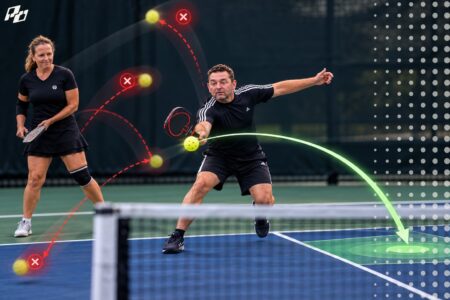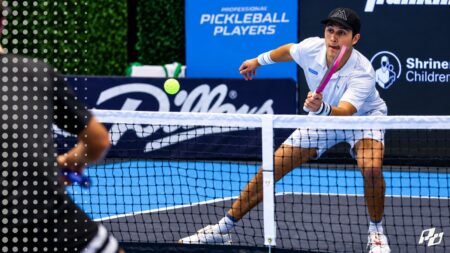


Most players at the early-intermediate level work on drops, drives, dinks, and speed-ups—but still lose points they shouldn’t. Not because of weak mechanics, but because of poor movement as a team.
They hit decent shots but leave open space. They play defense reactively instead of intelligently. They get pulled apart by opponents who understand positioning better.
The missing link is shading—the ability to adjust your position based on where the ball is. It looks small, but it changes everything.
If you want to win more in doubles, shading is non-negotiable.
Why Shading Matters
Shading means adjusting your court position together with your partner so you take away open angles and cover space efficiently. Instead of guarding ‘your half,’ you guard space based on the ball angle.
That means less running, better defense, cleaner attacks, and fewer free points for opponents.
Why it works:
- It cuts off angles before opponents can use them
- It protects the middle without confusion
- It shrinks the court for your opponents and gives them fewer targets
- It keeps your team connected—no big gaps for them to attack
- It turns defense into steady neutral play instead of panic scrambling
Why most players ignore it:
- They focus only on shots—not positioning
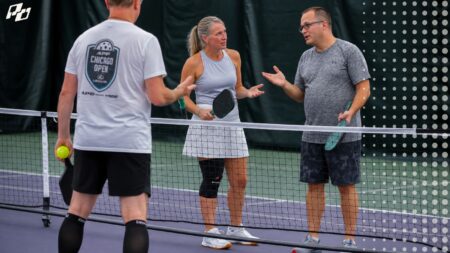
- They play two separate singles games instead of one doubles system
- They assume movement is “advanced” instead of fundamental
- They don’t realize bad movement creates bad shots
Shading doesn’t just make you harder to beat—it makes you look smoother and more in control without changing your mechanics at all.
The Golden Rule of Shading
Where the ball goes, your team goes.
If the ball moves to one side, both players should shade in that direction. If your partner gets pulled wide, you don’t stay still—you slide and close the middle. If you attack, you squeeze space together.
Shading is subtle, 2–3 steps at a time. But those steps remove open space faster than any swing.
How Shading Actually Works (Without Overthinking It)
Here’s the simplest way to understand it:
✅ When the ball is on your partner’s side—YOU cover middle

Why: Your partner is busy hitting. You must protect the most dangerous part of the court—the middle.
✅ When the ball is on your side—YOUR PARTNER shades behind you

Why: You control the next shot. Your partner stabilizes behind you to defend counters.
✅ When you’re attacked—SHRINK the court
If your team is under pressure, shade tighter together to cover faster exchanges.

Spacing: 6–8 feet apart. Too close = tangled. Too far = holes.
✅ When YOU attack—SQUEEZE space
If you hit a strong attack or push them back, move in as a team and take time away.

Pressure isn’t created by swinging harder—it’s created by taking space at the right time.
Who Takes Middle Balls?
Forget the myth. It’s not always forehand takes middle.
The real rule:
The player who can take the ball EARLIEST takes the middle.
- Crosscourt player has better timing? They take it.
- Stronger hand speed player? They take it.
- Opponent attacks middle? Whoever’s set early steps in and owns it.
Decide middle ownership before the game:
“I’ll take middle unless you call me off.”
Simple clarity prevents chaos.
When Shading Matters Most
Shading affects positioning every point, but it matters most in three situations:
| Situation | Why Movement Matters |
|---|---|
| Partner pulled wide | You MUST slide middle or get burned |
| Transitioning to the kitchen | Move as a unit—not a ladder |
| Attacking from midcourt | Must squeeze together or lose advantage |
Most rec players lose these points not because of bad hands—but because they’re out of position.
Common Shading Mistakes (These Lose Points Fast)
| Mistake | Why It Fails | Fix |
|---|---|---|
| “I’ve got my side” | Leaves middle wide open | Guard ball angles |
| Partner gets pulled wide and you freeze | Big gap through middle | Slide inside automatically |
| You attack but stand still | Give time back to opponents | Squeeze forward |
| You move alone | Team shape breaks | Stay connected |
Communication That Makes Shading Work
You don’t need long speeches—just short, useful cues.
| Call | Meaning |
|---|---|
| “Shift” | Shade toward ball |
| “Squeeze” | Step in together on attack |
| “Middle” | Protect central lane |
| “Back” | Watch lob |
| “Switch” | Swap responsibility fast |
Movement Rules for Doubles Success
✅ You don’t guard sides—you guard space
✅ You don’t wait—you anticipate
✅ You don’t move randomly—you move with purpose
✅ You don’t defend alone—you defend as a team
The better your shape, the smaller the court becomes for your opponents.
Key Shading Cues
- Ball moves → WE move
- Partner stretched wide → I close middle
- We attack → WE squeeze
- Under pressure → Tighten spacing
- Transitioning → Same depth line
- These rules don’t change. This is real doubles discipline.
Doubles Defense Isn’t Reaction—It’s Shape
Most players think they need faster hands, bigger drives, or a new paddle to level up. They don’t. They need smarter positioning and better movement discipline.
Shading takes your team from reactive to organized. From exposed to dangerous. From “two decent players” to “one strong team.”
And the best part? You don’t need more athleticism, speed, or power to do it.
Just awareness. Movement. And commitment to court shape.
Shading is the skill nobody teaches—but it’s the skill every team needs.