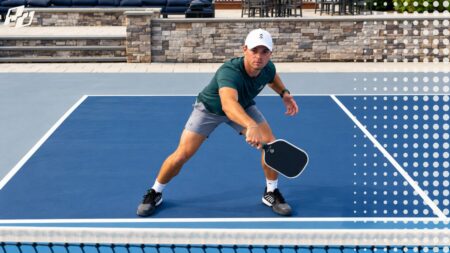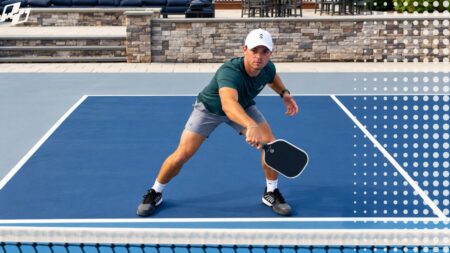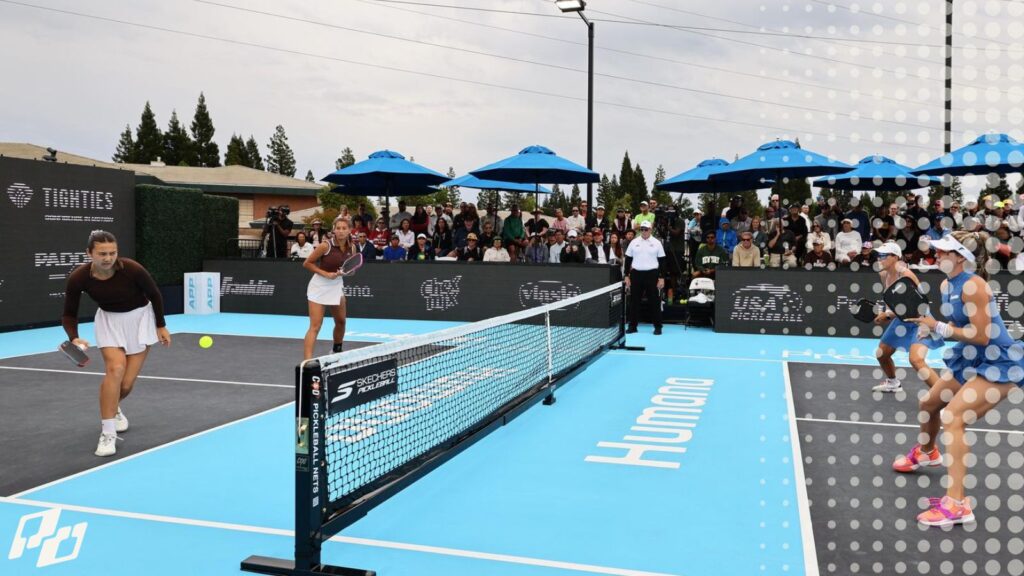
Use a down-the-line dink when you’re balanced and can pressure your opponent, not just change direction. Aim inside the sideline toward the outside foot rather than the line itself to reduce errors while creating time pressure and opening the middle for the next shot.
Many recreational players have been taught one simple rule at the kitchen: when in doubt, dink crosscourt.
That advice has value. A crosscourt dink travels over the lower middle portion of the net and gives you more court to work with. The diagonal path is longer, so you have more room to clear the net and still land the ball inside the kitchen.
But “crosscourt is safer” often gets turned into a much worse rule: never dink down the line. That is where players become predictable.
A down-the-line dink is not automatically a low-percentage shot. It becomes low percentage when you use it from the wrong ball, aim too close to the sideline, or try to force offense while off balance.
Used with the right intent, it can rush an opponent, attack a weaker contact point, open the middle and turn a neutral dink rally into an offensive pattern.
The key is understanding when the shorter path helps you—and when the extra crosscourt margin still matters more.
Why Crosscourt Is Usually the Safer Default
There is a real geometric reason players prefer the crosscourt dink.
A regulation pickleball net is 34 inches high in the center and 36 inches at the sidelines. The kitchen also extends seven feet from the net on each side. A diagonal dink therefore travels across a lower section of the net and toward a longer landing area than a straight-ahead ball near the sideline.
That extra distance gives the ball more time to descend. It also lets you hit with slightly more shape, height or spin without sending the ball beyond the kitchen line.
For those reasons, crosscourt is usually the better choice when:
- you are stretched or contacting the ball late;
- the ball is below net height;
- you need to recover your balance;
- your opponent is protecting the line well;
- your main goal is to neutralize the rally.
Crosscourt is not merely conservative. It is often the correct shot because the incoming ball has not given you permission to do anything more aggressive.
The mistake is assuming it must remain the correct shot forever.
The Real Advantage of Going Down the Line
The down-the-line dink has a shorter flight path. That smaller distance creates less margin, but it also gives your opponent less time.
When you contact the ball comfortably, especially at or near net height, especially at or near net height, a purposeful line dink can arrive quickly enough to pressure the opponent’s outside foot, paddle-side hip or backhand contact zone.
That is the trade-off:
Crosscourt gives you more margin. Down the line can take away time.
The shot becomes especially useful when the net is no longer a major obstacle. If you are balanced, contacting the ball early and able to direct it downward or with controlled topspin, you do not need the full diagonal court to keep the ball safe.
You can use the shorter route to make the opponent play sooner and from a less comfortable position.
Use the Line Dink to Attack, Not Merely Redirect
A common recreational mistake is changing direction without changing the quality of the ball.
The player has been dinking crosscourt, suddenly decides to go down the line, and gently floats the ball into the middle of the opponent’s kitchen.
That does not create pressure. It simply gives the opponent a comfortable ball from a new direction.
A useful down-the-line dink should have a specific purpose. You might use it to:
- push the opponent toward the sideline
- force contact near the outside foot
- jam the paddle-side hip
- expose a weaker backhand dink
- pull one player away from the middle
- create a speed-up lane on the next ball
Aggressive dinking focuses on directing the ball toward your opponent’s feet, forcing low, uncomfortable contact instead of floating neutral balls into open space.
That distinction matters.
You are not going down the line because you are bored with the crosscourt rally. You are going there because the line offers a better pressure point.
The Best Ball to Redirect
The easiest line dink usually comes from a ball that gives you time and space. Look for one or more of these conditions:
1. You can let the ball reach the correct contact window
A down-the-line redirect often requires a slightly later contact than a crosscourt dink.
If you take the ball too early and too far in front, your natural swing path may continue across your body and send the ball crosscourt. Instead, stay turned and allow the ball to travel a fraction longer so contact occurs closer to your body.
This does not mean letting the ball get behind you or crowding your swing. The ideal contact is still comfortable and controlled—just later and less extended than your crosscourt contact.
Use this cue:
Crosscourt earlier. Down the line slightly later.
2. The ball is near net height
You do not need the ball to be high enough to attack as a volley. But the closer your contact is to net height, the less you must lift the ball.
That lets you send it on a flatter, more pressuring trajectory.
3. You are balanced
Direction changes require paddle-face precision. If you are reaching, falling sideways or recovering from a difficult ball, the crosscourt path usually provides the safer margin.
4. The opponent has shifted toward the middle
Some players lean inward during crosscourt exchanges because they expect the next ball to continue diagonally.
That can leave their outside foot or sideline area exposed.
The opening may be small, but you do not need to paint the line. You only need to make them move or contact the ball outside their preferred position.
Think Slight Diagonal, Not Sideline Paint
“Down the line” can be misleading.
It does not mean the ball must travel parallel to the sideline or land within inches of it.
For most recreational players, the smarter target is a slight diagonal toward the opponent’s outside foot, with enough margin inside the sideline to survive a small directional error.
This target still changes the pattern and pressures the outside half of the court, but it does not require perfect accuracy.
A useful cue is:
Attack the outside foot, not the white line.
The sideline is not your target. It is your boundary.
By aiming several feet inside it, you can apply pressure without turning the dink into a low-percentage gamble.
When the Line Dink Creates the Next Attack
The down-the-line dink does not always win the rally directly. Its real value often appears one ball later.
Imagine a crosscourt exchange in which your opponent has started leaning toward the middle. You redirect firmly toward the outside foot. The opponent reaches, contacts the ball late and sends a soft reply toward the center.
Now the middle is open.
You or your partner may have a speed-up at the inside hip, a roll through the gap or a chance to move forward and take the next ball out of the air.
This is why the line dink should be viewed as a pattern starter, not just a destination.
The sequence might look like this:
Crosscourt to establish the pattern.
Down the line to stretch the player.
Attack the middle on the weak reply.
That is far more intentional than changing direction and hoping something good happens.
When You Should Stay Crosscourt
The down-the-line dink becomes dangerous when players choose it from a defensive ball. Stay crosscourt when:
- you are reaching outside your balance
- contact is below your knees
- the opponent is crowding the line
- your paddle face is late or unstable
- you cannot control the height
- your partner is out of position for the likely reply
Instruction on crosscourt and line redirects supports treating direction as a situational decision rather than a fixed preference. The goal is to recognize when the current crosscourt pattern is helping you and when changing direction improves your position.
There is no tactical prize for forcing the line from a bad ball.
The best players are not aggressive because they attack constantly. They are aggressive because they recognize which balls can be attacked safely.
Choose the Right Shape
Not every down-the-line dink needs the same spin or trajectory.
⮕ The push dink
Use a simple push dink when you want control, disguise and a low-risk change of direction.
Keep the swing compact and send the paddle through the target with a long extension. This works well when the incoming ball is neutral and you are trying to move the opponent rather than produce an immediate pop-up.
⮕ The topspin dink
A topspin dink can be more offensive because the ball can clear the net and then dip more quickly. Use it when you can contact the ball early and accelerate upward without making a large swing.
The cue is:
Lift, brush and finish forward.
Do not over-roll it. Recreational players often create too much upward motion and not enough forward direction, producing a short ball that sits up.
⮕ The slice dink
Slice can help keep the ball low and make the bounce less comfortable, particularly from the backhand side. It is also useful when you are not perfectly positioned to generate topspin.
However, avoid chopping steeply downward. A severe chop often produces a floating ball with little forward penetration.
Think:
Carve through the ball, not straight under it.
Watch our friend Nicholas Wade demonstrate all three types of dinks:
Forehand vs. Backhand Down-the-Line Dinks: Which Is Better?
Many recreational players assume the forehand down-the-line dink is automatically the stronger shot.
It isn’t.
The better shot is usually the one you can contact in a comfortable, repeatable window while staying balanced. On a forehand down-the-line redirect, that window is often slightly later and closer to the body than it would be for a crosscourt dink.
The Forehand Advantage
When you have time and space, the forehand generally offers more offensive options.
Most players can generate a little more topspin, disguise direction changes more easily and accelerate through the ball with greater confidence. That makes it an excellent choice for applying pressure or setting up the next attack.
A forehand down-the-line dink also allows you to threaten several follow-up shots. Your opponent must respect another dink, a speed-up or even a faster roll on the next ball.
The key is not hitting harder.
It’s using the forehand to produce a more penetrating dink that forces uncomfortable contact.
Coach Tyler Stroyek shares simple technical tips for mastering the down-the-line forehand dink:
The Backhand Advantage
The backhand is often the more reliable redirect.
On the left side of the court, right-handed players naturally spend much of the dink rally hitting backhand crosscourt. Redirecting one of those balls straight ahead requires only a small adjustment to the paddle face instead of a major grip or body change.
Many high-level players use the backhand down the line not because it is more powerful, but because it is compact, difficult to read and easy to recover from.
A backhand slice can also stay exceptionally low, making it difficult for the opponent to attack.
So Which One Wins More Points?
Neither.
The forehand tends to create more offensive potential, while the backhand often provides greater consistency and disguise.
For most 3.5–4.5 recreational players, the deciding factor isn’t whether they’re using a forehand or backhand. It’s whether they’re changing direction from a ball they actually have permission to attack.
A simple rule to remember is:
| If you have… | Favor… | Why |
|---|---|---|
| Comfortable forehand contact above net level | Forehand down the line | More topspin, pace variation and offensive options |
| A compact backhand dink exchange | Backhand down the line | Easier redirect, better disguise and quicker recovery |
| A difficult, low contact point | Stay crosscourt | Higher margin and lower risk regardless of stroke |
Do Not Advertise the Direction Change
A line dink is much more effective when it looks like your crosscourt dink during preparation.
If you rotate early, pull the paddle back or stare at the target, stronger opponents will close the line before you make contact.
Keep the same setup for as long as possible:
- approach the ball with the same footwork
- prepare the paddle in the same position
- delay the directional decision
- change the paddle path subtly near contact
- Stay turned until contact instead of opening your shoulders early
The goal is not theatrical disguise. It is simply avoiding an obvious early signal. The less your preparation changes, the less time the opponent has to adjust.
Your Partner Must Understand the Pattern
Changing direction also changes the likely return.
After a down-the-line dink, the opponent may reply straight ahead, redirect through the middle or send the ball sharply crosscourt.
That means both partners must shift their attention.
The player who hits the line dink should recover the paddle quickly and protect the immediate ball in front.
The partner should become alert to the middle, because stretching one opponent toward the sideline often creates space between the two players.
Do not admire the shot.
A good line dink may create an attackable ball, but it may also trigger a counterattack if it sits too high.
Use this cue:
Redirect, recover, expect the middle.
A Simple Decision Test
Before going down the line, ask three quick questions:
✔️ Am I balanced?
✔️ Can I reach the correct contact window without getting crowded?
✔️ What advantage will this direction create?
If you cannot answer the third question, continue crosscourt.
A down-the-line dink should pressure a foot, expose a weakness, move a player or set up the next attack. Without one of those goals, you are accepting less margin for no meaningful reward.
The Line Is an Option, Not a Rule
The crosscourt dink deserves its reputation as the higher-margin choice. But higher percentage does not mean universally better.
When you are stretched, late or neutralizing, use the diagonal space.
When you are balanced, contacting early and able to pressure a specific target, the shorter down-the-line path can work in your favor.
The best dinkers do not divide shots into “safe” and “bad.”
They ask a better question:
Which direction gives me the greatest advantage from this ball?
Crosscourt when you need margin.
Down the line when you can create pressure.
That is not reckless dinking. It is purposeful dinking.