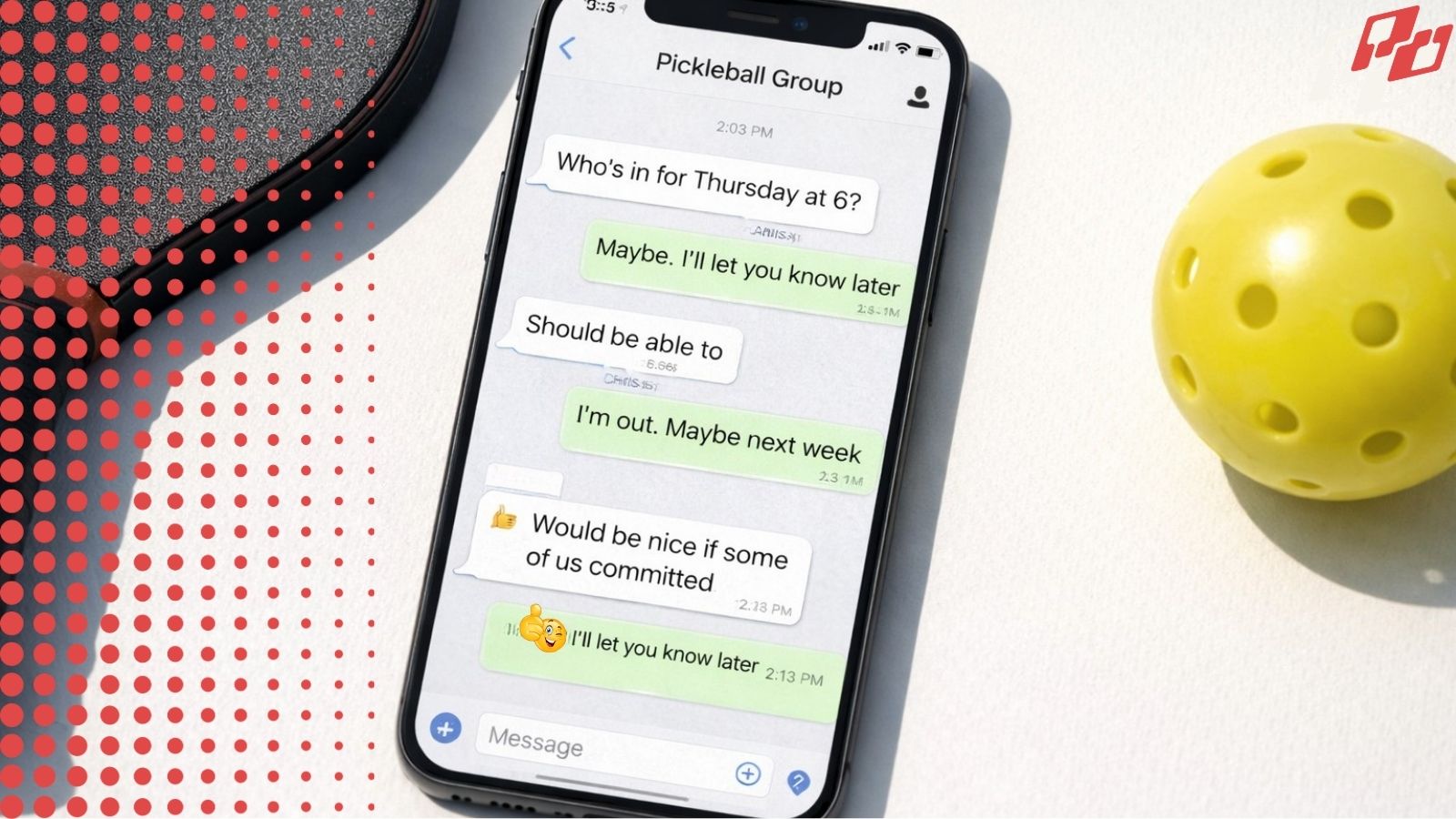
Every rec pickleball group chat starts innocent.
“Who’s in for Thursday at 6?”
Fast forward six months and that same chat now manages court fees, skill gaps, bruised egos, rain reschedules, and at least one passive-aggressive thumbs-up.
We talk endlessly about strategy on the court. But off the court? Group chat management might be the real advanced skill.
Here’s what actually goes wrong — and how to fix it without blowing up the vibe.
1️⃣ The “Maybe” Player
“Maybe.”
“Should be able to.”
“I’ll try.”
In isolation, that’s harmless. But when three people do it, the entire session hangs in limbo.
Why it matters
Rec pickleball depends on numbers.
Courts need to be booked.
Teams need to be balanced.
Waitlists might exist.
Indecision creates scheduling paralysis.
Often, the “maybe” isn’t malicious. It’s fear of commitment:
- Waiting to see if stronger players show up
- Checking if better courts are available
- Keeping options open
But uncertainty spreads.
Upgrade your response
Instead of:
“Maybe.”
Say:
“I’m 70% in. I’ll confirm by 3pm.”
Now people can plan.
If it’s a pattern in the group
Keep it neutral and structured:
“We’ll lock numbers by 3pm. After that we release spots.”
Deadlines reduce drama.
2️⃣ The Last-Minute Canceler
Stuff happens. Injuries. Work. Kids. But if it happens often, the group quietly recalibrates around you. They stop counting you as “in.”
And that’s when trust shifts.
Why this stings
Someone might have:
- Turned down another invite
- Paid for your spot
- Adjusted teams around you
The issue isn’t the cancellation. It’s the impact.
The mature move
Instead of:
“Can’t make it.”
Try:
“Really sorry — I know we were counting on 4. If you need help finding a sub, I’ll message around.”
That small ownership preserves reputation.
If someone is chronically canceling
Don’t escalate publicly.
Private text:
“Hey — totally get life gets busy. We’re just trying to lock consistent numbers. Can we treat you as tentative unless confirmed earlier?”
Clear > passive resentment.
3️⃣ The Skill-Level Drift
This one quietly divides groups. The chat started mixed 3.0–4.0. Now some players have improved. Some haven’t. Games feel uneven. And suddenly:
A second chat exists.
People notice when they’re not in it.
Why this gets emotional
Pickleball feels social first, competitive second. When someone stops getting invites, it feels personal — even if it’s logistical.
The healthy way
Transparency. Example:
“We’re starting a 4.0+ Tuesday competitive block. Main chat stays open for all play.”
No secrets. No silent exclusion.
4️⃣ The Public Coaching Moment
After a missed shot:
“You should’ve dropped that.”
Even if technically correct — it lands wrong.
Why?
Tone doesn’t translate in text. What sounds helpful in your head feels critical on a screen. Public corrections create defensiveness. Especially in mixed-level groups.
Better approach
Private message:
“If you ever want to workshop that transition ball, I noticed something that might help.”
Notice the difference: Invitation > instruction.
And sometimes? Say nothing. Not every miss needs analysis.
5️⃣ The Rating Debate Spiral
Someone posts:
“What rating do you think I am?”
This never ends neutrally. Why? Ratings aren’t just numbers. They’re identity. Once opinions start flying:
- Someone feels underrated
- Someone feels exposed
- Someone feels judged
Redirect it
Instead of:
“You’re not 4.0.”
Try:
“Maybe we structure sessions by DUPR range so games feel balanced.”
Shift from evaluating people to organizing play. Systems reduce ego friction.
6️⃣ The Meme Flood vs. The Scheduling Purist
Every chat eventually splits into:
- The meme machine
- The silent competitor
- The logistics-only player
Conflict happens when expectations clash.
Some want banter. Some want efficiency.
Easy fix
“Let’s keep this chat for scheduling. I’ll start a meme one too.”
Two lanes. No irritation. Organization beats annoyance.
7️⃣ The Prime Time Problem
Someone always books:
- Saturday 8am
- Tuesday lights
- Best indoor courts
Others feel edged out. Usually it’s not intentional. It’s just initiative.
Simple solution
“Want to rotate booking so everyone gets a turn?”
Shared responsibility reduces resentment.
Systems > assumptions.
8️⃣ The Post-Game Line Call Autopsy
Dangerous territory.
“About that out ball…”
Text removes tone. Emotion gets amplified.
➡️ If it truly matters: have that conversation in person.
➡️ If it doesn’t: let it die.
Group chat is not VAR review.
9️⃣ The Negative Spiral
Complaints about:
- Court cost
- Partners
- Skill gaps
- Weather
- Politics
Tone spreads faster than spin. Energy shapes participation. One grounded message resets it:
“Let’s keep this about getting better and enjoying play.”
Light. Not preachy.
The Bigger Picture
Let’s be real for a second. Your pickleball group chat isn’t just about “Who’s in for 6pm?” It’s the place where you celebrate wins, vent about missed overheads, share inside jokes, and feel like you belong to something.
That’s why little things in the chat can hit harder than they should. A skipped invite. A sarcastic comment. Someone reshuffling games without saying much. It’s rarely about the court time. It’s about feeling included. Respected. Part of the group.
Most tension in pickleball chats isn’t about pickleball skill. It’s about communication gaps.
One person assumes. Another overthinks. Someone stays silent. And suddenly there’s weird energy — all because nobody clarified something simple.
The healthiest groups I’ve seen aren’t the most competitive ones. They’re the ones where people:
• Say what they mean
• Give others the benefit of the doubt
• Address small issues before they turn into big ones
If something rubs you the wrong way in the chat, pause before reacting. Ask yourself: “Is this intentional… or just unclear?”
Nine times out of ten, it’s just unclear.
At the end of the day, you’re all there for the same reason: to play, to improve, to compete a little, and to have fun doing it.
The chat should support that — not stress you out.