
Good pickleball sportsmanship does not mean staying silent. Speak up calmly when bad calls, wrong scores, rotation issues, or repeated rule problems affect fairness. Let go of legal strategies, harmless habits, and personal preferences. The goal is to protect the game without becoming the court referee.
Here’s an opinion that might annoy some people. A lot of what gets praised as “good sportsmanship” on pickleball courts isn’t sportsmanship at all.
It’s conflict avoidance.
Someone makes three terrible line calls.
Nobody says anything.
A player repeatedly serves before the score is called.
Everyone rolls their eyes but stays quiet.
A regular cuts the paddle stack.
People complain in the parking lot instead of on the court.
Then everyone says, “We’re just keeping it friendly.”
Are you?
Or are you simply avoiding an uncomfortable conversation?
There’s a difference. Real sportsmanship isn’t pretending nothing happened. It’s handling uncomfortable moments respectfully enough that the game stays fair.
That’s actually much harder.
Nice Isn’t Always Kind
One of the biggest mistakes recreational players make is confusing being nice with being respectful.
⮕ Being nice often means avoiding awkward moments.
⮕ Being respectful means handling awkward moments well.
Those aren’t the same thing.
Imagine someone accidentally makes two clearly bad line calls. The “nice” response is saying nothing.
The respectful response might be:
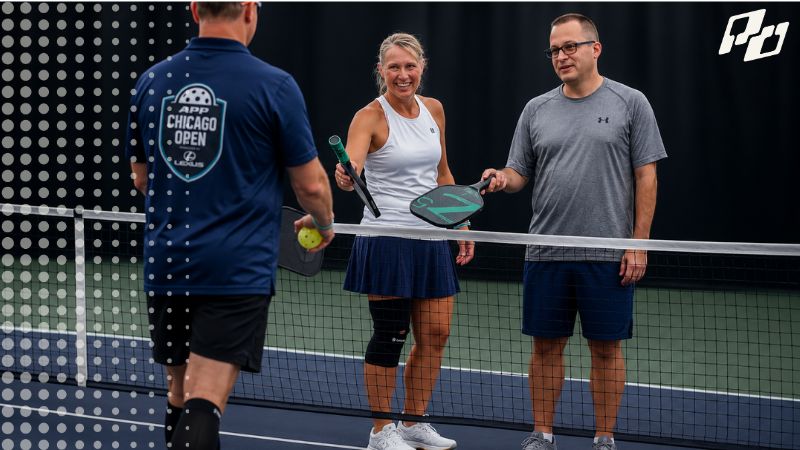
“I thought that caught the line. If you’re not completely sure next time, let’s give it the benefit of the doubt.”
One avoids tension.
The other protects trust.
USA Pickleball’s Sportsmanship Guide doesn’t tell players to ignore problems. It emphasizes respectful communication, accurate line calls, correcting your own mistakes, and resolving uncertainty in your opponent’s favor.
Notice the theme.
Respect.
Not silence.
Stop Saving the Conversation for the Parking Lot
Here’s a funny thing about pickleball. Some players are terrified of saying one polite sentence during a game.
Then they’ll spend twenty minutes talking about it afterward. We’ve all seen it.
“Did you notice his line calls?”
“She coaches every partner.”
“They never rotate properly.”
“They’re impossible to play with.”
None of those comments improve tomorrow’s game. A calm ten-second conversation usually does.
If something genuinely affects the match, address it while everyone is still holding a paddle—not after everyone is holding coffee.
The Best Players Correct Small Problems Early
Watch experienced players. They rarely let little issues become big arguments. They fix them when they’re still tiny.
Wrong score?
“Let’s double-check. I had us at 6-5.”
Confusing rotation?
“I think we’re switched.”
Questionable line call?
“I thought that clipped the line, but it’s your call.”
⮕ Short. Calm. Done.
Notice what’s missing.
⮕ No speeches. No sarcasm. No courtroom cross-examination.
Good communication sounds boring. That’s exactly why it works.
Don’t Be the Court Referee Either
Now let’s go too far in the other direction. Some players think good sportsmanship means correcting everything they notice.
It doesn’t.
Nobody enjoys playing with the self-appointed court supervisor who questions every serve, narrates every rule, and treats a casual game like an officiating exam.
A simple filter helps: Correct what affects fairness. Ignore what only irritates your ego.
Fairness issues include:
- The score is wrong.
- Someone repeatedly makes calls they clearly could not see.
- A player consistently serves before the score is called.
- Someone skips the agreed rotation.
- A partner makes an obviously incorrect line call.
- A rules misunderstanding changes the point.
Those are worth addressing because they affect the game.
Ego issues are different. That is when you speak up because:
- Someone uses a strategy you dislike.
- A beginner does not play “proper” patterns.
- Your opponent celebrates more than you prefer.
- A player hits hard in a way that annoys you.
- Someone does not follow your preferred positioning.
- A partner ignores advice they never asked for.
- An opponent makes a close call you dislike, but was clearly in position to see.
- A legal serve looks awkward or unconventional.
- Someone calls the score in a tone you find irritating.
- A player does not take the game as seriously as you do.
Those things may bother you. They do not automatically require correction.
A good test is: “If this person keeps doing this, does it make the game unfair—or does it simply make the game less like the version I prefer?”
That question will save you from becoming exhausting.
Good sportsmanship is not correcting every imperfection. It is knowing which moments require clarity and which ones require you to let go.
Learn the Difference Between a Pattern and a Mistake
This is probably the most useful skill nobody talks about.
One bad line call?
Move on.
Everybody misses one.
Five questionable calls in one game?
Now you’re dealing with a pattern.
Someone forgets the score once?
Normal.
Someone changes the score every other rally?
Now it deserves a conversation.
Many recreational players react too early or far too late. The sweet spot is identifying patterns.
⮕ Patterns deserve discussion.
⮕ Mistakes deserve grace.
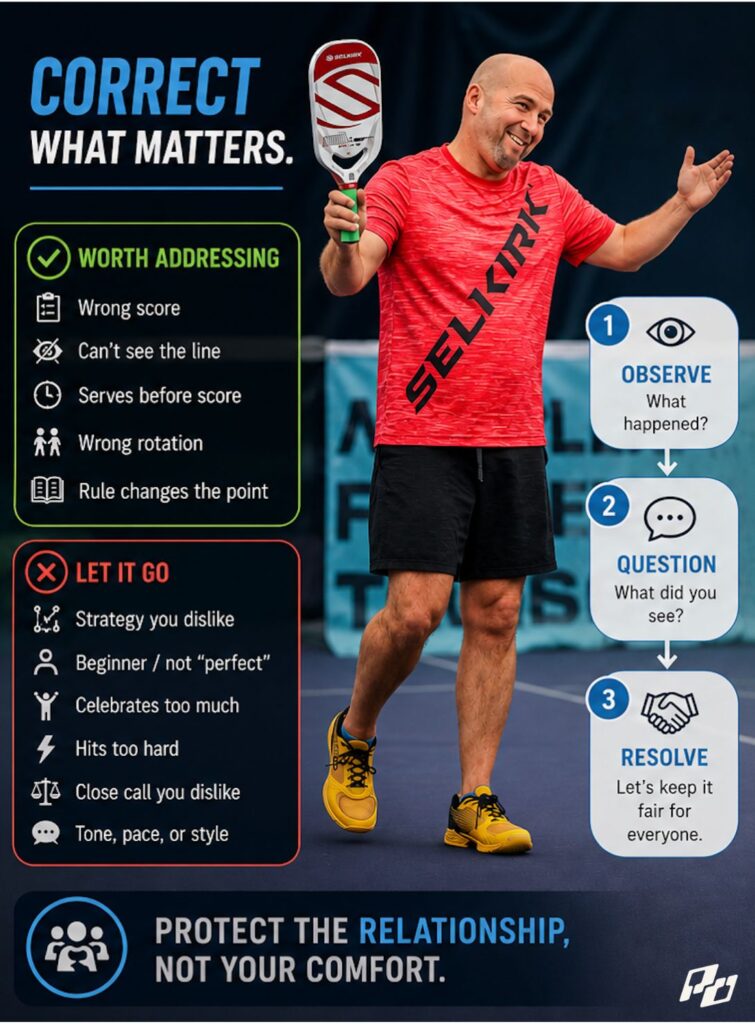
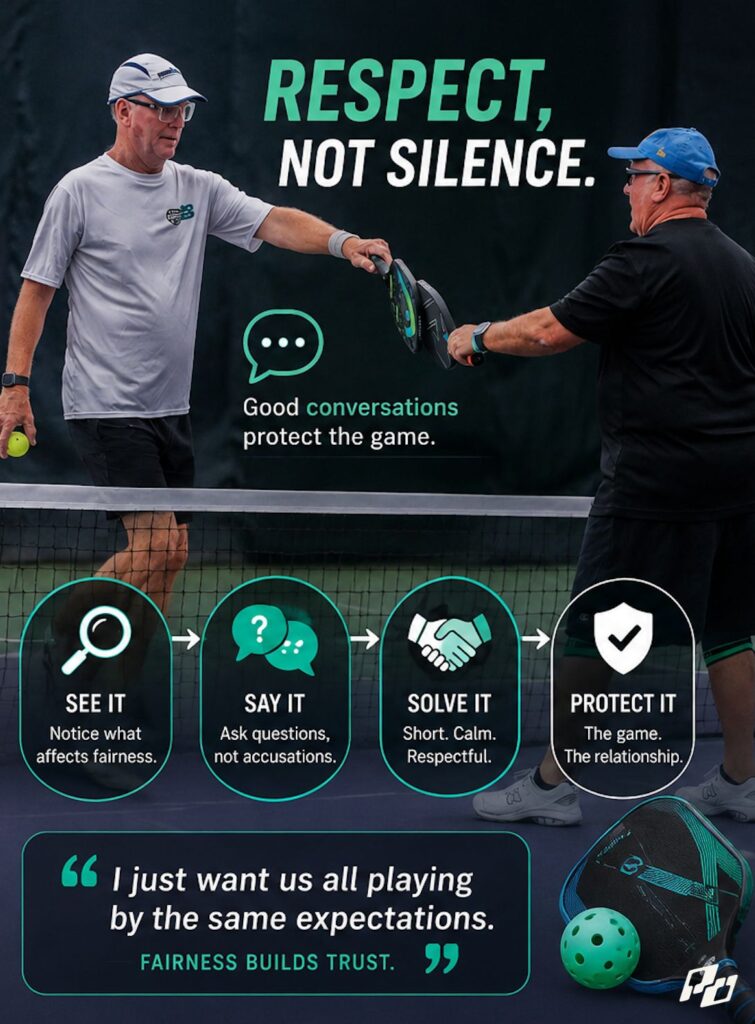
Steal This Communication Formula
If you don’t know what to say, use this pattern.
Observation.
Then…
Question.
Instead of:
“You’re making terrible line calls.”
Try:
“I thought that one caught the line. What did you see?”
Instead of:
“You’re stacking the paddles wrong.”
Try:
“How are you rotating today?”
Instead of:
“You keep coaching me.”
Try:
“Can we save feedback until after the game? It helps me stay focused.”
⮕ Questions lower defenses.
⮕ Accusations raise them.
One Sentence That Solves Half of Court Drama
Here’s my favorite phrase in rec pickleball.
“I just want us all playing by the same expectations.”
That’s it.
You’re not accusing.
You’re not judging.
You’re reminding everyone—including yourself—what the conversation is actually about.
Fairness.
Not pride.
What Good Sportsmanship Actually Looks Like
Forget the clichés. Good sportsmanship isn’t smiling after every point. It’s doing the slightly uncomfortable things that make everyone trust the game.
That means:
- Calling your own faults before someone else has to.
- Correcting your partner’s obvious bad call.
- Asking questions instead of making accusations.
- Letting one mistake go but addressing repeated patterns.
- Accepting when you’re wrong just as quickly as you expect others to.
Ironically, those habits create less conflict, not more. Because people trust players who communicate clearly.
The Players Everyone Wants Back
Think about your favorite people to play with. They’re probably not the ones who never speak up. They’re the ones who make awkward moments feel… less awkward.
⮕ They’ll question a score without making it personal.
⮕ They’ll admit they touched the ball before anyone asks.
⮕ They’ll overrule their own partner if they know the ball was in.
⮕ They’ll apologize once, not five times.
They don’t avoid uncomfortable moments. They shorten them.
That’s the difference.
Protect the Relationship, Not Your Comfort
Here’s the bonus advice I’d leave you with. Every awkward conversation on a pickleball court gives you two choices.
You can protect your comfort…
or you can protect the relationship.
Those sound like the same thing. They’re usually opposites.
Protecting your comfort means saying nothing, building frustration, then complaining later.
Protecting the relationship means having a respectful five-second conversation before resentment has a chance to grow.
The irony?
The second option feels more uncomfortable for about ten seconds. The first option often ruins an entire season.