Bad indoor pickleball lighting can make the ball hard to track because of glare, shadows, poor contrast, glossy floors, and wrong ball color. What helps most is testing a higher-contrast ball, wearing a cap or visor, trying sport lenses, shortening swings, and adjusting shot selection on courts where visibility is poor.
When it rains, gets too hot, or gets too cold, indoor pickleball feels like the obvious solution.
No wind.
No sun.
No sunscreen.
No weather excuses.
But then you step onto a gym court or indoor club court and realize something strange: The ball is harder to see indoors.
That is not “just your eyes getting older.”
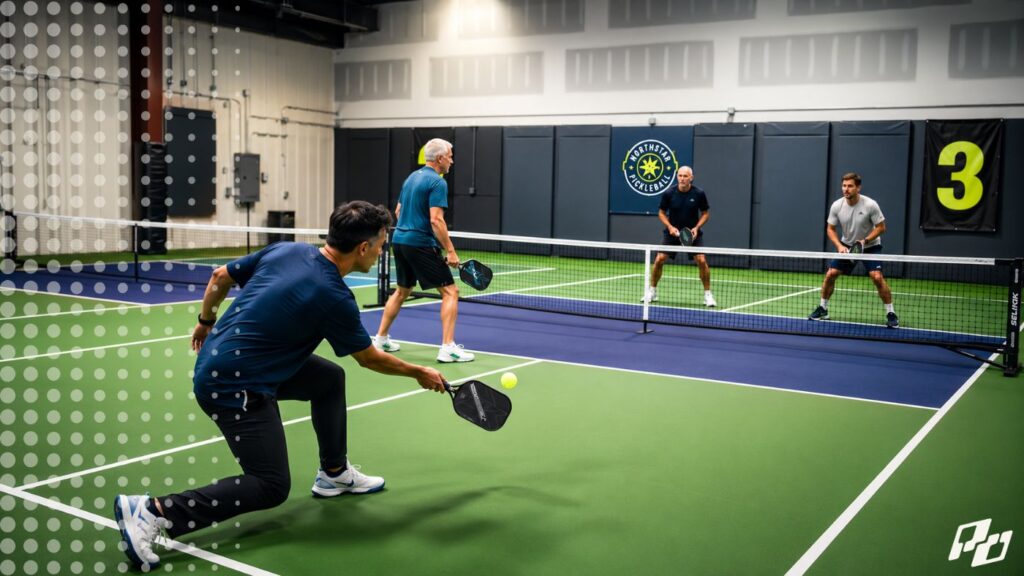
Indoor pickleball creates a specific visibility problem: the ball moves through changing light, against inconsistent backgrounds, with less natural contrast than you get outdoors.
And if the facility lighting is bad, your technique may not be the real problem. You may simply be reacting late because your brain is getting poor visual information.
The Indoor Problem Nobody Talks About Enough
Indoor pickleball is not automatically easier just because there is no wind. The ball may be moving through:
| Indoor Issue | What You Feel on Court |
|---|---|
| Overhead glare | You lose the ball on lobs or high volleys |
| Uneven lighting | One side of the court feels fine; the other feels awful |
| Shadows | The ball seems to “skip” visually as it crosses zones |
| Bright LED fixtures | Your eyes feel strained or washed out |
| Glossy floors | Light reflects upward and makes tracking harder |
| Bad wall color | The ball blends into the background |
| Windows or side glare | Certain times of day become unplayable |
| Wrong ball color | The ball disappears against walls, floors, or lights |
USA Pickleball’s facility guidance specifically recommends high-quality lighting to avoid shadows and glare, which is exactly what players complain about indoors.
That matters because pickleball is a reaction sport. At the kitchen, you are not just seeing the ball. You are reading height, speed, spin, depth, and direction in a fraction of a second.
If lighting interferes with any of those, your hands feel late.
Why the Ball “Disappears” Indoors
This is the key idea: Your eyes do not track the ball by color alone. They track contrast.
That means the ball has to stand out from everything behind it: the walls, ceiling, floor, lights, other courts, banners, windows, and players’ clothing.
A neon yellow ball may look bright in your hand, but if the wall is pale yellow, the gym floor is light wood, and the LED lights are harsh, that ball may not stand out well at all.
This is why two players can disagree on the “best” indoor ball color.
One player sees orange better.
Another sees yellow better.
Another likes pink, blue, red, or white.
That is the lesson: There is no universal best indoor ball color. There is only the best contrast for that court.
The Lighting Standard Problem
A facility can feel “bright” and still be bad for pickleball. Brightness is not the whole story.
Good court lighting needs:
- enough light
- even light
- low glare
- limited shadows
- good vertical visibility
- consistent contrast from both sides
That last part is huge. Many players notice that one side of an indoor court feels easier than the other. That usually happens because the lights, windows, wall color, or ceiling background are not balanced from both directions.
Indoor lighting guides commonly separate recreational, club, and tournament lighting levels. One court-surface company lists indoor recommendations around 30–50 foot-candles for recreational play, 50–75 for club play, and 75–100 for tournament play, with higher levels for broadcast.
But raw foot-candles do not solve everything. Lighting engineers point out that many systems meet a horizontal brightness target but still fail players because glare control, ball visibility, and uniformity were not handled well.
That explains the indoor complaint perfectly: The court can be bright and still be visually difficult.
What Actually Helps: Start With the Court, Not Your Paddle
When players struggle indoors, they often blame their timing. Sometimes that is fair. But before changing technique, ask whether the court is giving you a clean look at the ball.
1. Check the Background Behind the Ball
During warmup, do not just hit casually. Notice where you lose the ball.
Do you lose it:
above the net?
on lobs?
against the back wall?
against the ceiling?
when looking toward one side only?
when the ball crosses a light fixture?
when it drops below the lights into shadow?
That tells you what problem you are solving.
⮕ If you lose the ball high, the issue may be overhead glare or ceiling color.
⮕ If you lose it low, the floor or wall contrast may be the problem.
⮕ If one side is worse, it may be uneven lighting or window glare.
Better cue: Find the blind zone before the match finds it for you.
The Ball Color Test
This is the easiest fix when you have control over the ball. Bring two or three colors and test them before games.
Not in your hand. On the actual court.
Have someone hit:
low dinks
drives through the middle
lobs into the lights
volleys against the back wall
balls from both ends of the court
Then judge which ball stays visible longest.
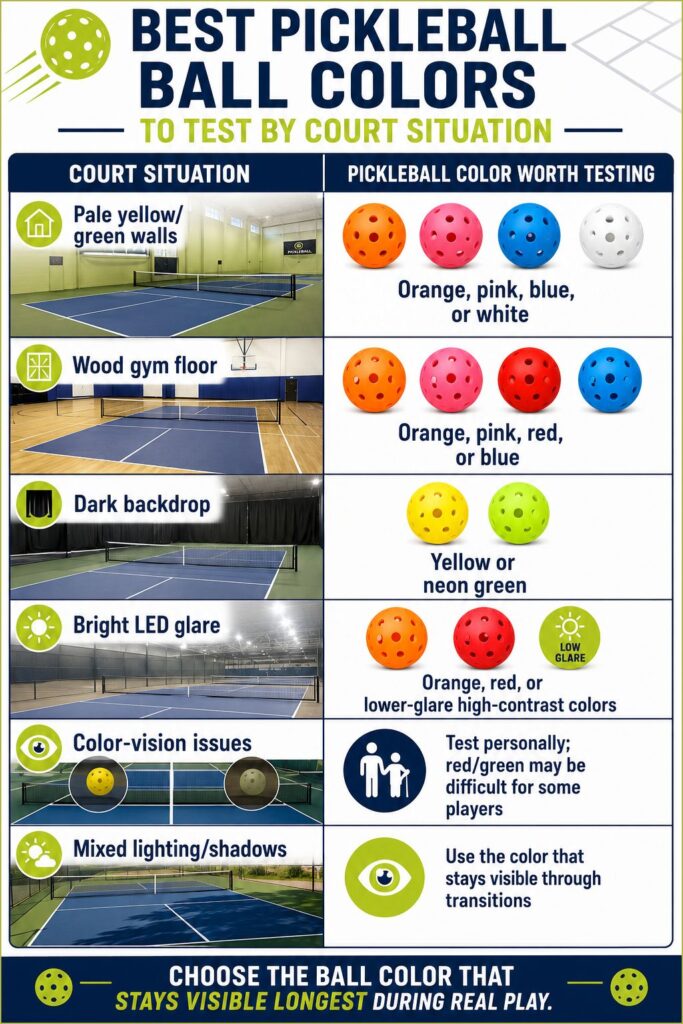
| Court Situation | Pickleball Color Worth Testing |
|---|---|
| Pale yellow/green walls | Orange, pink, blue, or white |
| Wood gym floor | Orange, pink, red, or blue |
| Dark backdrop | Yellow or neon green |
| Bright LED glare | Orange, red, or lower-glare high-contrast colors |
| Color-vision issues | Test personally; red/green may be difficult for some players |
| Mixed lighting/shadows | Use the color that stays visible through transitions |
The mistake is assuming the “official” or default ball is the most visible one. It may not be.
A facility using yellow-green balls against yellow-green walls is asking players to track a moving object with poor contrast. That is not a skill test. That is a design problem.
Practical rule: The best indoor ball is the one that contrasts with the worst background, not the best background.
Glasses Can Help — But They Are Not Magic
Players often try yellow, amber, rose, orange, low-light, shooting, or sport-specific lenses indoors. Players mention Oakley low-light lenses, yellow shooting glasses, amber safety glasses, pink-tinted glasses, Pilla lenses, and other sport eyewear as possible helpers. Some say they help with glare or contrast; others say they do not solve ball tracking.
That range of experiences makes sense.
Tinted lenses can help with:
- glare reduction
- contrast enhancement
- eye comfort
- LED harshness
- ball definition against certain backgrounds
But they cannot fully fix:
- bad fixture placement
- uneven court lighting
- severe shadows
- wrong ball color
- glossy floor reflection
- medical vision issues
So do not treat glasses as the whole answer. Treat them as one tool.
| Lens Type | May Help With | Watch Out For |
|---|---|---|
| Clear protective lenses | Eye safety without changing color | May increase glare for some players |
| Yellow/amber lenses | Low light, contrast, some glare | Can distort ball/background contrast |
| Rose/pink lenses | Contrast in mixed lighting | May not help every ball color |
| Low-light sport lenses | Harsh LEDs, night play, contrast | May still struggle with yellow balls |
| Polarized lenses | Outdoor glare | Often not ideal indoors because they can affect depth perception or reduce useful light |
My opinion: for indoor pickleball, avoid buying expensive lenses based only on someone else’s recommendation. Your court, ball color, prescription, eye history, and lighting all matter.
Best test: wear them during a full warmup and track lobs, drives, and dinks from both sides. If they only help one shot but hurt another, keep testing.
The Hat or Visor Fix Is Underrated
A cap or visor sounds too simple, but it can work. Why?
Because some indoor problems are not low-light problems. They are angle-of-light problems.
If overhead fixtures or side glare are hitting your eyes directly, a brim can block the harshest light while still letting you see the court.
Several players in the discussion mentioned wearing a cap indoors, and some said it solved or reduced their issue.
This is especially useful when:
- lights are directly above the kitchen
- you lose lobs in the ceiling
- windows create side glare
- clear safety glasses create reflections
- one side of the court is harsher than the other
The brim does not change the court. It changes what reaches your eyes.
Simple test: wear a cap for one game from the bad side only. If the ball becomes easier to track on lobs or high volleys, glare angle was part of the problem.
Indoor Ball Type Matters Too
Indoor and outdoor balls do not play the same.
Indoor balls are typically softer and have larger holes; outdoor balls are harder, faster, and have smaller holes. Some indoor facilities still use outdoor balls because they play faster and more consistently for competitive play.
That creates a visibility and timing issue.
A hard outdoor ball indoors may come off the paddle faster, skid more, and give you less time to react, especially under poor lighting. A softer indoor ball may be easier to control but can float, sit up, or feel slower.
So when you struggle indoors, ask: Is this a lighting problem, a ball problem, or both?
| Ball Issue | What You Feel |
|---|---|
| Outdoor ball indoors | Faster, harder, louder, less reaction time |
| Indoor ball indoors | Softer, slower, may float more |
| Yellow ball on pale walls | Hard to see early |
| Orange/red ball under certain LEDs | Better contrast for some, worse for others |
| Old or dirty ball | Less visible, less predictable bounce |
| Glossy floor + bright ball | Reflection can make tracking harder |
The official rulebook allows approved balls for play, but facility choice, event choice, and local conditions determine what players actually use. The current USA Pickleball rulebook is the source for official play rules and ball requirements.
For rec play, visibility should matter more than tradition. If everyone is missing the ball under the lights, try a different color.
What Does Not Help as Much as People Think
⮕ “Just watch the ball better”
That advice is too lazy. If the ball is crossing glare, shadows, or a low-contrast background, effort alone will not fix it. You may need better contrast, better positioning, or earlier anticipation.
⮕ Buying glasses before diagnosing the problem
Not every visibility issue needs lenses. If yellow balls blend into yellow walls, a different ball color may help more. If overhead lights are the issue, a visor may help more than a tint. If depth perception changed after eye surgery, get medical guidance.
⮕ Blaming age automatically
Older players may deal with glare, cataracts, dry eyes, contacts, or prior surgeries, but younger players can struggle indoors too. Often, the real problem is the court environment.
⮕ Playing the same way indoors
Indoor courts may require different habits: earlier split steps, shorter swings, safer lobs, and better pre-contact reads — especially when the ball briefly disappears in tricky lighting.
The Indoor Visibility Checklist
Use this before blaming your game.
| Question | Why It Matters |
|---|---|
| Do I lose the ball on one side only? | Uneven lighting or window glare |
| Do I lose lobs? | Overhead fixtures or ceiling contrast |
| Does the ball blend into the wall? | Wrong ball color |
| Do my eyes feel strained after games? | Glare, LEDs, dryness, or lens issue |
| Do clear glasses make glare worse? | Lens reflections may be part of it |
| Do I track better with a cap? | Light angle is likely part of the problem |
| Do other players complain too? | Facility issue, not just personal vision |
| Does a different ball color help? | Contrast problem |
| Is the floor glossy or dusty? | Reflection or bounce/footing issue |
When It Might Be an Eye Issue, Not a Court Issue
This matters.
If you consistently struggle with glare, depth perception, halos, double vision, tracking, or one eye seeing differently than the other, do not treat it as just an indoor pickleball problem.
That is especially true if you have had cataract surgery, retinal issues, contact lens changes, eye procedures, or new light sensitivity.
Gear can help comfort.
It cannot diagnose vision.
Tinted lenses, caps, and different ball colors may make the game easier to see, but they should not be used to ignore a vision issue that is new, worsening, one-sided, or affecting everyday life.
If the problem also shows up while driving at night, reading signs, tracking motion, or moving between bright and dim spaces, it is worth checking with an eye-care professional.
Don’t Let a Bad Room Rewrite Your Game
Here is the bonus piece I would add: When indoor visibility is rough, resist the urge to become a completely different player.
A lot of players start guessing. They rush the return. They overhit because they picked up the ball late. They stop trusting their hands. Then one bad indoor session turns into a fake confidence problem.
Do not let that happen. Bad lighting should change your risk tolerance, not your identity. You can still play your game. You just need to be a little less greedy with it.
Do not chase perfect corners. Do not attack balls you saw late. Do not judge your timing off one ugly court. And definitely do not assume your paddle, eyes, or technique are broken after one bad indoor night.
The smarter mindset is: “This court gives me less visual information, so I’m going to make cleaner decisions.”
That alone can save you points.
Because indoors, the calm player usually has an edge. Not the player who complains the most about the lights. Not the player who swings harder to compensate. The player who accepts the conditions early, simplifies the choices, and makes everyone else deal with the same imperfect room.