We’ve got 3 pickleball ready position hacks to help you react faster: use your non-dominant hand to reset the paddle, angle the paddle face to protect against body shots, and stay loose instead of stiff. These small fixes help rec players handle speedups, volleys, and kitchen exchanges sooner.
Most rec players do not need faster hands. They need a better reset between shots.
When your paddle stays too low, too wide, too tight, or stuck after the last ball, the next shot feels faster than it really is. That is when you get jammed, miss easy volleys, pop up counters, or freeze on body shots.
This fixes the three ready-position problems that cost rec players the most points:
Your paddle gets back too late.
Your paddle face is not protecting the right space.
Your body is tense instead of ready to move.
Clean those up, and you start reacting sooner without actually becoming faster.
The Big Problem: Your Paddle Is Ready Too Late
A lot of intermediate players technically know where the paddle should be. They just do not get it there soon enough.
They hit a dink and leave the paddle low.
They block a drive and let the paddle drift across the body.
They speed up and finish with the paddle wrapped.
They hit a volley and watch the ball instead of resetting.
Then the next ball comes back faster than expected. That is when players say, “I need quicker hands.”
Maybe. But often the real issue is simpler:
Your paddle was late before the ball was even hit.
Ready position is not something you find once the opponent attacks. It is something you rebuild after every contact.
Adjustment 1: Use Your Non-Dominant Hand as the Reset Button
This is the smallest habit with the biggest payoff. After you hit, let your non-dominant hand touch or guide the paddle back to center.
Not slowly.
Not dramatically.
Not as a separate motion.
Just a quick reset:
Hit. Touch. Ready.
Hit. Touch. Ready.
For a right-handed player, that means the left hand helps bring the paddle back in front of the body. For a left-handed player, the right hand does it.
@calliejosmith_pickleball Want to instantly improve your pickleball game? 👀 Watch my left hand in this video. Did you catch what it’s doing? After every shot, I’m using my non-dominant hand to touch my paddle and bring it back to the ready position. It’s a simple habit that helps you reset faster, stay prepared, and react quicker to the next ball. Sometimes the smallest adjustments make the biggest difference. Give this a try the next time you’re on the court and see how it changes your game! Have you been doing this already, or is this a new tip for you? #pickleball #pickleballtips #pickleballtraining #pickleballcoach #pickleballlife ♬ How You Like Me Now – The Heavy
Why does this work?
Because your non-dominant hand gives your body a physical reminder. It stops the paddle from drifting, hanging, or staying stuck after the last shot.
It also helps your shoulders stay more organized. When your off-hand reconnects to the paddle, your upper body naturally comes back toward neutral instead of staying twisted from the previous swing.
What it fixes: late volleys, lazy paddle recovery, over-wrapped finishes, slow reloads after speedups, and getting jammed because your paddle never came back home.
The feel: your off-hand “collects” the paddle after the shot.
A good cue: “Touch it back to ready.”
Not “hold it forever.” Not “grab it hard.” Just touch it back. That touch is the reset.
Adjustment 2: Put the Paddle Where the Next Ball Is Most Likely
This is where ready position gets more advanced. Many players use the same ready position everywhere.
That sounds simple, but it is not always smart. At the baseline, you may need a more neutral paddle because you have time and the ball can come deeper, wider, or higher.
At the kitchen, especially in hands battles, the next ball is often coming at your body, hip, shoulder, or paddle-side window.
So your ready position should match the danger.
If your opponent is about to speed up from close range, a paddle that is too low or too sideways leaves your body exposed. For many rec players, especially 50+ players, it can help to set the paddle face a little more toward the opponent, almost like a shield.
That does not mean you freeze there. It means you start from a position that protects the most likely attack zone.
What it fixes: body shots, chicken-wing blocks, late chest-high volleys, and panic reactions when the ball comes fast.
The feel: your paddle is not just “in front.” It is covering the space your opponent is most likely to attack.
A good cue: “Show them the face.”
At the kitchen, your paddle face should already be available to the ball. If the attack comes at your body, you should not need a big move to survive it.
Adjustment 3: Accept the Tradeoff Instead of Chasing the Perfect Stance
This is the part rec players need to hear. There is no perfect ready position for every player, every ball, and every situation.
A paddle held more neutral may help you move equally to both sides.
A paddle held more face-forward may protect your body better.
A slightly higher paddle may help against speedups.
A slightly lower paddle may help if you are expecting a low dink or reset.
Ready position is always a tradeoff.
For a younger, fast-handed player, giving up a little body protection to stay loose and reactive may be fine.
For a 50+ player, or anyone who struggles with body attacks, the smarter choice may be a more protective paddle position that covers the torso better, even if it is slightly slower to the forehand side.
That is not “wrong.”
That is intelligent.
The goal is not to copy a textbook picture. The goal is to put your paddle where it solves your most common problem.
What it fixes: copying a stance that does not match your reaction speed, getting beat at the body, and feeling like you are always late in kitchen exchanges.
A good cue: “Protect first, react second.”
Especially at the kitchen, if you are getting tagged through the middle of your body, your ready position is probably too cute and not protective enough.
The Ready Position Should Change by Court Zone
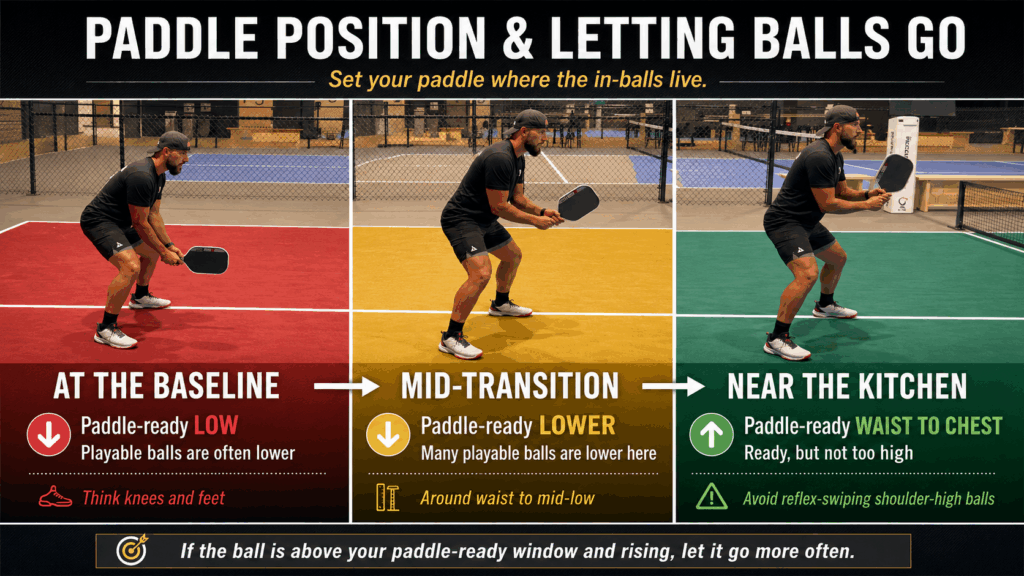
Here is a simple way to think about it.
| Court Situation | Better Ready Position | Why |
|---|---|---|
| At the kitchen in a dink rally | Paddle relaxed, in front, slightly favoring the backhand/middle | You need quick access to dinks, counters, and body balls |
| Opponent looks ready to speed up | Paddle face more toward opponent, covering chest/hip area | Protects the body and shortens reaction time |
| You just attacked | Paddle returns immediately to center with off-hand help | The counter is coming faster than you think |
| You are defending at midcourt | Paddle slightly lower but still in front | You may need to reset balls at your feet |
| At the baseline | More neutral and relaxed | You have more time and need range on both sides |
The key is not one “best” ready position. The key is having a ready position that fits the next ball.
The Mistake: Holding the Paddle Still Instead of Resetting It
Some players hear “ready position” and get stiff. They park the paddle in front of them like a statue.
That is not the goal.
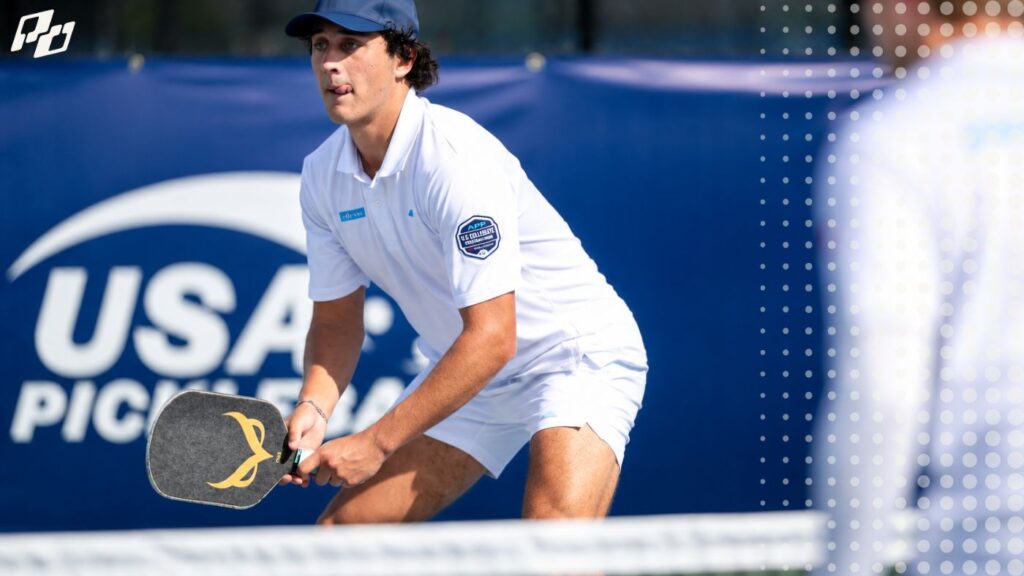
Good ready position should feel alive. The paddle is centered, but your grip is not locked. Your shoulders are not tense. Your elbows are not pinned. Your feet are still able to adjust.
Think of it like being at a stoplight with your foot lightly on the brake.
You are not asleep.
You are not flooring it.
You are ready to move.
A stiff ready position makes you slower because tension has to be undone before movement can happen.
A loose ready position makes you faster because the paddle can respond immediately.
Better feel: ready, not rigid.
The “Hit, Tap” Drill
Use this in warmup before you try it in games. Start with easy kitchen volleys or dinks. After every shot, touch the paddle with your non-dominant hand and bring it back to ready.
Say the rhythm quietly:
Hit. Tap.
Hit. Tap.
Hit. Tap.
Do not worry about winning the rally. The point is to build the reset habit.
Then make it harder:
First, do it with cooperative dinks.
Then with faster volleys.
Then after speedups.
Then in a game where your only focus is whether the paddle came back home after contact.
The important part is timing.
The tap has to happen right after the shot, not after you watch where the ball went.
If you tap late, you are just decorating the mistake.
The Body-Protection Test
This is especially useful for 50+ players or anyone who gets jammed in hands battles. Stand at the kitchen and have a partner feed controlled speedups toward your body.
Try two ready positions:
First, use your normal paddle position.
Then try a more protective version: paddle face more parallel to the net, slightly in front of your torso, with two hands available if that feels natural.
Ask yourself:
Did I see the ball earlier?
Did I block more balls cleanly?
Did I feel less panicked on body shots?
Was I too slow getting to the forehand side?
That last question matters.
This version gives you more body coverage, but it can cost you a little reach to the forehand. That is the tradeoff.
For many rec players, it is worth it.
If most of your missed fast balls are hitting your hip, ribs, chest, or paddle-side shoulder, protect the body first.
Three Ready-Position Checks That Actually Matter
1. Did your paddle reset in time?
If your paddle returns to ready after your opponent starts swinging, you are already late. You might still make the ball, but you are reacting from behind.
2. Is your paddle protecting the right space?
Do not just ask, “Is my paddle in front?”
Ask: What ball am I most likely to get next?
If they are speeding up, protect the body.
If they are dinking low, be ready to soften.
If you just attacked, expect a counter.
3. Are you relaxed enough to move?
A paddle in the right place with a death grip is still not ready. Your grip should feel available, your elbows should have space, and your shoulders should stay loose.
The best ready position is not the one that looks sharp in a photo. It is the one you can move from.
Common Ready-Position Mistakes
⮕ Leaving the paddle where the last shot finished.
This is the classic rec-player leak. The swing ends, the paddle stays there, and the next ball wins.
⮕ Resetting with the paddle too low.
Low paddle positions feel relaxed until a chest-high speedup arrives.
⮕ Overprotecting one side.
Some players cheat so far toward the backhand or body that they give up an easy forehand counter. Protection is good. Overcommitting is not.
⮕ Gripping tighter when the point gets faster.
The faster the point, the more tempting it is to squeeze. But tight hands often make the paddle late and the ball pop up.
⮕ Copying a pro stance without copying the timing.
Pros can get away with positions that rec players cannot because they reset faster and read earlier. Build the habit before copying the look.
The Best Cues
“Touch it back.”
Use the non-dominant hand to bring the paddle home after every shot.
“Ready before they swing.”
If your paddle is late, your reaction is already compromised.
“Show them the face.”
At the kitchen, give the incoming ball paddle face before it surprises you.
“Protect the body first.”
Especially if speedups keep jamming you.
“Ready, not rigid.”
You want structure without tension.
Your Ready Position Should Feel Boring
A great ready position does not look exciting. Nobody claps for it. That is fine.
Clapping is not scoring.
The players who win more hands battles are often not the ones with magical reflexes. They are the ones whose paddle is back in the right neighborhood before the chaos starts.
That is the unglamorous edge.
After every shot, get the paddle home. Use the off-hand if you need the reminder. At the kitchen, protect the space that keeps beating you. And stop treating ready position like a still photo.
It is a rhythm.
Hit. Reset. Read. React.
Do that better, and you will feel faster without actually being faster.