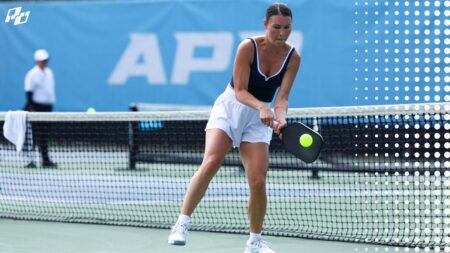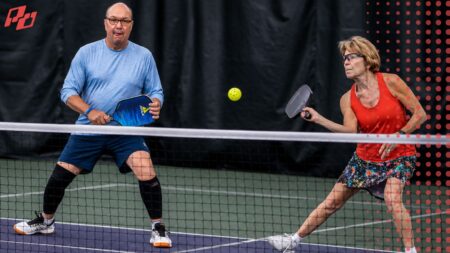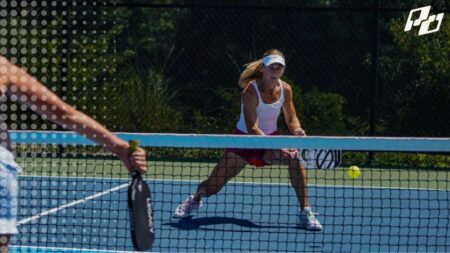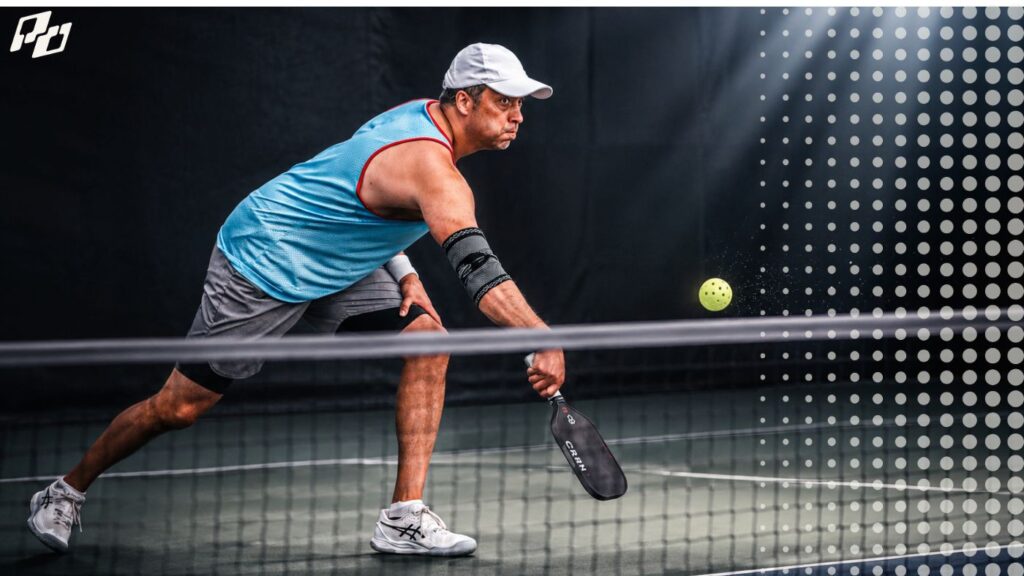
Three defensive pickleball reset shots help you survive pressure: the half volley reset, the stretched reset, and the defensive volley reset. Use them when you are late, wide, jammed, or under attack so you can soften the ball into the kitchen and turn a bad position back to neutral.
Most rec players want better offense at the kitchen. That makes sense. Speedups are fun. Flicks feel great. Put-aways get the compliments.
But the players who actually level up are usually the ones who stop panicking on defense.
At the kitchen line, you do not need a miracle shot every time you are under pressure. You need a few default defensive answers that keep the ball low, short, and unattackable enough to get you back to neutral.
That is the real value of the half volley, the stretched reset, and the defensive volley reset.
They are not flashy.
They are the shots that stop one bad position from becoming a lost point.
One of the clearest signs of an advanced player is this: they don’t try to attack from defensive positions. When they’re under pressure, they reset first, neutralize the rally, and wait for a better opportunity.
Why These Defensive Shots Should Be Your Default
At the 3.0–3.5 level, a lot of players lose points because they try to solve defensive balls with offensive instincts.
A ball gets fired at their feet, and they swing.
A dink pulls them wide, and they try to do too much.
A ball is about to land awkwardly near the kitchen line, and they let it become a harder problem.
Better players are more boring in those moments.
They ask one question: Can I make the next ball neutral again?
That is what these shots do. They take pace off, land the ball short in the kitchen, and deny your opponent the easy next attack.
Default 1: The Half Volley Reset
This is the ball that lands at your feet before you can take it out of the air.
A lot of players hate this shot because it feels rushed. The ball is low, fast, and already bouncing. Your instinct is to scoop, jab, or pop it up.
The better default is a half volley reset.
You take it right after the bounce, soften the pace, and land it shallow enough that your opponent cannot step in and crush the next ball.
This shot matters because it protects you from the most common pressure pattern in rec pickleball: someone attacks your feet, you panic, they get the pop-up. The half volley breaks that pattern.
Watch pro amateur pickleball athlete Ricardo break down 3 keys to cleaner half-volley resets.
Use it when: the ball is already dropping or bouncing near your feet and you cannot comfortably volley it.
What you want: soft contact, low arc, first half of the kitchen.
What to avoid: lifting too much. If your half volley lands deep in the kitchen or floats above net height, your opponent still owns the point.
⮕ Cue: “Catch the bounce, don’t hit the bounce.”
That cue keeps the paddle quiet. You are not trying to add power. You are trying to remove trouble.
Default 2: The Stretched Reset
This is the ball that pulls you wide, late, or slightly behind your body.
Most rec players dread being stretched because they feel like they have to create something special from a bad position.
They do not.
When you are extended, your best shot is often the least ambitious one.
A stretched reset means you use the paddle face to keep the ball soft and short rather than trying to roll, flick, or redirect too aggressively. The goal is to survive the stretch without giving your opponent a free attack.
This is especially important on wide dinks. If you get pulled outside your base and try to do too much, you often leave the next court open or pop the ball up.
A stretched reset says: I am not winning this ball. I am buying the next one.
That is a mature defensive decision.
Use it when: you are reaching, off balance, pulled wide, or contacting behind your ideal window.
What you want: shallow kitchen placement, enough height to clear the net, but not enough for a put-away.
What to avoid: trying to change direction sharply from a full stretch. That is where the paddle face gets unstable.
⮕ Cue: “When stretched, shrink the shot.”
The farther your body is from balance, the smaller your shot should become.
Default 3: The Defensive Volley Reset
This one surprises players because they think taking the ball out of the air is always offensive.
It is not.
Sometimes the most defensive shot you can hit is a soft volley before the ball becomes a worse problem.
If a ball is floating toward your feet, and you can legally reach it before it drops, cutting it off softly can save you from having to dig out a half volley. You are not attacking. You are preventing the ball from creating trouble.
That is a huge concept.
A defensive volley reset is not a punch. It is not a speedup. It is a soft touch that takes the ball early and drops it into the kitchen before it gets below your comfort zone.
@chipspickleball Tag your pickleball partner who needs to see this 👇 Follow @chipspickleball for more! #pickleballtips #pickleballstrategy #chipspickleball
♬ original sound – ChipsPickleball
Use it when: the ball is about to land near your feet, but you can take it out of the air with balance.
What you want: soft hands, short landing, no swing.
What to avoid: turning it into an attack just because it is a volley.
⮕ Cue: “Cut it off before it becomes a problem.”
That is the whole reason this shot belongs in your defensive toolbox.
The Defensive Decision Map
Use this when the point speeds up.
| Ball You Get | Best Default | Why |
|---|---|---|
| Fast ball already bouncing at your feet | Half volley reset | You cannot volley it, so soften it off the bounce |
| Wide ball that stretches you | Stretched reset | You are off balance, so reduce risk |
| Ball about to drop at your feet but still reachable | Defensive volley reset | Take it early before it forces a harder pickup |
| Ball above net height and you are balanced | Counter or attack | Now you have permission to pressure |
| Ball low and you are late | Reset, not roll | Shape matters more than offense |
| Ball pulls you behind your body | Soft reset | Do not attack from a losing position |
This is the upgrade: you stop asking, “What shot do I want to hit?”
You start asking: “What does my position allow?”
That question fixes a lot of rec-player mistakes.
Why “First Half of the Kitchen” Matters
A defensive reset that lands too deep is not really a reset.
If your ball lands near your opponent’s kitchen line and sits up, they can step in and attack again.
That is why the better target is usually the front half of the kitchen. It forces your opponent to move forward and hit up or soften the next ball. You are not trying to paint the net. You are trying to make their attack less comfortable.
Think of the kitchen in two zones:
| Reset Landing Zone | Result |
|---|---|
| Front half of kitchen | Better chance to neutralize pressure |
| Back half near kitchen line | More likely to get attacked again |
This is why touch matters more than just “getting it over.” A good defensive reset does not just survive.
It changes the next ball.
What Not to Do Under Pressure
The biggest defensive mistake is trying to look aggressive from a defensive position.
You are stretched and try to roll winner.
You are late and try to flick.
You are digging at your feet and try to counter hard.
You are off balance and aim for a perfect sideline.
That is how one uncomfortable ball becomes two.
A better rule: If your body is defending, your shot should probably defend too.
That does not mean passive. It means smart.
You can still be firm. You can still be intentional. But you are using the shot to reset the point, not prove you have hands.
The Drill That Makes These Shots Automatic
Do this at the kitchen with a partner.
One player applies controlled pressure. The other player must use the right defensive default.
- Round one: feeder attacks softly at the feet. Defender half volleys into the front half of the kitchen.
- Round two: feeder dinks wide. Defender stretches and resets shallow.
- Round three: feeder sends balls that are about to land at the defender’s feet. Defender cuts them off out of the air and drops them short.
- Round four: mix all three.
The mixed round is the real drill. You are not training the shot. You are training the decision.
A useful practice rule: No offense unless your balance earns it.
Quick Troubleshooting
| Problem | Likely Cause | Fix |
|---|---|---|
| Resets float high | Paddle is too active or grip too tight | Soften the hand and reduce swing |
| Ball lands too deep | Too much push through contact | Think shorter landing, not safer height |
| Half volleys pop up | You are hitting the bounce instead of absorbing it | Quiet paddle, soft face |
| Stretched balls go wide | You are trying to redirect too much | Reset back middle or crosscourt with margin |
| Defensive volleys become attacks | You see “air ball” and swing | Treat it as a soft interception |
| You get attacked again | Reset landed too deep or too high | Aim front half of kitchen |
The Mental Cues That Fix Your Defense Instantly
“Neutral first.”
Do not try to win from a losing position.
“When stretched, shrink the shot.”
Big reaches need small ambitions.
“Cut it off before it becomes a problem.”
Some defensive volleys prevent harder half volleys.
“Front half of the kitchen.”
A reset that lands too deep is often just a delayed attack.
“No offense unless balance earns it.”
Your body position decides how aggressive you get.
Make Defense Boring on Purpose
The best defensive players are frustrating because they do not give you the easy finish.
They do not panic at their feet.
They do not swing from bad positions.
They do not turn every stretch into a highlight attempt.
They just keep making the attacker hit one more ball. That sounds simple, but it changes matches.
At 3.5 and 4.0, a lot of points are not won because someone hits an amazing winner. They are won because someone gets impatient after their first good attack comes back.
Your job on defense is to create that impatience.
Half volley when the ball gets to your feet. Reset when you are stretched. Cut the ball off softly when you can prevent the harder pickup.
Make those your defaults, and you become much harder to finish.
Not flashy.
Just annoying.
And in rec pickleball, annoying defense wins a lot of points.