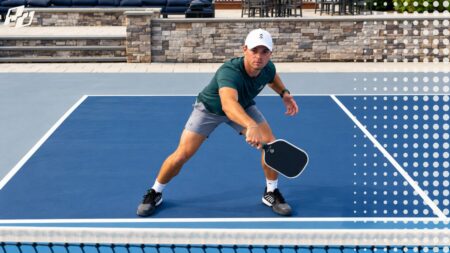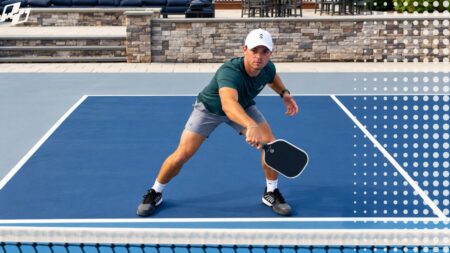

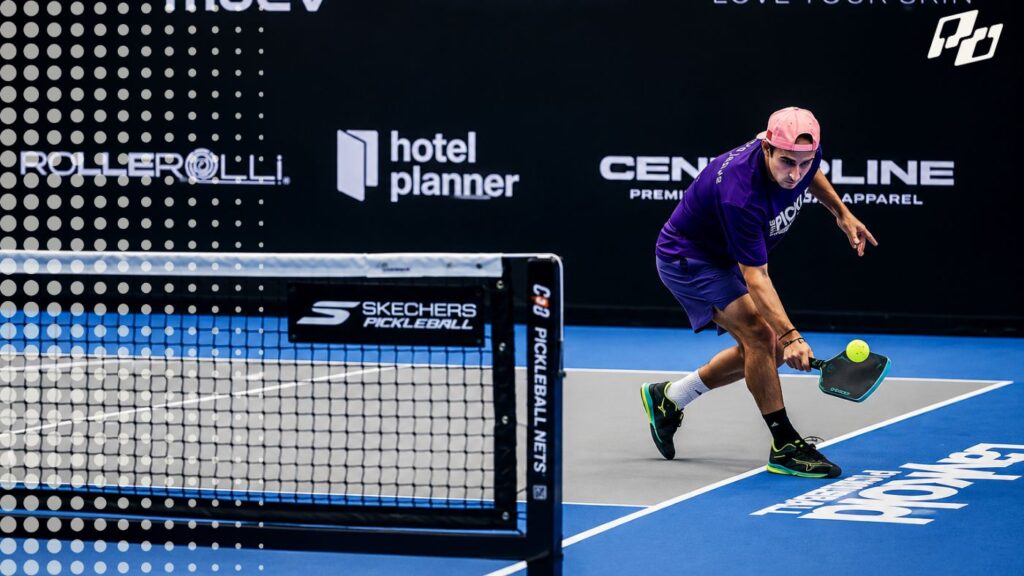
When a wide dink pulls you off court, the safest reply is usually a soft middle reset that lands in the kitchen and buys recovery time. Avoid forcing a winner from a stretched position. Make the ball bounce, help your partner cover, and rebuild the point instead of creating a bigger scramble.
There is a moment in doubles pickleball where a lot of rec players instantly make the point worse.
You are at the kitchen line. The dink rally is under control. Then your opponent rolls or angles one wide enough to pull you toward the sideline — maybe even outside the court.
Suddenly, the whole court feels open. You are reaching. Your partner is sliding over. Your balance is late. And your brain screams:
“Do something!”
That is usually where the mistake happens.
Most players do not lose this point because they got pulled wide. That happens to everyone. They lose it because they try to escape the problem with a shot that creates an even bigger problem.
A hard crosscourt swipe.
A rushed speedup.
A floating save.
A desperate angle.
A lob they were not balanced enough to hit.
Here’s a cleaner format:
When you get pulled out wide, the goal changes. You are not trying to steal the point back with one spectacular shot. You are trying to stop the rally from turning into a full-court emergency.
That is the mindset shift: Get neutral first. Get dangerous later.
The Real Problem Is Not the Wide Ball — It Is the Next Ball
When you get dragged off the court, the danger is not only the shot you are about to hit. The real danger is what happens after it.
- If your reply sits up, your opponent attacks before you recover.
- If your reply goes too sharp crosscourt, your team has to shift even farther.
- If your reply goes down the line and floats, the player in front of you may have an easy jump, punch, or Erne-style attack.
- If you attack while falling away, your partner may have to defend almost the entire court alone.
That is why better players are so calm in this situation. They are not trying to win the point immediately. They are trying to make the opponent hit one more ball from a less dangerous position.
That is the whole goal: Make the next ball less scary.
Your First Read: Are You Beaten or Balanced?
Before you choose the shot, read your body first.
A wide ball creates two very different situations:
Playable wide means you can reach the ball and still stay organized. Your chest is mostly under control, your paddle is in front, and you can recover if the ball comes back.
Beaten wide means you can touch the ball, but your body is already leaking out of the point. Your weight is past your outside foot. Your paddle is late. Your next step feels like a scramble, not a choice.
That distinction matters.
A lot of rec players treat any ball they can reach as a ball they can do something aggressive with. But reaching the ball is not the same as owning the ball.
If you are still organized, you can choose.
If you are stretched and leaking off the court, the shot has already chosen for you:
Get the ball low, soft, and recoverable.
Think of it this way:
⮕ If your feet are under you, you can be creative.
⮕ If your feet are chasing you, be boring.
Boring is not bad here. Boring keeps your team in the point.
The Best Default: Soft Middle Reset
For most rec players, the best default when pulled wide is a soft reset toward the middle of the kitchen.
Not a sharp angle.
Not a big swing.
Not a winner.
A calm ball that lands low enough and central enough to give you and your partner time to recover.
This works for a few reasons.
First, the middle reduces angles. If you send the ball back wide, your opponent may have more court to work with. If you send it middle, you make their next attack less extreme.
Second, middle gives your partner a better read. When you are pulled outside the court, your partner is already trying to cover the gap you left. A middle reset gives both of you a more predictable recovery shape.
Third, a soft middle ball is harder to punish than a floating sideline ball. Your opponent may still attack, but they are less likely to have a clean angle behind you.
The target is not the back of the kitchen.
- Think front-middle.
- Soft enough to bounce.
- Low enough to avoid being crushed.
- Central enough to let your team breathe.
Cue: Wide trouble, middle bubble.
That means when the point stretches you out wide, your safest bubble is usually the middle of the kitchen.
Why the Ball Needs to Bounce
When you are pulled wide, the reset is not just about where you hit the ball. It is also about how much time you give your team.
If your reply floats high enough for your opponent to take out of the air, you are still in trouble. They can attack before you have recovered, and your partner may be stuck defending the open court by themselves.
That is why the bounce matters.
A soft reset that lands in the kitchen forces your opponent to wait. Even a tiny delay helps.
⮕ It gives you time to move back toward the court.
⮕ It gives your partner time to slide and cover the middle.
And it often makes your opponent contact the ball from a lower, less aggressive position.
Think of the goal this way:
Not enough:
“Can I get this ball over?”
Much better:
“Can I land it softly enough that they have to let it bounce?”
That is the reset you want when you are stretched wide — not just over the net, but slow enough to buy your team time.
Cue: Make them wait. Then recover.
Why the Hero Shot Is So Tempting
Getting pulled wide does something sneaky: it makes the point feel worse than it actually is.
You feel the open court behind you. You feel your partner sliding over. You feel your balance disappearing.
And because everything feels urgent, the temptation is to “fix” the point immediately.
That is when the risky choices show up:
The extra-hard swing because you feel late.
The sharper angle because you feel out of position.
The rushed lob because you want instant recovery time.
The forced attack because soft feels too passive.
But most of those shots are emotional solutions, not tactical ones.
The better play is often calmer: Admit the point is messy, make them hit up or wait, and give your team time to rebuild.
That is not playing scared. That is recognizing the real job of the shot.
When you are stretched wide, the best reply is usually not the one that looks most impressive. It is the one that gives your partner a chance to help on the next ball.
The Partner Rule: Do Not Abandon Them Twice
When you are pulled wide, your partner already has a problem. They have to slide toward the middle, protect the gap, and prepare for a possible attack.
So your reply should help them, not punish them. This is the part that gets overlooked in rec play.
You may think you are being brave by trying a difficult shot. But if it sits up, your partner is the one who gets blasted. If it goes too sharp, your partner has to cover even more space. If it gets countered quickly, your partner may be defending while you are still outside the court.
That is why the wide-ball decision is a team decision.
Your shot should answer: What gives my partner the best chance to help on the next ball?
Most of the time, that is not the flashiest option. It is the calmest one.
Cue: If you are outside the court, do not make your partner play singles.
When the ATP Is Actually the Right Choice
There is one obvious exception: if the ball is wide enough and low enough to travel around the post, the ATP can be the best shot.
But here is the key for rec players: the ATP is not a desperation bailout. It is a geometry shot.
It works when the ball has been pulled far enough outside the sideline that you can send it around the net post without forcing the angle.
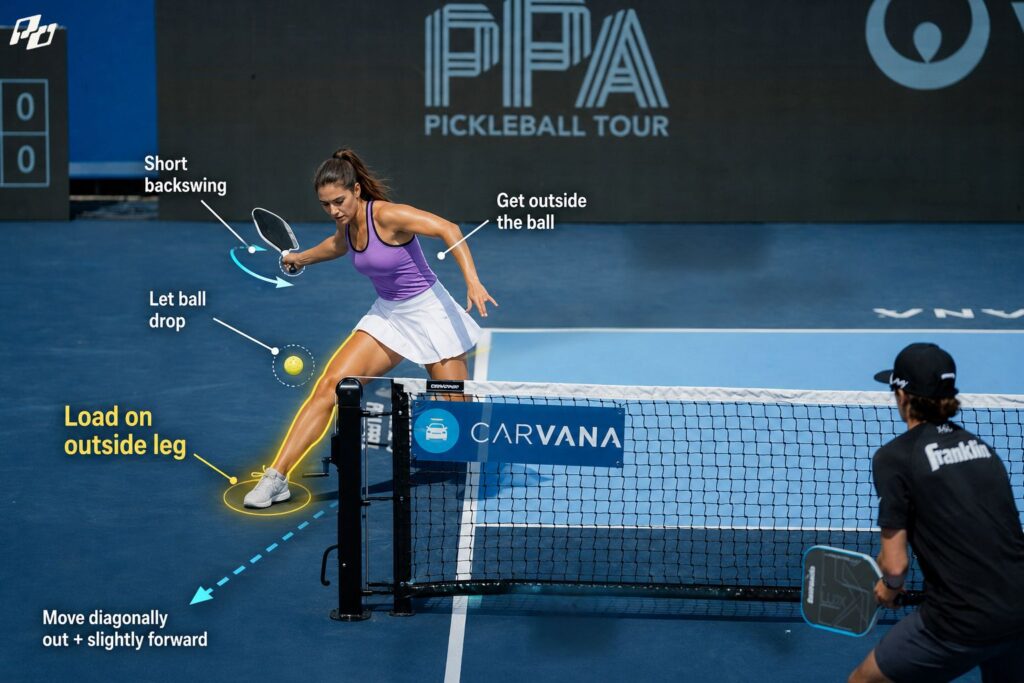
If the ball is not wide enough, many players try to manufacture the ATP anyway. That usually leads to a rushed slap, a ball into the net, or a shot that misses wide.
So use a simple test:
- If the outside path is clearly there, take it.
- If you have to invent the outside path, reset.
Cue: Take the ATP when the court gives it to you. Do not beg for it.
When the Lob Makes Sense
The lob can work when pulled wide, but it is not the automatic safety option many rec players think it is.
A good defensive lob requires touch, height, depth, and enough balance to control the paddle face. If you are sprinting, leaning, or reaching behind your body, that is a lot to ask.
The lob is best when:
- your opponents are leaning forward
- you have enough time to lift cleanly
- your paddle face is not wildly open
- and you can send the ball deep enough to prevent an easy overhead
The surprise matters too. If you lob every time you get pulled wide, better opponents will start hunting it.
For most rec players, the lob should be a changeup, not the default. A soft middle reset is usually the safer first choice.
Cue: Lob when you have touch. Reset when you have panic.
What About Going Crosscourt?
Crosscourt is not a bad choice by itself.
It becomes risky when your body is already stretched.
That is the part many rec players miss. The court may look open, but the shot is asking for a lot from a bad position.
To hit a good crosscourt ball from wide, you usually need:
Enough balance to control the paddle face.
Enough touch to keep the ball low.
Enough angle to clear the net without floating it.
Enough recovery time to get back before the counter.
If one of those pieces is missing, the shot can turn against you quickly.
A wide crosscourt reply often pulls your team even farther out of shape. Your partner has to slide harder, the middle gets messy, and if the ball sits up, your opponent can attack into the space you just left.
So crosscourt is not forbidden. It is earned.
Use it when you are stable enough to shape the ball softly and recover behind it.
Skip it when you are reaching, leaning, or hoping the open court will save you.
Cue: The court may be open, but your body has to be available.
The Recovery Footwork Most Players Forget
After the wide reset, do not admire the shot. Your first recovery step matters.
Instead of popping straight up or drifting backward, push back toward the court with your outside leg and return toward the middle with your paddle already in front.
Your partner should also be shifting with you. In good doubles, wide-ball defense is a two-player recovery. The outside player gets the ball back safely. The partner shades middle and protects the obvious counter.
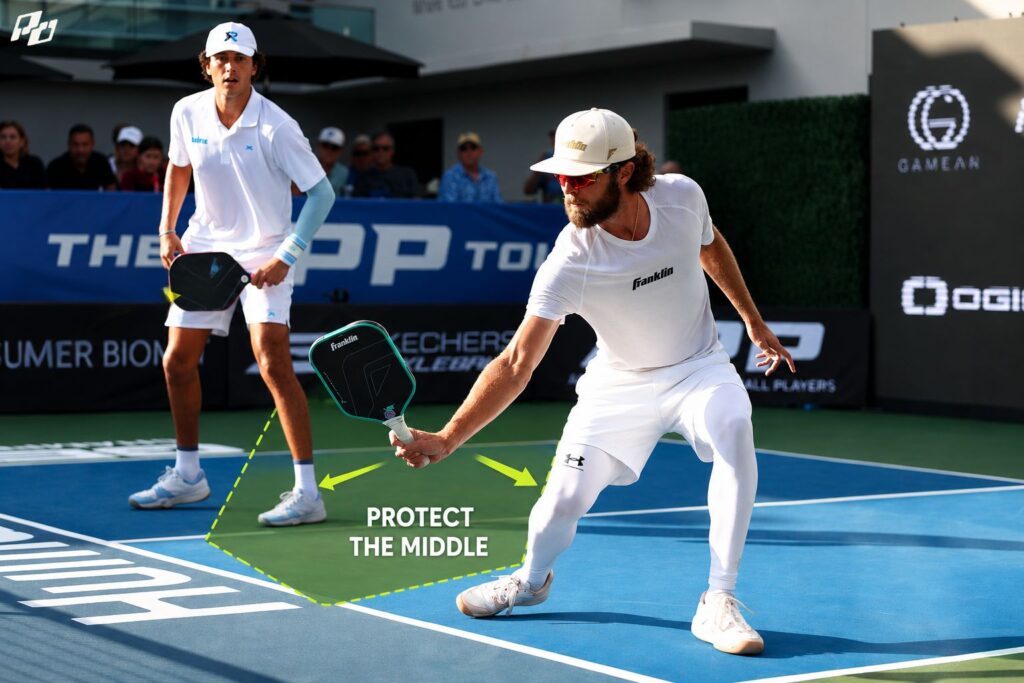
Then both players rebuild the wall. The goal is not to sprint wildly back to your original spot. The goal is to close the biggest hole first.
Usually, that means protecting middle before worrying about perfect spacing.
Cue: Recover the middle first, then rebuild your side.
A Simple Decision Tree for Wide Dinks
When you get pulled wide, run this quick mental order:
1. Can I ATP cleanly?
If yes, take it.
2. Am I balanced enough to shape a quality crosscourt ball?
If yes, it can be an option.
3. Am I stretched, late, or off balance?
Reset soft middle.
4. Are they leaning hard forward and I have touch?
Consider the lob.
5. Am I panicking?
Do not attack. Reset.
That last one might be the most important. Panic shots feel urgent, but they usually create the exact ball your opponents want.
The Rule I’d Give Myself Before the Next Dink Rally
If I kept getting pulled wide, I would not make my goal “never get pulled wide again.” That is unrealistic. Good players are going to move you. Smart dinkers are going to test your outside foot. Some rallies are designed to make you uncomfortable.
The better goal is to decide ahead of time what kind of player you want to be when you are uncomfortable.
Because that is where the point usually turns.
Do you get rushed and try to win it back immediately?
Or do you stay boring for one more shot and give your team a chance to reset?
That is the habit I would build.
The next time you play, give yourself one simple rule: When I am stretched wide, my first win is getting the rally back to playable.
Not perfect. Playable.
That one word takes a lot of pressure off. You do not have to hit a highlight. You do not have to erase the opponent’s good shot. You just have to send back something your team can defend.
And if you do that often enough, something interesting happens: opponents stop getting easy putaways from your panic shots. Your partner stops feeling stranded. You start recovering faster because your shot choice is no longer making the scramble worse.
That is when wide defense becomes less about survival and more about maturity. You are not giving up the point. You are refusing to lose it too early.