
In intense pickleball groups, don’t try to impress people — become easy to trust. Communicate early, make fair calls, reset under pressure, and avoid risky “prove myself” shots. Competitive players respect calm, readable partners who reduce chaos and keep playing solid pickleball when the game gets tense.
Some pickleball groups are relaxed. Others make Tuesday morning open play feel like a playoff match.
You know the vibe: tight rotations, serious strategy talk, instant targeting, visible frustration after misses, and a “good game” that somehow sounds like a quarterly review.
If you are trying to fit into a more intense group, the goal is not to act intense.
It is to become easy to trust under pressure.
Strong groups usually do not expect perfection. They respect players who communicate early, make fair calls, follow the rotation, and recover quickly after mistakes.
That earns more respect than one flashy winner followed by three chaotic decisions.
First, Read the Room
Before you decide whether the group is “too serious,” figure out what kind of serious it is. There are two types.
| Group Type | What It Feels Like | What to Do |
|---|---|---|
| Healthy competitive | Intense but fair, clear rotations, good communication | Match the focus and enjoy the level |
| Toxic competitive | Blame, eye rolls, exclusion, constant criticism | Protect your energy and limit exposure |
Healthy intensity can make you better.
Toxic intensity just makes you tight.
A good rule: Competitive is fine. Contempt is not.
If people are trying hard, that is normal. If people are making others feel small, that is a culture problem.
Your Job Is to Be Predictable
In intense groups, players care less about whether you are perfect and more about whether they can trust your decisions.
That means:
- Call balls early.
- Say “mine” or “yours” before the ball gets awkward.
- Return deep with margin.
- Reset when you are in trouble.
- Do not speed up low balls just to prove you belong.
- Do not apologize after every miss.
Strong players can handle a missed smart shot. What frustrates them is random pickleball.
The best way to fit into a competitive group is to become predictable in the best way: clear calls, smart targets, steady body language, and no emotional spillover.
What to Say When You’re New to the Group
Do not over-explain yourself.
Do not walk in apologizing for your level.
Use short, confident phrases.
“How are you rotating today?”
This shows you respect the system.
“I’m around a 3.5/4.0 and happy to mix in wherever it fits.”
Simple, useful, not needy.
“I’ll play solid and keep it moving.”
This tells competitive players you understand the assignment.
“Good with feedback after the game, but I’m trying to stay focused during points.”
This is perfect if someone starts coaching you mid-game.
Better players are not required to teach during open play, and unsolicited coaching can disrupt focus and rhythm. That boundary is reasonable.
Don’t Play Like You’re Being Evaluated
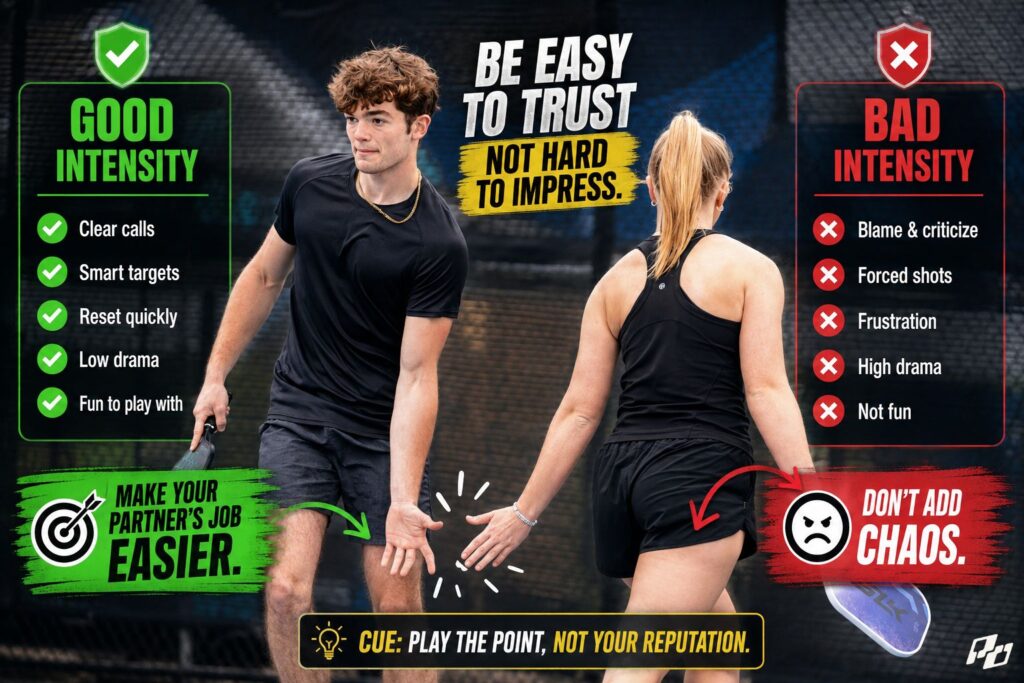
This is the trap.
You finally get into the stronger game, and instead of playing your normal style, you start trying to prove your level.
That usually makes you worse.
You force the drive because you want to look aggressive.
You poach because you want to look confident.
You speed up early because you want to look dangerous.
You go for the perfect shot because you want one point to announce, “I belong here.”
But strong players can feel when someone is performing instead of playing. The better move is quieter: show them you understand the game.
Take the smart reset when you are in trouble. Let the out ball go. Choose the bigger target at 9–9. Leave your partner a predictable next ball. Keep your body language neutral after a miss.
That is what good players notice.
Not whether you can hit one flashy winner.
Whether your decisions make the game easier to play with you.
Cue: Play the point, not your reputation.
Have a Pressure Script After Mistakes
Intense groups make mistakes feel louder. So you need a script. After a miss, do not perform guilt.
Say one quick thing and move on:
“I rushed that.”
“Next one middle.”
“I’ll reset that next time.”
“Good idea, bad execution.”
“I’ve got the next ball.”
Then actually reset.
Mental-game coaches often recommend short routines, cue words, and task-focused resets because pressure pulls attention toward worry instead of the next action.
The best phrase is: One note. Next point.
That keeps one miss from becoming your whole personality.
Play “Low-Drama Competitive”
This is the sweet spot. You can be competitive without becoming tense.
Low-drama competitive looks like this:
| Instead of… | Do This |
|---|---|
| Apologizing constantly | Give one quick “my bad” and reset |
| Arguing line calls | Make your call clearly and move on |
| Coaching your partner mid-game | Save it unless they ask |
| Showing frustration | Use neutral body language |
| Trying to prove your level | Make repeatable decisions |
| Playing scared | Use bigger targets with full commitment |
This is how you become someone strong players want in the group. Not because you never miss. Because your misses do not infect the game.
If Someone Gets Too Intense
You do not have to match bad energy. Try calm, non-dramatic lines:
“Let’s keep it playable.”
“I’m good with competitive, not with the commentary.”
“Let’s talk strategy after the game.”
“I heard you. I’m focusing on the next point.”
“All good — let’s just play.”
The key is not to argue. Keep it short. Keep it neutral. Keep the ball moving.
If the person keeps blaming, coaching, or making the game miserable, you have your answer. That is not a group you need to win over.
Know When to Leave
This is underrated. Some players stay in intense groups too long because they want approval. Do not do that.
Leave if:
- You play scared every time.
- The group uses mistakes as social punishment.
- You are constantly being coached without asking.
- The games are competitive but not enjoyable.
- You feel worse about pickleball afterward.
- The only reason you stay is to prove you can handle it.
A competitive group should challenge you. It should not make you feel like you are on trial.
Don’t Misread Competitive Behavior
Strong groups often look less friendly than casual groups. That doesn’t always mean they’re unfriendly. Many players simply become quieter when they’re focused.
- They aren’t chatting as much.
- They celebrate less.
- They move quickly between points.
- They expect ready paddles and clear communication.
Don’t mistake concentration for rejection. Give a new group a few sessions before deciding they don’t like you.
Sometimes they’re just locked into the game.
Sometimes they really are cliquey.
Time usually tells you which one it is.
Become Easy to Partner With
Here’s something you’ll notice in strong groups. Players rarely talk about who hit the biggest winner after a session. They talk about who they enjoyed playing with.
That doesn’t mean being the nicest player on the court. It means making your partner’s job easier.
Before every point, ask yourself: “If I were my partner, what would I want from me right now?”
Usually the answer is simple:
- Stay connected instead of drifting too wide.
- Cover your assignment instead of chasing hero poaches.
- If you’re under pressure, reset instead of forcing a winner.
- If you make a mistake, recover immediately so your partner isn’t playing the next point with your frustration too.
Strong groups notice those habits immediately because they reduce chaos.
Ironically, when you stop trying to prove you’re the best player on the court and start making life easier for your partner, people begin trusting you with more games.
Cue: “Make your partner’s job easier.”
What Experienced Players Say They Wish They Knew Sooner
After reading discussions from hundreds of recreational players, one theme kept coming up: the groups that feel intimidating on day one usually feel completely normal a few weeks later.
One player summed it up perfectly:
“I realized nobody was judging me as much as I thought. They were mostly focused on their own game.”
That’s a great reminder.
When you join a stronger group, it often feels like every miss is being analyzed. In reality, most experienced players are thinking about their own decisions, their own partner, and the next point—not keeping a mental list of your mistakes.
Another comment that came up repeatedly was this:
“Once I stopped treating every game like a tryout, I started playing more like myself.”
That is the real shift. Intense groups can make you shrink or overperform. Neither works. The goal is to stay recognizable: same smart targets, same communication, same reset habits, same personality.
You are not there to pass an exam. You are there to play solid pickleball under a little more pressure.
Don’t Let Intensity Turn You Into Someone Weird
Here is the bonus advice I’d give any rec player stepping into a serious group: stay normal.
That sounds simple, but competitive courts can make people act strange. They start apologizing too much, forcing shots they don’t own, pretending they’re not nervous, or copying the mood of the loudest person on court.
Don’t do that. Be the player who stays easy to read.
If you’re under pressure, reset.
If it’s your ball, call it early.
If you miss, own it once and move on.
If someone gets dramatic, don’t absorb it.
If the game gets tight, choose the shot you trust — not the shot that proves something.
That is the quiet skill strong groups respect: you don’t add chaos.
And here’s the part people forget: you’re allowed to decide whether the group is good for you, too. You’re not auditioning for a lifetime membership.
Thought for a couple of seconds
Some intense groups make you sharper.
Some just make you smaller.
Learn the difference.