
To win more pickleball games, keep soft shots below the opponent’s attack zone, use controlled third-shot drives, reset from midcourt, return deep through the middle, and split-step before contact. Together, these five habits reduce unforced errors, improve positioning, and make your point construction more reliable under pressure.
Finding one pickleball tip is easy. Finding a combination of habits that consistently raises your chances of winning is much harder.
At the 3.0-3.5 level, most players already know the basic shots. The bigger problem is choosing the right shot, managing pressure and moving efficiently enough to execute it.
After comparing the advice of experienced coaches and high-level players, five habits kept standing out. None will win every match on its own.
Together, however, they can dramatically reduce unforced errors, improve point construction and make you much harder to beat.
1. Make Your Soft Ball Land Below Their Attack Zone
“Make every soft shot bounce in the kitchen” is a useful goal, but the real objective is to make your opponent contact the ball below net height.
The safest way to do that is usually a soft topspin drop or dink. Brush up the back of the ball with a compact swing so it clears the net, then dips sooner and stays lower after the bounce. Do not try to create heavy spin. A slightly closed paddle face, relaxed grip and smooth low-to-high path are enough.
Watch pickleball coach Tanner Tomassi explain how to keep your dinks low:
A neutral, low-spin drop also works well when you are stretched or under pressure. Give it more arc, reduce the pace and aim for the middle third of the kitchen. Gravity—not spin—will bring it down.
Use underspin sparingly. Slice can keep the ball low after the bounce, but it often floats longer through the air. If the shot travels too deep, the opponent may volley it above net height before the backspin helps you.
Three practical cues:
- Topspin: brush up and let the ball dip.
- Neutral: lift with margin and take pace off.
- Slice: use only when you can keep the trajectory short and low.
From the baseline or transition zone, your shot should peak on your side of the net or near the tape, then descend into the kitchen. From the kitchen line, keep the swing compact and avoid pushing the dink deep toward the opponent’s feet.
Your visual cue is:
Arc early, descend before contact.
Judge the shot by the opponent’s paddle height. If they must volley upward, reach below the tape or let the ball bounce, you have succeeded.
2. Use the 70% Drive as a Transition Shot, Not a Panic Shot
A controlled third-shot drive can be a good pressure-management tool.
When players get tight, they often decelerate through their drops and leave them short or high. A drive allows a more committed swing and gives the opposing team less time to organize.
But “nervous” is not enough reason to drive. Use the controlled drive when:
- the return is short enough to contact in front
- you are balanced rather than backing up
- the ball is at a comfortable height
- you can drive through a large target
Aim through the middle, at the returning player’s backhand-side hip or toward the player who is still moving forward. Avoid trying to paint the sidelines. The purpose of reducing the drive to roughly 70% is to preserve shape, depth and control—not merely to hit slower.
Then expect the ball to come back.
A third-shot drive is often most effective as the first half of a drive-and-drop combination. Drive the third, move forward only as far as the shot allows, then prepare to drop or reset the fifth ball.
Use this cue:
Drive to earn an easier fifth—not to end the point.
If the return is deep, low or still pushing you backward, a forced drive may be riskier than a high-margin drop.
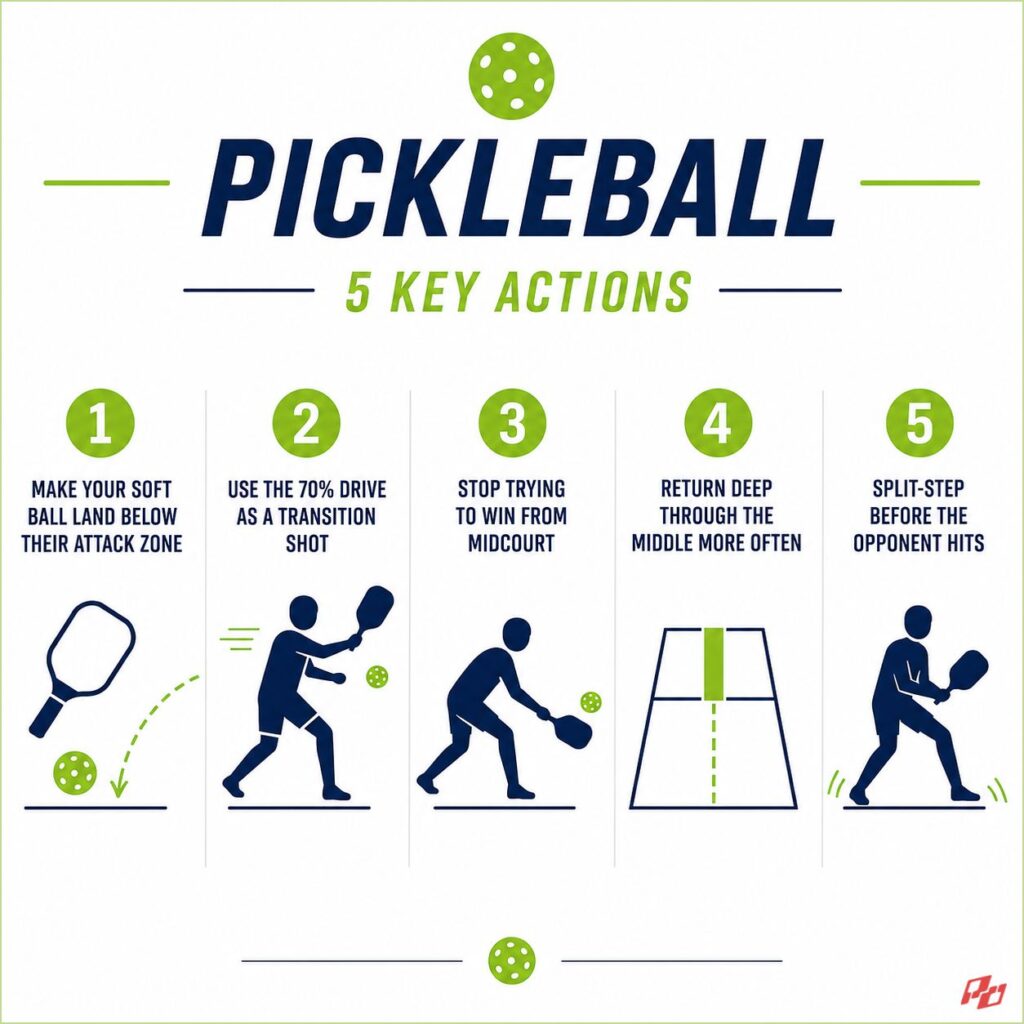
3. Stop Trying to Win From Midcourt
The transition zone is not dangerous because standing there is automatically wrong. It is dangerous because many players are moving forward while trying to hit.
That combines three problems:
- unstable contact
- a rising paddle face
- reduced reaction time
When an opponent attacks your feet, resist the urge to counter hard from below net height. Absorb the pace and reset the ball into the kitchen.
Use a loose grip, a short paddle path and a stable face. Your legs should lower your body behind the ball; your wrist should not scoop underneath it.
The most useful reset target is often the middle of the kitchen. The net is lower there, the target is larger and the opponents have fewer sharp angles available. Coaches also recommend middle targets under pressure because they can reduce angles and slow the rally.
Your cue is:
Soft middle, then move.
Do not run all the way to the kitchen simply because you hit a reset. Watch its quality.
- If it lands low and forces an upward contact, advance.
- If it sits high, stop and prepare to defend.
- If the opponents can attack downward, retreat slightly if necessary.
Resets are meant to neutralize the opponent’s offense and give the defending team time to recover, not to counterattack from a compromised position.
4. Return Deep Through the Middle More Often
Most intermediate players understand that a deep return is useful. Fewer understand why the deep middle can be better than flirting with a corner.
A deep middle return does three things:
- It keeps the serving team farther from the kitchen
- It reduces the angles available on the third shot
- It can make partners decide who should take the ball
It also gives you a larger target than the sidelines, which matters when the serve is heavy or you are protecting a lead.
The ball does not have to land on the centerline. Think of a broad lane extending from the middle third of the baseline toward the opponent’s inside hip.
Use enough height and depth to give yourself time to reach the kitchen. A low, fast return that lands short may look aggressive, but it can leave you moving forward as the opponent contacts an easy third-shot drive.
Watch our coach, Marko Grgic, share three excellent tips for hitting deeper, more effective returns:
Your cue is:
Deep middle, then beat the ball to the line.
This is especially effective against teams that rely on a dominant forehand taking most third shots. Make them establish ownership before they can begin their preferred pattern.
5. Split-Step Before the Opponent Hits
This may be the least glamorous point in the formula, but it is one of the most important. Many recreational players reach the correct court position and still lose because they are moving when the opponent makes contact.
When your feet are crossing, drifting or running forward, your body has momentum in one direction. If the ball goes somewhere else, you must first stop that momentum before reacting.
A split-step solves that problem.
As the opponent begins the forward swing, make a small hop or controlled stop so your feet land slightly wider than shoulder width. Your weight should be forward, your knees flexed and your paddle in front.
Do not turn it into a large jump. The purpose is to become balanced—not airborne.
This is especially important after a third-shot drop or midcourt reset. Advance while the ball is traveling, then stop before the opponent contacts it. If they hit another soft ball, move again. If they attack, you are balanced enough to defend.
The split-step stops forward momentum, creates a stable base and makes it easier to change direction. Move with the ball while staying connected to your partner.
Your cue is:
Move while your ball travels. Stop while they hit.
That one rhythm change can improve your resets, blocks and counters without changing your swing at all.
How the Five Parts Work Together
These are not five unrelated tips. They create a sequence.
Start the rally with a deep return through the middle. On the serving side, use a controlled drive or drop based on the return you receive. Move forward behind the shot, but split-step before the opponent makes contact.
If they keep you in transition, reset rather than forcing pace. Once you reach the kitchen, keep your soft shots descending so the opponents must contact from below their preferred attack zone.
The complete formula is:
Reduce their angles. Control your third shot. Stop before contact. Reset under pressure. Attack only after earning a better ball.
That will not guarantee victory against every opponent.
It will, however, eliminate many of the rushed decisions, attackable balls and movement errors that allow opponents to beat you without doing anything special.