Foam pickleball paddles can make mishits more forgiving, but foam alone isn’t the reason. Paddle shape, twist weight, stability, and weight distribution all matter. The best foam paddles help off-center hits keep more direction and depth—making imperfect contact less costly for rec players.
Foam paddles are no longer some strange experiment sitting on the edge of pickleball. They’re becoming a real category.
New to pickleball? Start with our beginner paddle picks, picked with lab data and 3,600 player survey responses.
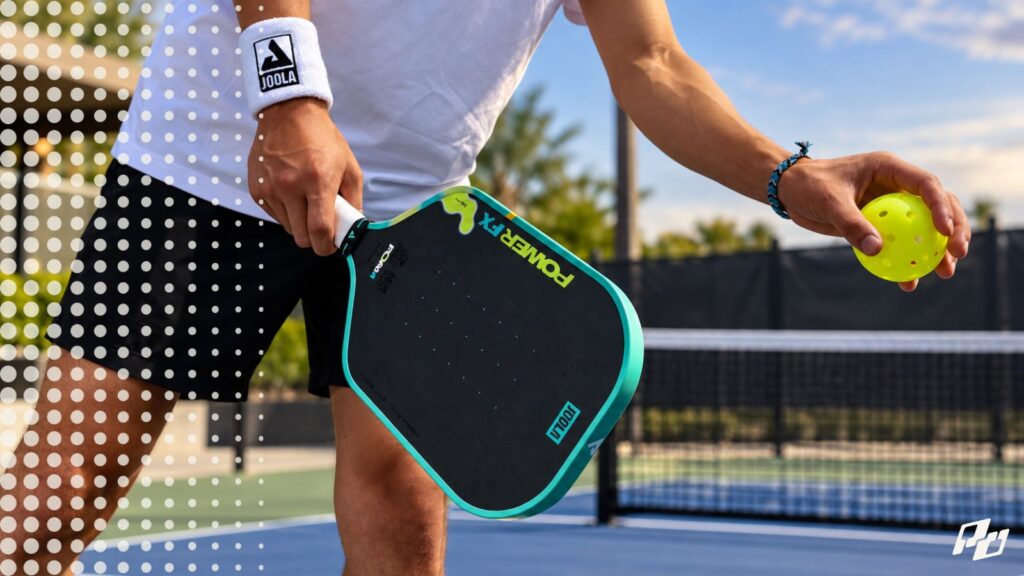
And with JOOLA now entering the full-foam conversation with its new POWER FX, launching September 30, it’s pretty clear this technology has moved beyond the smaller paddle brands and gear obsessives. JOOLA says its first foam paddle combines a 16mm foam construction with its Propulsion Core technology, localized reinforcements and a tuned surface layup.
But for the average 3.0–4.0 player, I think there’s a much more interesting question than: “Is foam the future?”
It’s this: can a foam paddle make your imperfect contact less costly?
Because let’s be realistic. Most of us aren’t hitting the exact center of the paddle 100 times out of 100.
We’re blocking a speed-up late.
Reaching for a wide dink.
Catching a return slightly toward the edge.
Getting handcuffed at the kitchen.
Hitting a reset while our feet are still moving.
For an intermediate player, what happens on those contacts may matter more than what happens when you absolutely flush one.
And that’s where certain foam paddles get very interesting.
First, What Does “Forgiving” Actually Mean?
Players tend to use sweet spot and forgiveness as if they mean exactly the same thing.
They don’t. A paddle can feel wonderful in the middle but lose stability quickly when you move away from center.
For me, forgiveness is simpler: when I miss the center slightly, how much does the shot fall apart?
Does the paddle twist?
Does the ball suddenly die?
Does a block that should reach the kitchen land halfway up the transition zone?
Does the face open and send the ball wide?
Or does the paddle preserve enough pace, direction and stability that the rally continues?
The best forgiving paddle doesn’t eliminate mishits. It makes your mishits less expensive.
And I think that distinction is especially important for rec players.
Why Foam Can Help
Traditional paddles usually rely on a polypropylene honeycomb core.
Full-foam designs replace that cellular structure with foam—or, in some newer designs, use multiple foam densities and reinforcement structures to control how the paddle bends and rebounds.
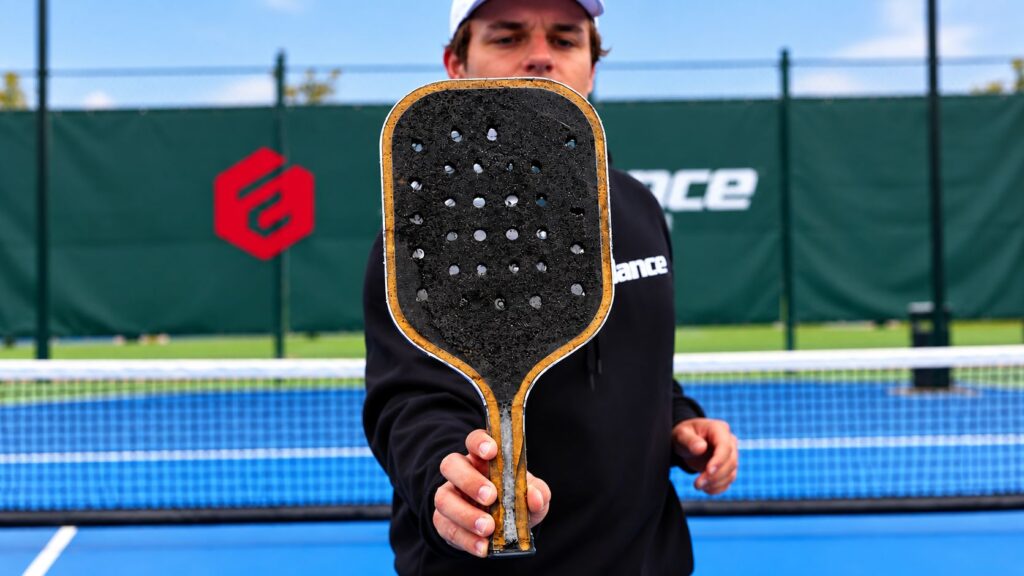
The potential advantage is that designers now have another way to tune the paddle’s response across the face.
But here’s the key: foam itself isn’t the magic trick.
The entire construction matters. A wide paddle with good lateral stability can resist twisting much better when you catch the ball toward either side.
A narrow elongated paddle may use foam too—but still give you considerably less margin for error.
We can already see this in current foam paddles.
Pickleball Effect found that CRBN’s TruFoam models were generally a little more forgiving than typical 14mm paddles, but not necessarily more forgiving than the average 16mm polymer paddle. Even within that one foam family, the wider CRBN² performed better than the elongated CRBN¹.
Independent testing of the CRBN¹ has similarly found a narrower off-center margin, while the wider CRBN² produces stronger lateral stability and a broader usable hitting area.
That tells us something important:
Don’t buy a paddle because it says “foam.” Buy it because that particular foam paddle is forgiving.
The Number I’d Pay Attention To: Twist Weight
If you’re a rec player shopping for forgiveness, one measurement is especially useful: twist weight.
You don’t need to become a paddle engineer. Think of it this way:
Higher twist resistance = the paddle is harder to rotate in your hand when you hit away from center.
Imagine blocking a hard drive and catching it toward the outside edge of the paddle. If the paddle rotates significantly, the face angle changes. And once the face changes, so does the shot.
A stable paddle fights that rotation. That can help an imperfect volley still go approximately where you intended.

This is one reason widebody shapes often make so much sense for recreational doubles players.
Look at Vatic’s current V-SOL Pro foam family.
Its elongated V7 has more reach, but current testing places its forgiveness around the middle of the line. The much wider Bloom has measured twist-weight figures around 6.8–7.2 and has been rated substantially better for sweet spot, stability and forgiveness.
Same foam family. Very different margin for error.
That might be the most useful lesson in this entire foam-paddle conversation.
Here’s Where I Think Foam Gets Really Interesting for 3.0–4.0 Players
It isn’t your perfect third-shot drive. You probably don’t need much help when you center that ball cleanly.
I’m more interested in these four shots:
1. The late kitchen block
Someone speeds the ball up. You’re half a beat late. The contact lands a little toward the edge.
A stable, forgiving paddle can be the difference between: ball dying into the net and ugly block that somehow stays in the point.
I’ll take ugly and alive every time.
2. The transition reset you don’t quite center
This may be an even bigger one. Resets are rarely struck from a beautiful, stationary position.
You’re moving.
The ball is at your feet.
Your contact is low.
Maybe you’re reaching.
A paddle that retains a reasonably predictable response when contact drifts from center can give you more margin.
3. The stretched dink
You get pulled wide and catch the ball closer to the edge of the face. You don’t need the paddle to make the shot for you.
You need it to not make the miss worse.
4. The return you catch high or toward the frame
Intermediate players mishit plenty of returns but still have enough swing behind the ball to keep them playable.
If the paddle preserves direction and depth better on those contacts, that is useful forgiveness—not marketing-sheet forgiveness.
I Think “Bad Contact Becomes Less Bad” Is the Better Sales Pitch
This is where I think paddle marketing sometimes gets ahead of what rec players actually need.
“Massive sweet spot” sounds great. But I don’t really care whether somebody draws a giant glowing circle on a paddle graphic.
I care what happens when I miss that circle. That’s why I would judge forgiveness with three questions:
Did the paddle twist?
Did the ball lose a huge amount of depth?
Did the rebound suddenly feel completely different?
If the answers are no, no and no—or at least not much—that’s a forgiving paddle. And for an intermediate player, that can be a real advantage.
You’re not buying better technique. You’re buying a little more tolerance for imperfect technique.
That’s very different.
But Don’t Assume the JOOLA POWER FX Will Automatically Be Super Forgiving
This is important because JOOLA’s entry into foam will probably bring a lot more attention to the category.
The POWER FX is a 16mm full-foam Perseus-shape paddle. JOOLA describes an Adaptive Propulsion Core, localized reinforcements, an optimized surface layup and unibody construction, with the emphasis currently on effortless power and pop. It is priced at $179.95.
What JOOLA has not yet given us publicly is enough independent off-center testing to declare it exceptionally forgiving. And its Perseus shape is relatively elongated rather than a big square widebody.
So I’m not ready to say: “JOOLA made a foam paddle, therefore it has a giant sweet spot.”
We need to hit it. We need independent measurements. And most importantly, we need to see what happens when the ball lands two inches away from perfect contact.
That’s the test I’d care about.
Foam Doesn’t Cancel Paddle Shape
This may be the part rec players should remember when shopping. Imagine two full-foam paddles:
Paddle A
- elongated
- narrow
- more head-heavy
- smaller lateral hitting area
Paddle B
- shorter
- wider
- higher twist resistance
- quicker to position
Even if both use excellent foam technology, Paddle B may still be dramatically easier to live with when your priority is forgiveness.
We see exactly that pattern in several current foam lines.
The Vatic V-SOL Bloom, for example, is the widest member of its family and current testing describes it as the most forgiving and stable of the three. Its elongated V7 offers more reach and leverage but a narrower lateral margin.
CRBN shows something similar: its wider TruFoam shapes offer a more forgiving hitting area than its narrow elongated options.
So if you miss toward the sides of your paddle frequently, shape may matter just as much as the word “foam.”
Here’s a Better Way to Demo a Foam Paddle
Don’t spend ten minutes hitting perfect cooperative dinks and deciding: “Wow, this feels soft.”
That tells you almost nothing about forgiveness. Instead, deliberately test the edges of the usable face.
The Mishit Test
Have a partner feed you medium-speed volleys. Hit five from the center. Then deliberately catch five slightly toward the left side and five toward the right. Don’t try to shank them off the edge guard.
We’re talking about the kind of small miss that happens constantly in real games.
Watch three things:
1. Direction
Does the paddle stay square, or does the ball spray?
2. Depth
Does the off-center ball still travel reasonably close to your normal shot?
3. Feel
Does the response change slightly—or does the entire paddle suddenly feel dead?
Then repeat it on:
- blocks
- resets
- returns
- counters
Now you’ve actually tested forgiveness.
And Here’s My Opinion: Forgiveness Matters More Than Maximum Power for Most Rec Players
Not everybody will agree with this. But if I gave a typical 3.5 doubles player two choices—
5% more putaway power
or
a larger margin on the imperfect contacts they make throughout every game
—I think the second one probably improves their actual pickleball more.
Because intermediate games aren’t usually lost because somebody’s overhead needed another 2 mph.
They’re lost because:
the block caught the edge
the reset died
the return floated short
the counter twisted the paddle
the stretched dink popped up
If a paddle makes some of those contacts a little less punishing, that is a performance feature a rec player can actually use.
Foam cores are on the rise. Here’s how players rate them in our consumer report.
So, Do Foam Paddles Make Mishits More Forgiving?
Some absolutely can.
But the correct answer isn’t: foam = giant sweet spot.
It’s: foam gives paddle designers another way to build stability, tune rebound and control how the face responds—but forgiveness still depends heavily on the entire paddle.
Shape matters.
Twist resistance matters.
Weight distribution matters.
Face construction matters.
The specific foam design matters.
And that’s actually good news.
Because as brands such as CRBN, Vatic and now JOOLA keep developing this category, we’re moving past the question of “Is foam good?”
The better question is becoming:
What kind of foam paddle is good for your misses?
For the average intermediate doubles player, I’d start with a paddle that is stable, reasonably wide, quick enough for your hands, and proven to retain useful response away from dead center.
If foam happens to be inside it?
Great.
Just don’t buy the foam. Buy the forgiveness.