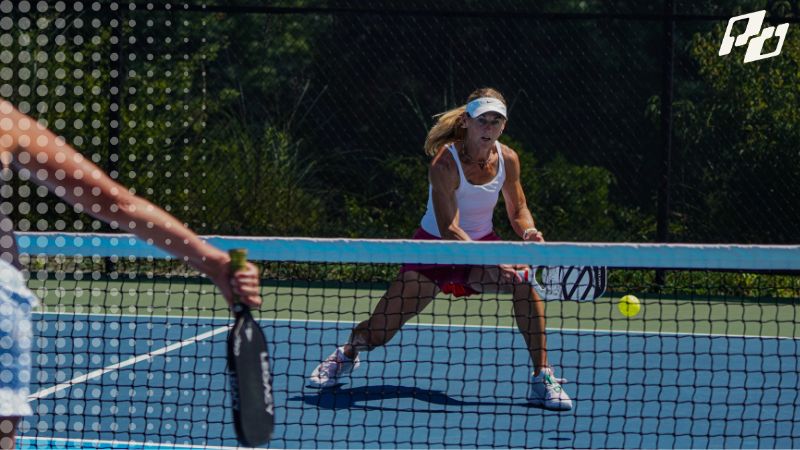
Correct pickleball split-step timing means starting the split just before your opponent hits, landing around contact, then pushing toward the ball. This helps you react sooner, stay balanced, and avoid getting caught moving through the shot.
You know you’re supposed to split step. You even do the little hop.
And yet hard drives still jam you. Passing shots catch you moving. You reach the transition zone and somehow end up hitting resets while falling forward.
The problem may not be your split step. It may be when you’re doing it.
A split step that happens half a beat late doesn’t make you quicker. It can actually leave you airborne while the ball is already coming toward you.
And that tiny timing mistake matters enormously in pickleball, where the distance between opponents can be only 14 feet at the kitchen.
The useful cue is simple: Start the split before contact. Be ready to land as the opponent hits. Then move.
Get that rhythm right and you don’t necessarily become physically faster. You simply stop wasting the first fraction of a second.
The Split Step Isn’t Really About Jumping
Think of the split step as a movement reset, not a hop.
You’re moving forward, sideways or recovering from your previous shot. Then, just before your opponent sends the next ball, you briefly unload and reload both legs so you can push in whatever direction the shot demands.
USA Pickleball describes the split step as a small hop that helps stop forward momentum, regain balance and prepare to change direction. Its coaching guidance emphasizes beginning the hop just before opponent contact so you’re ready to react when the ball leaves the paddle.
That last part is what intermediate rec players often miss.
They think: Opponent hits → I split → I chase.
The better sequence is: Opponent starts hitting → I split → opponent contacts → I read → I push.
That’s a completely different rhythm.
Early, Late and Just Right
Here’s the easiest way to diagnose your timing.
Too Early: You Land Before the Opponent Hits
You hop, land, and then wait.
For a moment you’re ready—but by the time the opponent actually contacts the ball, the elastic benefit of the movement is gone and you may already be leaning or guessing.
This often happens when players split according to where they are on the court rather than what the opponent is doing.
They think: I’m halfway to the kitchen. Time to stop.
But your location doesn’t determine the timing. Opponent contact does.
Too Late: You Start the Split When You Hear the Hit
This is probably the more common mistake. You see the opponent strike the ball—or hear the familiar paddle “pop”—and then jump.
Now the ball has already revealed its direction while you’re still leaving the ground.
By the time you land, you’ve spent valuable time unable to push decisively toward the shot.
The key is to split before your opponent makes contact, rather than waiting until the ball is already on its way.
Correct: Start Before Contact, Land Around the Hit
For rec players, the cleanest practical cue is: Hop on the swing. Land on the hit.
PPA Tour pro and coach Michael Loyd, a former Division I tennis player who turned pro in pickleball in 2023, uses a similar drill: have the hitting partner call “Hit!” at contact and try to synchronize your split-step landing with that cue.
That puts your legs underneath you just as the ball’s direction becomes clear. And here’s where the science gets interesting.
Also, coach John Cincola recently shared a great short video that shows too early, too late, and just-right split-step timing side by side — so you can clearly see what good timing should look like:
What the Research Says About the Exact Timing
There isn’t much direct biomechanical research on pickleball split steps yet, so the best evidence comes from tennis, where the movement serves the same basic purpose: prepare for an opponent’s shot while preserving the ability to move either direction.
A study of collegiate tennis players found that using a split step allowed players to complete a choice-reaction step-and-reach task significantly faster than without one: about 764 milliseconds versus 868 milliseconds on average.
That’s roughly a 104-millisecond advantage in that laboratory task. A tenth of a second doesn’t sound dramatic. At the kitchen line, it can be enormous.
But the study found something equally important: timing affected whether the movement was reliable.
When the landing occurred within an appropriate window relative to the directional signal, players achieved both fast movement and a very low error rate. Mistiming the landing could sometimes produce a fast reaction but made the response less reliable.
So the split step isn’t simply: Jump = faster.
It’s: Correctly timed loading = a faster first move.
There’s a Small Twist to “Land When They Hit”
High-level research gives us an even more precise picture.
A study of world-class tennis players returning fast serves found that players began the split-step movement around racket-ball contact and landed once early information from the ball’s flight became available.
Another analysis covering 8,545 strokes found that split-step timing changed depending on the type of shot and game situation. Players weren’t using one mechanically identical timing pattern for everything.
That’s why “land exactly when they hit” should be understood as a training cue, not a stopwatch rule.
In real play, the sequence is more fluid: Opponent’s swing begins → unload → contact → ball direction appears → land/load → push.
You aren’t trying to consciously calculate milliseconds. You’re training your body to synchronize with the opponent.
The Transition Zone Is Where Timing Matters Most
This is where the split step changes games for 3.0–4.0 players.
Imagine you’ve hit a decent third-shot drop.
You start moving toward the kitchen.
The mistake is thinking: I need to get there as fast as possible.
So you keep charging forward while the opponent volleys your drop. Now their ball arrives at your feet while your body weight is still traveling toward the net. Even a technically decent reset becomes difficult from that position.
Instead:
- Move forward while you have time.
- As the opponent prepares to hit, split.
- Play the fifth shot from balance.
- Then continue forward if the ball allows it.
You might move only one or two steps after the third shot before needing to split, and that’s perfectly fine. Reaching the kitchen quickly is less important than being balanced when the opponent contacts the next ball.
That’s an important mindset shift: The kitchen isn’t a finish line.
You don’t win a prize for arriving first.
Don’t Make the Split Step Too Big
If your split step looks athletic enough for a slow-motion commercial, it’s probably too large.
This is not a vertical jump.
You only need enough unloading to:
- interrupt your momentum
- widen into a stable base
- load the legs
- and make either direction available
USA Pickleball calls it a small hop. Pickleball coaching sources similarly emphasize staying balanced rather than jumping high.
For many 50+ rec players, it can be even subtler.
Think: Light → land → push.
Your heels don’t need to fly six inches off the court.
In fact, if you’re already balanced at the kitchen, the movement may barely look like a hop at all. It can become more of a tiny unload-and-reload of the legs.
Timing matters much more than height.
Just watch how pro player Jorja Johnson uses a seamless split step to stay ready for both the middle and the line — it’s so subtle, you can barely see it happen:
Watch the Hitter, Not the Ball
This is one of the best ways to fix late timing. Many rec players stare almost exclusively at the ball. But once the ball reaches your opponent, you need information from the player who’s about to hit it.
Their preparation tells you when your split should begin.
As their paddle swing develops: unweight.
At contact: land/load.
Then let the incoming ball tell you where to push.
This creates a useful visual trigger rather than asking yourself: Is it time to split yet? The opponent gives you the answer.
The “Hit” Drill Fixes Timing Fast
You don’t need cones, ladders, or a complicated footwork drill. Put one player at the kitchen and one in transition. The feeder hits controlled balls and calls “Hit” at contact.
The moving player focuses on one rhythm: move → split → land
At first, don’t even return the ball. Just match your landing to the feeder’s contact.
Once that feels natural, start playing the ball.
Then make it harder: have the feeder randomly go forehand, backhand, feet, or middle.
Now you’re landing without knowing which direction comes next. That’s the real skill.
Don’t Confuse “Stop Your Feet” With Freezing
You’ve probably heard coaches say: “Stop your feet before you hit.”
Useful advice—but easy to overdo. The goal isn’t to become a statue. The split step should turn forward momentum into directional readiness.
You land.
Read.
Push.
Then move into the ball.
If the shot is wide, you’ll naturally move after the split.
The problem isn’t moving while playing pickleball. The problem is carrying uncontrolled momentum into a ball that demands balance.
Think: Balanced first. Movement second.
Not: Never move while hitting.
How to Know You’re Still Late
You may not notice late split-step timing until you watch yourself on video.
Look for these clues:
- You’re routinely hitting transition balls while drifting forward.
- Hard drives jam your dominant hip even though you saw them coming.
- Your first move after opponent contact is another little hop rather than a directional push.
- You’re often reaching instead of stepping.
- Your paddle preparation is late because your feet haven’t finished organizing themselves.
Or the biggest giveaway: Your opponent hits while both of your feet are clearly off the ground.
Film one transition rally in slow motion. Pause at the exact frame where the opponent contacts the ball.
Ask: What are my feet doing right now?
That single frame can tell you more than ten generic footwork drills.
One Cue Is Enough
Don’t go into your next rec game thinking: Small hop, shoulder width, balls of feet, knees bent, paddle up, watch opponent, land on contact…
You’ll turn a useful movement into a choreography routine.
Use one cue: Land on the hit.
If you’re consistently late, temporarily switch to: Hop on the swing.
That makes you initiate sooner. Once your timing improves, stop consciously managing it. The goal is for the opponent’s hitting motion to trigger your feet automatically.
The Real Payoff Isn’t Faster Feet
This is the part players underestimate. A good split step doesn’t just help you reach more balls. It improves the quality of the ball you reach.
- Instead of stretching for a volley, you’re behind it.
- Instead of stabbing at a transition reset, you’re underneath it.
- Instead of running through a fifth shot, you’re balanced enough to choose whether to reset, counter or attack.
That’s why a correctly timed split step can make pickleball feel slower even though the opponents haven’t slowed down. You’ve simply bought yourself the fraction of a second you used to waste getting organized.
So remember the sequence:
- Move while you can.
- Hop as they swing.
- Land around contact.
- Read the ball.
- Push.
The split step isn’t about becoming quicker after the shot. It’s about being ready before you know where the shot is going.