
Pickleball Union earns a commission on purchases made through links in this article, at no extra cost to you.
The best pickleball for most players is the Franklin X-40. It’s approved for sanctioned play, it’s the ball your local courts most likely already use, and it costs about $2.50 a ball by the case. If you want a faster, firmer ball, the Onix Dura Fast 40 held its stiffness best in independent testing. For winter play, the Selkirk Pro S1 is the ball least likely to crack. On a gym floor or other temporary indoor court, get the Onix Fuse Indoor.
Here’s the twist: every ball cracks eventually. The best independent test we found put the two most popular outdoor balls at about 30 games each before cracking. So the real differences are how a ball plays in its first few games, how it handles the cold, and what you pay per ball.
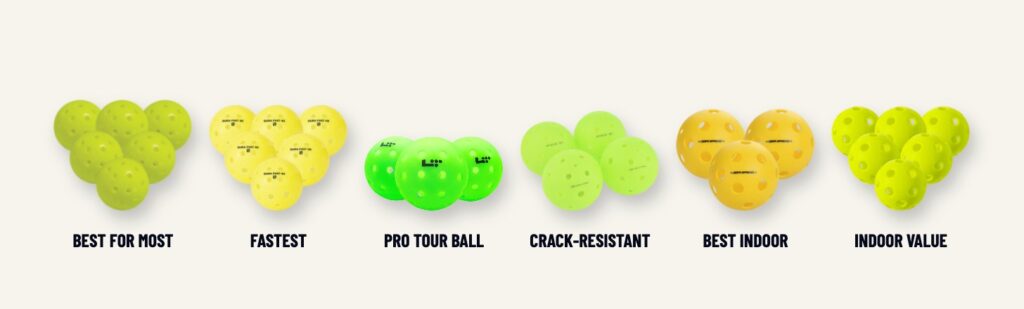
Our picks at a glance
|
Best for most players

|
Fastest and most consistent

|
The pro tour ball
|
Most crack-resistant

|
Best indoor ball

|
Best indoor value
|
| Pick | Best for | Indoor or outdoor | Holes | List price* |
|---|---|---|---|---|
| Franklin X-40 | Best for most players | Outdoor | 40 | 3 for $9.99 |
| Onix Dura Fast 40 | Fastest and most consistent | Outdoor | 40 | 4 for $12.99 |
| Life Time LT Pro 48 | The pro tour ball | Outdoor | 48 | from $12.99 |
| Selkirk Pro S1 | Most crack-resistant, cold weather | Outdoor | 38 | 4 for $15 |
| Onix Fuse Indoor | Best indoor ball | Indoor | 26 | 3 for $9.99 |
| Franklin X-26 | Best indoor value | Indoor | 26 | 12 for $15.99 |
*About prices: these are list prices. Sales and case discounts are common, so check the current price before you buy.
What the pros play in 2026
The pro tours don’t agree on a ball anymore. Here’s who uses what:
| Tour or event | Official ball (2026) |
|---|---|
| PPA Tour | Life Time LT Pro 48 (since Aug 2025, replacing the Vulcan VPRO Flight) |
| Major League Pickleball | Life Time LT Pro 48 (since Apr 2026) |
| APP Tour | Franklin X-40 |
| US Open | Franklin X-40 |
| USA Pickleball Nationals | Franklin X-40 |
| DUPR leagues | JOOLA HC-40 (since Sep 2026) |
Official-ball deals are sponsorships, so treat this as a guide to what you’ll see on TV, not a quality ranking. If your league or tournament names a ball, practice with that one.
What the testing actually shows
Most ball guides are opinions. Two tests have real numbers behind them:
- Pickleball Science measured how stiff each ball stayed as aggressive 3.5 players used it. The Dura Fast 40 started stiffest and lost only 8% of its stiffness over 32 games. The X-40 started softer and softened faster, but it lasted about as long before cracking: roughly 30 games, against 32 for the Dura.
- A ball-cannon test fired each ball 500 times at 50 mph. The LT Pro 48 was the fastest ball and never cracked. The X-40 never cracked either; it just slowed down gradually. The Vulcan VPRO Flight cracked at about 200 hits.
Neither test covered the Selkirk Pro S1. Its case rests on Selkirk’s one-year no-crack warranty and on consistent reports from cold-weather players, and we say so below.
The best pickleballs of 2026
1. Franklin X-40: Best for most players
- Outdoor play
- 26 grams
- 40 holes
- USAPA-Approved
Specs: outdoor, 40 holes, 26 g, one-piece molded construction, approved by USA Pickleball. List price 3 for $9.99. The 100-pack works out to about $2.50 a ball.
Why it’s here: It’s the ball most courts already play. It’s the official ball of the APP Tour, the US Open and USA Pickleball Nationals, and it outsells every other outdoor ball on Amazon by a wide margin. In the cannon test it never cracked, and in game testing it lasted about 30 games. Its softer feel makes dinks and resets a little easier to control, which is why so many rec players prefer it.
Watch out for: It softens as you play, faster than the Dura Fast 40, and it gets noticeably softer in summer heat above about 90°F. Like any hard outdoor ball, it can crack in the cold.
2. Onix Dura Fast 40: Fastest and most consistent
- Outdoor play
- .881 ounces
- 40 holes
- USAPA-Approved
Specs: outdoor, 40 holes, about 26 g, seamless one-piece construction, approved by USA Pickleball. List price 4 for $12.99.
Why it’s here: It’s the stiffest, fastest-feeling ball of the big names, and it keeps that feel the longest. In Pickleball Science’s test it lost only 8% of its stiffness over 32 games. If you play a fast, hard-hitting game and want the ball in game 20 to feel like the ball in game one, this is it. It has been a tournament standard for years, with more than 1,800 reviews at Pickleball Central.
Watch out for: Below about 50°F it cracks more often than the X-40 or Pro S1. That firm feel is also less forgiving on resets.
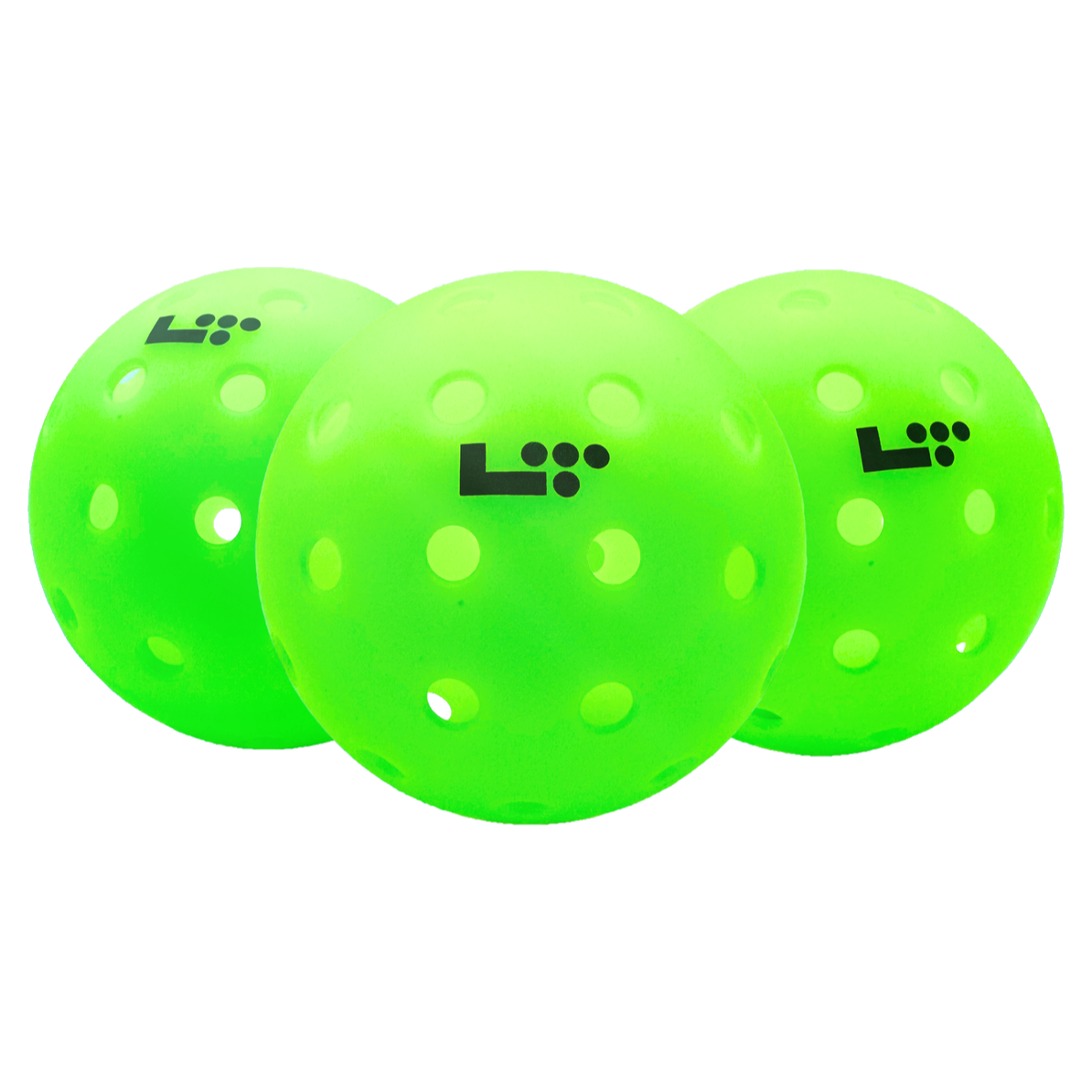
3. Life Time LT Pro 48: The pro tour ball
Outdoor play
26 grams
48 holes
Official ball of the PPA Tour and MLP
Specs: outdoor, 48 chamfered holes, 26 g, two-piece molded construction. List price from $12.99.
Why it’s here: It’s the official ball of the PPA Tour and Major League Pickleball. In the cannon test it was the fastest ball and never cracked. Pros interviewed after the switch called it the most consistent tour ball they’d played, and said one ball now lasts a full match.
Watch out for: Pros say it takes a little less spin. Fewer retailers carry it than the X-40 or Dura. If you play USA Pickleball-sanctioned tournaments, check the approved list before you practice with it.
4. Selkirk Pro S1: Most crack-resistant, best for cold weather
- Outdoor play
- 0.93 oz.
- 38 holes
- USAP-Approved
Specs: outdoor, 38 holes, about 26 g, seamless rotomolded construction, approved by USA Pickleball. List price 4 for $15, and case prices are often much lower.
Why it’s here: It’s the only major ball sold with a one-year no-crack warranty, and cold-weather players consistently report it outlasting the X-40. One group playing at 38 to 42°F cracked three X-40s and no Pro S1s. If you play outdoors from October through March, this is the ball to buy.
Watch out for: No controlled test has measured its crack rate yet, so the evidence is a warranty and player reports. Several reviewers say it goes slightly out of round over time, even when it doesn’t crack.
5. Onix Fuse Indoor: Best indoor ball
- Indoor play
- 26.2 grams
- 26 holes
- USAPA-Approved
Specs: indoor, 26 larger holes, 26.2 g, approved by USA Pickleball. List price 3 for $9.99.
Why it’s here: Indoor balls are lighter and softer, with bigger holes, so rallies are slower and more controllable on gym floors. The Fuse Indoor is the most-reviewed indoor ball at Pickleball Central, with almost 400 reviews, and it’s the indoor pick of other independent guides too. Its bright yellow is easy to see under gym lights.
Watch out for: Use it on gym floors, wood basketball courts and carpet. Most dedicated indoor pickleball facilities play outdoor balls, so check with your club before you buy. Rough courts wear indoor balls down fast, and wind pushes them around.
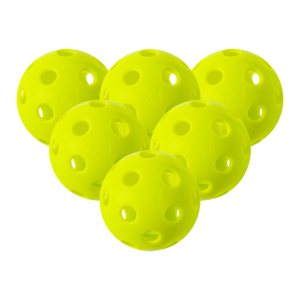
6. Franklin X-26: Best indoor value
- 26 holes
- (3, 12 and 100 packs)
- Blue, lime, peach, yellow, lime green color options
- USAP Approved
Specs: indoor, 26 holes, 26 g, approved by USA Pickleball. List price 12 for $15.99, about $1.33 a ball.
Why it’s here: It’s the indoor partner to the X-40, at about half the per-ball price of most indoor balls when you buy a 12-pack. For clubs, schools and rec centers stocking a bin, that adds up.
Watch out for: It plays a little softer and slower than the Fuse Indoor. If your indoor league uses the Fuse, practice with that.
Balls and paddles go on sale often. Join the free Pickleball Union newsletter for sale alerts on our picks and member-only deals from our brand partners.
Also considered
- Vulcan VPRO Flight: we don’t recommend it. The PPA dropped it in Aug 2025 after a year of pro complaints about warping and uneven bounce, and it cracked at about 200 hits in the cannon test.
- Gamma Photon Indoor: a strong indoor ball with a nice mix of visibility, control and speed. It’s an editor favorite here, and a close call with the Fuse.
- Wilson TRU 32 Pro: 32 holes and a reputation for handling wind well. There’s little independent data on it.
- JOOLA HC-40: DUPR’s official ball since Sep 2026. It’s too new for us to judge yet.
- HEAD Penn 40: the cheapest case on this list at about $2.00 a ball, but we found no durability data on it.
- Selkirk Q1 Quiet: the first noise-reducing ball approved for sanctioned play. Worth a look if your courts get noise complaints.
How to choose a pickleball
Indoor or outdoor first. Outdoor balls have about 40 small holes and are harder and heavier, so they hold up to wind and rough courts. Indoor balls have about 26 larger holes and are softer and lighter, for slower, more controllable rallies on smooth floors. One catch: “indoor ball” means indoor surface, not indoor building. Indoor balls are for temporary courts like wood basketball floors, gym floors and carpet. Most dedicated indoor pickleball facilities have hard pickleball courts that play like outdoor courts, and they use outdoor balls. Watch out for cheap paddle-and-ball bundles on Amazon and elsewhere, too: many of them come with indoor balls. The quickest way to spot a new player at open play is the shiny indoor ball they volunteer for the next game. Using the wrong one makes the game feel off and wears the ball out faster. More on playing pickleball indoors and court surfaces.
Then think about temperature. Every hard outdoor ball gets brittle in the cold. If you regularly play below about 50°F, buy the most crack-resistant ball you can, and keep balls warm in your bag between games. See how long pickleballs last.
Buy by the case if you play often. A 100-pack typically costs about a third less per ball than a 3-pack. If your group plays three or more times a week, a case pays for itself within a month.
Match the ball to your league. If your league or tournament names a ball, practice with it. The difference between a soft X-40 and a stiff Dura is noticeable.
Color doesn’t change how a ball plays. Pick whatever you see best against your court: here are the best pickleball colors, plus our picks for glow-in-the-dark and yellow pickleballs.
What makes a ball tournament-legal
- Diameter: 2.87 to 2.97 inches
- Weight: 0.78 to 0.935 oz
- Holes: 26 to 40, evenly spaced
Balls also have to pass bounce and hardness tests. Before you buy a ball for a sanctioned tournament, check it against USA Pickleball’s approved list.
What our team plays
Outdoors, most of our team plays the X-40 for everyday games. On gym floors, the office is split between the Onix Fuse and the Gamma Photon.
We play-test new balls as they launch. Join the free newsletter to get the results first.
Pickleball FAQs
What is the best pickleball for outdoor play?
For most players, the Franklin X-40. It is approved for tournaments, widely used, and lasted about 30 games in independent testing. For a faster, firmer ball, try the Onix Dura Fast 40. For cold weather, try the Selkirk Pro S1.
What pickleball do the pros use?
In 2026, the PPA Tour and Major League Pickleball use the Life Time LT Pro 48. The APP Tour, the US Open and USA Pickleball Nationals use the Franklin X-40.
How long do outdoor pickleballs last?
Independent testing puts the X-40 and Dura Fast 40 at about 30 games before they crack. Most balls go soft or slightly out of round before that, and cold weather shortens their life.
Which pickleball cracks the least?
The Selkirk Pro S1 comes with a one-year no-crack warranty, and players report it holds up best in the cold. In a 500-hit cannon test, the LT Pro 48 and X-40 did not crack.
Can I use outdoor pickleballs indoors?
Yes. At most dedicated indoor pickleball facilities you should, because their courts are built for outdoor balls. On smooth gym floors, wood or carpet, outdoor balls bounce higher and play faster, so an indoor ball like the Onix Fuse Indoor is easier to control there.
Does pickleball color matter?
Not for performance. Color only affects how easy the ball is for you to see.