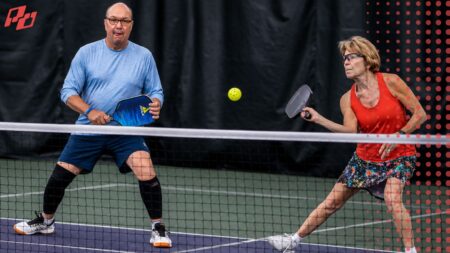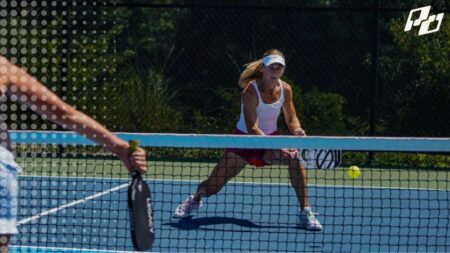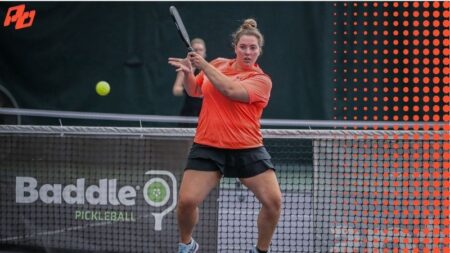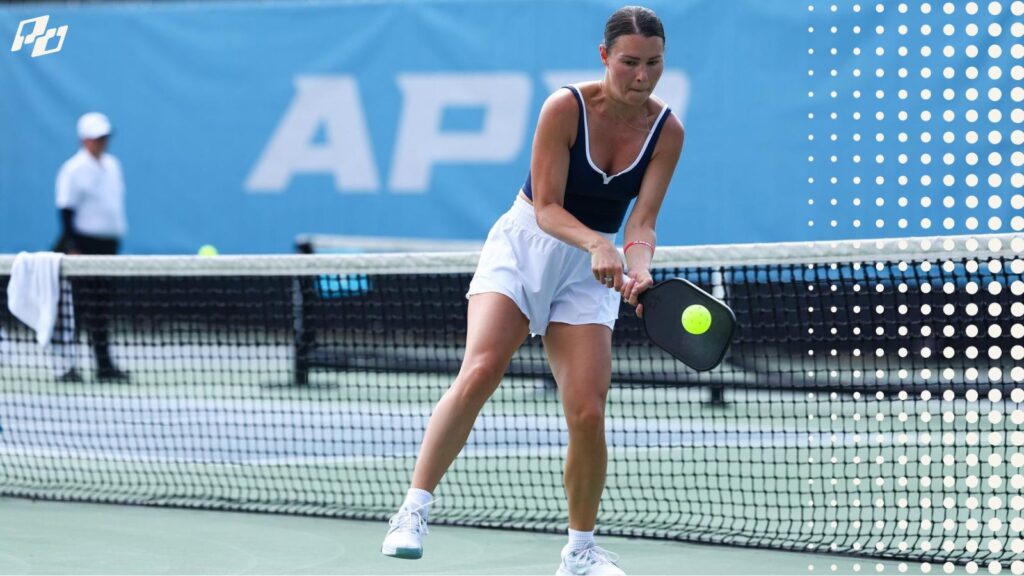
If you look at your target just before contact, better opponents may pick up the tell. Choose your target earlier, then track the ball and keep your setup neutral until the last moment.
Ever feel like your opponent is reading your mind? You see an opening, pick your target, and fire—only to find their paddle waiting there. Sometimes the giveaway happens before your swing even starts.
A quick glance toward the sideline, middle, or backhand hip can tip off a good defender.
The fix isn’t to stop looking at targets. It’s to choose sooner, then keep your setup looking the same until the last moment.
That’s where real deception starts.
First: Are Opponents Really Reading Your Eyes?
Sometimes. But let’s not oversell it.
There is surprisingly little direct scientific research showing how much eye direction alone predicts shot placement in pickleball.
What racket-sport research does show very clearly is that skilled players anticipate shots by extracting information before contact from an opponent’s movement and the situation around it.
In tennis, researchers have shown that experienced players use cues from the racket, arm and other parts of the stroke to anticipate direction. Court position and tactical context also influence those predictions.
And disguise works.
A tennis study comparing expert and novice observers found that disguised strokes significantly reduced anticipation accuracy. In one condition, disguise actually eliminated the experts’ normal anticipatory advantage 40 milliseconds before contact.
So opponents absolutely can read pre-contact information. Your eyes may be part of the package. They just aren’t the whole package.
Think of Your Shot Like a Poker Hand
You don’t need to hide the cards after you’ve played them. You need to avoid showing them before the decision matters. That’s where rec players get this backwards.
They pick a target late.
The ball is approaching.
They suddenly look at the sideline.
Their head turns.
Their shoulders subtly follow.
Their paddle preparation changes.
Then they attack exactly where they just looked. The eyes were not necessarily the only giveaway. They may have started a chain reaction of giveaways.
That’s why the goal shouldn’t be: “Never look at my target.”
It should be: Know the target before the final hitting phase begins.
Once the ball enters your contact window, the target decision should already be made.
Now your job is clean contact.
The Better Sequence: Scan → Decide → Track → Hit
This is the most practical way to train it.
1. Scan
Before the ball reaches you, gather the useful information.
- Where is the opponent’s paddle?
- Are they leaning forehand?
- Is the middle open?
- Has the crosscourt player cheated toward the sideline?
That is when you identify opportunity.
2. Decide
Choose the shot before you need to swing. For example:
- Backhand hip.
- Middle seam.
- Crosscourt dink.
- Behind the moving player.
You don’t need to stare at the destination. You need to know it.
3. Track
Now shift attention back to the incoming ball. One of the risks of trying too hard to disguise your eyes is that you begin looking at opponents or deliberately staring somewhere else while the ball enters your hitting zone.
That’s a bad trade.
Keeping the ball visually organized into the contact zone helps you stay stable through the shot. Peeking toward the target too early can lead to mishits, unstable paddle angles, and poorer contact.
Your disguise isn’t valuable if you fool the opponent and mishit the ball into the net.
4. Hit
Now let paddle face, acceleration and contact produce the direction. The target is already stored. You don’t need another confirmation glance.
Think: See it early. Decide early. Hit late.
That’s a much better deception cue than “don’t look.”
Watch pro player James Ignatowich add deception to his dinks by setting up early and disguising the shot until late:
@jamesignatowichpb How I Add Deception to My Dinks #pickleball #rpmpickleball #jamesignatowich ♬ original sound – jamesignatowichpb
The Best Disguise Is Boring
If your dink and your speed-up look completely different, hiding your eyes won’t save you.
Coaches often teach an advanced speed-up technique called holding the dink: prepare early with a short, compact backswing and delay the forward acceleration so the opponent cannot easily tell whether the ball will remain soft or become an attack.
Senior pro and coach Steve Dawson teaches a similar principle: make the dink and speed-up preparation look alike, then create the attack through late acceleration rather than a giant windup.
That’s the deception hierarchy I’d use:
- Same setup.
- Same posture.
- Same compact preparation.
- Same contact window.
Then change the outcome as late as your control allows. The eyes are the finishing detail—not the foundation.
Watch coach Richard Livornese Jr. break down how to hold your dinks and keep better control at the kitchen:
Here’s the Shot Where the Tell Is Most Obvious
Imagine a crosscourt dink rally. You’ve hit six balls diagonally. Then you see the opponent across from you leaning slightly toward the middle. The line is open.
A typical intermediate player does this:
They decide to redirect.
They glance down the line.
Their torso becomes more upright.
The paddle pulls slightly farther back.
Then they fire.
That is a lot of information. Instead, keep showing the seventh crosscourt dink.
Same stance.
Same paddle position.
Same relaxed tempo.
Track the ball.
Then redirect late.
The redirect isn’t surprising because you looked somewhere clever. It’s surprising because nothing changed until it had to.
Don’t Try the “Look One Way, Hit the Other” Trick Yet
This sounds sophisticated. It often isn’t.
A 3.5 player hears “disguise your eyes” and starts staring crosscourt while trying to hit down the line. Then:
- contact gets late
- the head moves
- the paddle face opens
- and the shot floats wide
You’ve added a deception task before mastering the underlying stroke. That is backwards.
Research on deceptive movement suggests that effective disguise tends to work by preserving believable movement information until relatively late in the action—not merely by providing one obvious fake cue.
So begin with neutrality, not deception. Don’t fake the eyes. Just stop unnecessarily advertising the target. That’s easier and usually more reliable.
Use Peripheral Vision Instead of a Last-Second Peek
This is where better players become difficult to read. They don’t need a hard stare at the opponent’s backhand before hitting there. They already know roughly:
- where the players are
- where the gaps are
- and which target they want
Peripheral vision helps maintain awareness while the central visual task shifts toward the ball/contact area.
Research on racket-sport anticipation suggests expert visual behavior is not simply “stare at one cue.” Skilled performers extract useful information from multiple regions and often organize gaze around areas such as the racket-contact zone while still gathering surrounding information.
For rec players, the practical version is simple:
Scan while you have time.
Track when you need precision.
Don’t try to visually inspect everything at the exact moment you’re striking the ball.
Speed-Ups Are Where This Matters Most
Why? Because surprise buys time. A speed-up your opponent identifies early gives them time to:
- load
- turn the paddle
- shade toward the target
- and counter
USA Pickleball explicitly notes that disguising the speed-up reduces the opponent’s preparation time. And current coaching advice goes beyond the eyes.
Instructor Troy Akin emphasizes keeping grip, paddle preparation and movement consistent because opponents read those changes before the attack.
That’s why the best question isn’t: “Did I look at my target?”
It’s: “What changed when I decided to attack?”
✔ Did your grip tighten?
✔ Did your elbow disappear behind you?
✔ Did your shoulders turn?
✔ Did your knees suddenly load?
✔ Did your eyes lock onto the target?
✔ Did your paddle accelerate earlier than normal?
Any one of those can become the tell.
Try the “Freeze Frame” Test
This is one of the quickest ways to find your own giveaway. Record yourself hitting:
- five crosscourt dinks
- five line dinks
- five speed-ups
Then freeze the video just before the forward swing. Hide the outcome. Could somebody tell which shot is coming?
Look at:
- your head
- your shoulders
- paddle height
- backswing
- stance
- and contact setup
If your speed-up frame looks obviously different from your dink frame, you have a disguise problem before the ball ever leaves the paddle.
This is more useful than simply asking a partner: “Can you read my eyes?”
One Cue Solves Most of It
You don’t want this running through your head during a dink rally: Don’t look there. Keep head still. Same paddle. Watch ball. Peripheral vision. Hide shoulders…
That’s a disaster.
Use one cue: Decide early, show late.
“Decide early” stops the frantic target glance.
“Show late” keeps the preparation neutral.
And once the incoming ball reaches your strike zone, your attention goes back to making clean contact.