Tournament-ready pickleball means more than playing well at open play. You need a reliable serve and return, repeatable patterns, smart shot selection, and the ability to handle unfamiliar opponents, score pressure, and long waits without your decision-making falling apart.
You beat good players at open play.
Your third-shot drop is behaving.
Your hands feel quick.
Your regular group keeps telling you: “You should enter a tournament.”
Maybe you should.
But there is a trap here. Open play tells you a lot about your best pickleball. Tournament play exposes your minimum reliable pickleball.
That’s a different test.
Can you still return deep when you’re nervous?
Can you recognize an opponent’s weakness when you’ve never seen them before?
Can you sit for 35 minutes, get cold, then play a meaningful game immediately?
Can you serve at 9-9 without suddenly guiding the ball?
That is tournament readiness. Not whether you occasionally look like a 4.0 on Tuesday night.
Tournament Pickleball Is an Audit
Your regular group knows you. And you know them.
You know who speeds up middle.
Who hates the backhand dink.
Who never lobs.
Who drives every third.
Without realizing it, you’ve accumulated hundreds of little scouting reports.
Then you enter a tournament.
You know nothing.
One opponent drives everything.
The next barely drives at all.
One has ugly mechanics but never misses.
Another looks technically beautiful and falls apart under pressure.
Coaches Michael O’Neal and Mircea Morariu make this point in their Tournament Prep series: tournaments expose players to unfamiliar opponents, greater pressure, and repeated targeting of weaknesses in a way ordinary rec play often doesn’t.
That changes your job. You can’t arrive with only a game plan. You need a diagnostic process. During the first few points, notice:
Who handles pace better?
Who struggles with low balls?
Who takes the middle?
Does either player avoid a backhand?
What happens when you make them hit one more ball?
Don’t spend half the game proving your favorite pattern works. Tournament margins are too small for that.
Your Tournament Floor Matters More Than Your Ceiling
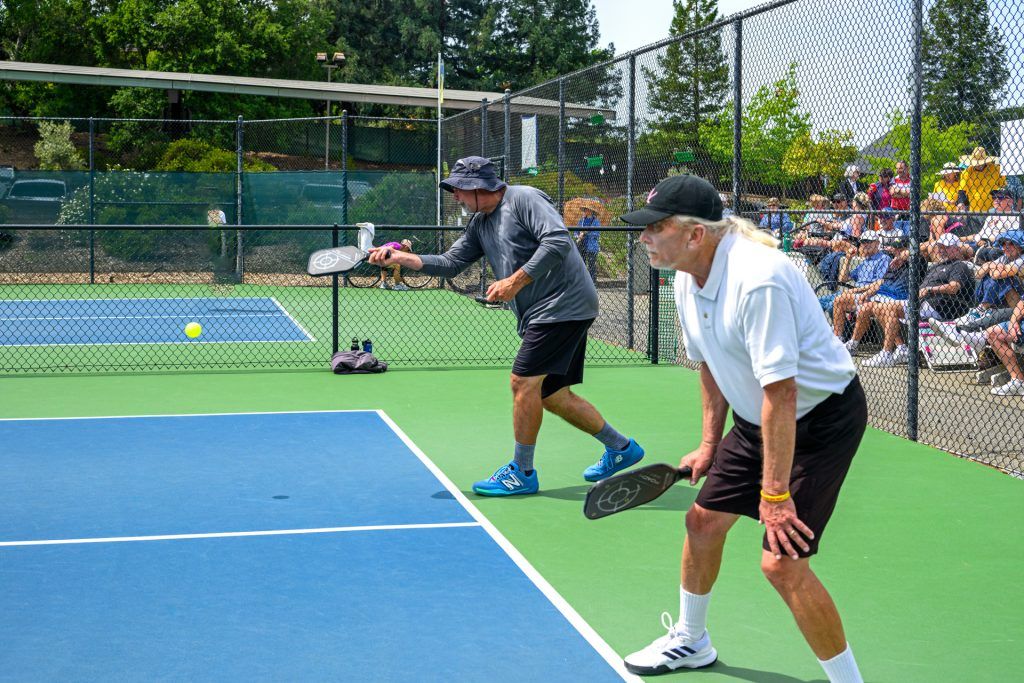
This may be the biggest difference. At open play, your spectacular points are memorable.
The ATP.
The perfect speed-up.
The ridiculous reset.
Tournament matches are often decided by something much less exciting: Who gives away fewer cheap points?
Tanner Tomassi recently recommended beginning tournament play with controlled third-shot drives around 70% power, partly because nerves can make more delicate third-shot drops less reliable early. The exact shot choice won’t fit every player, but the principle is excellent: Start with something you trust.
For a beginner or intermediate tournament player, your useful floor might be:
- a serve you make nearly every time
- a deep return with margin
- a third shot you trust
- a reset you can put somewhere safe
- and a clear rule about which balls you will not attack
That’s enough to compete.
You don’t need your highlight reel. You need the version of your game that survives nerves.
Pressure Usually Changes Something Small First
Players imagine tournament nerves as shaking hands and panic. Sometimes. More often, they show up quietly.
Your grip gets a little tighter.
Your legs straighten.
Your serve swing gets shorter.
You guide the return instead of swinging through it.
You attack a yellow-light ball because you want to “make something happen.”
Or you do the opposite and stop attacking obvious green-light balls.
Players who are aggressive and decisive in rec play become strangely passive in competition, or suddenly choose shots they normally wouldn’t.
So don’t ask: “Am I nervous?”
Ask: “What changes in my game when I care about the score?”
That answer is more useful.
Don’t Practice Calm. Practice Caring.
This is where normal tournament preparation often misses.
Players drill drops for an hour.
They play three rec games.
Then assume those skills are ready for 9-9.
Sport psychology suggests that isn’t guaranteed. A 2025 review examined 22 studies of pressure training and found broad support for progressively exposing athletes to pressure and competition-like conditions so coping and skill transfer can improve. The researchers identified 92 different ways pressure had been introduced in training.
You don’t need a sport psychologist and a laboratory. You need points that matter a little. Try this.
Start at 8-8.
No warm-up rally.
Play to 11.
Loser sits five minutes.
Or play a best-of-three series with the same pair and record the result.
Or make the losing team buy coffee.
The consequence should be harmless. The point is simply to notice what happens when you care.
Do you stop swinging?
Speed up?
Become cautious?
Argue with yourself after errors?
That’s valuable information.
The First Four Shots Should Become Boring
Tournament readiness starts before the sexy part of the rally.
- Serve.
- Return.
- Third.
- Fourth.
If those four shots become unreliable under pressure, your beautiful kitchen game doesn’t get much opportunity to matter.
A useful tournament-prep session should therefore contain a lot of starting points cold. Not 15 minutes of cooperative dinking followed by games.
Instead:
✔ Serve
✔ Return
✔ Third
✔ Play it out
Then immediately start again. Why?
Because tournament matches repeatedly ask you to execute the opening sequence without ten warm-up repetitions first.
You are training the ability to find your game quickly.
Then There’s the Problem Open Play Rarely Recreates: Waiting
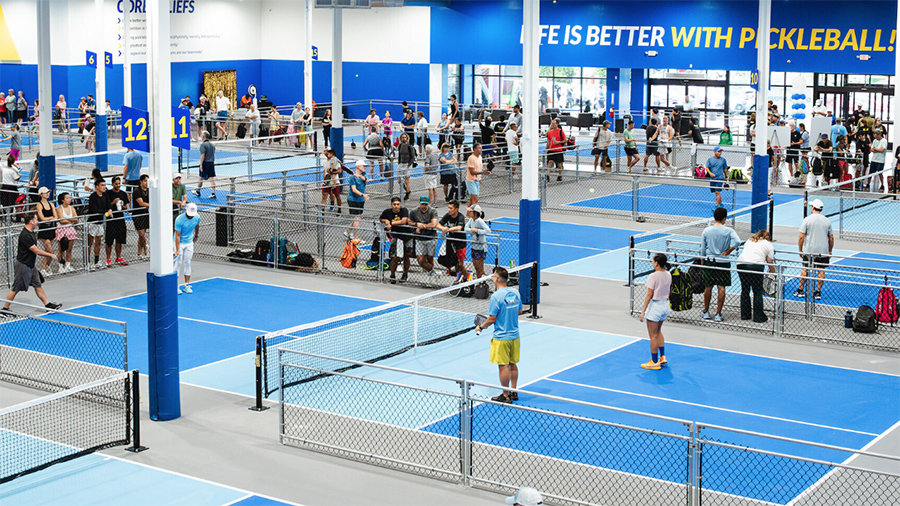
Tournament rhythm can be terrible.
Play.
Sit.
Play.
Wait for another bracket.
Get hungry.
Watch somebody else’s match.
Start thinking.
Play again.
Waits occur naturally because later matches depend on earlier results. Expect waits of 30–60 minutes or longer at some events.
That creates a skill almost nobody practices: Getting ready twice. Or five times.
You warm up in the morning.
That’s Warm-Up No. 1.
Then you sit for 40 minutes.
Now your next match needs another mini warm-up.
Not necessarily court time—you may not have a spare court.
But you can:
- walk briskly
- do lateral movement
- wake up your legs
- move the shoulders
- take practice swings
- and mentally rehearse your first two patterns
Tournament recovery guidance also emphasizes that same-day events involve repeated high-intensity bouts separated by variable recovery windows, making between-match recovery part of performance rather than dead time.
Don’t spend a 45-minute break becoming furniture.
You Need a “Cold Start” Routine
Here’s something I’d test before your first event.
Sit for 20 minutes.
No hitting.
Then walk onto the court and play a game that starts at 7-7.
You’ll learn quickly whether your normal game requires three games to wake up. Your cold-start routine might be only three minutes:
30 seconds: brisk movement.
30 seconds: split steps and lateral shuffles.
30 seconds: paddle swings and volleys without a ball.
30 seconds: visualize your serve and return targets.
60 seconds: tell your partner the opening plan.
Simple.
Repeatable.
That’s much more useful than hoping the tournament gives you a warm-up court.
New Opponents Require Fast Scouting
Open-play familiarity can make players think they are better tacticians than they actually are. You already know your friends. Tournament scouting starts from zero.
I like using the first five rallies as information gathering. Not throwing points away. Just observing.
On serve
Standing well behind the baseline? Serve deeper.
Hugging the line? Test depth.
On return
Who gets uncomfortable when pushed back?
At the kitchen
Who resets better?
Who counters better?
Who reaches instead of moving?
Under pressure
Who speeds up when impatient?
Who retreats?
Who abandons the crosscourt dink?
By 3-3, you should know something you didn’t know at 0-0.
That’s tournament intelligence.
Expect Them to Find Your Weakness
This part surprises first-time tournament players. Your regular friends may know you struggle with backhand returns. But they’re also working on their own game.
Maybe they want to practice serves wide.
Maybe they want to dink.
Maybe nobody wants to be obnoxious and hit your backhand 15 consecutive times.
Tournament opponents have a different incentive. If something works, they may keep doing it.
Again.
And again.
And again.
That’s why tournaments can be such useful feedback. They expose the weakness your normal games have politely allowed you to hide.
After a match, don’t write: “My backhand sucked.”
Write: “They served deep to my backhand 11 times and I gave them four short returns.”
Now you have something to practice.
Don’t Change Your Identity at 8-8
Pressure creates two opposite kinds of player.
The hero
Suddenly tries to win every rally immediately.
The passenger
Stops hitting anything assertively because they’re terrified of missing. Neither is your normal game.
Pro player Christian Alshon has spoken about staying prepared and emotionally neutral rather than letting the importance of the moment dominate the next point.
For rec competitors, a simpler version is: Make the same decision at 9-9 that you would make at 4-4.
Not the same result.
The same decision.
Green ball?
Attack it.
Bad ball?
Reset.
Good dink?
Stay patient.
Don’t suddenly rewrite your shot-selection rules because the scoreboard got interesting.
Give Your Brain One Job
Pressure encourages mechanical thinking.
Don’t miss.
Keep the wrist firm.
Bend your knees.
Watch the ball.
Follow through.
That’s a lot of instructions while somebody is hitting a pickleball at you.
A 2026 meta-analysis of interventions for choking under pressure found that approaches including pre-performance routines, self-talk, mindfulness and attentional-control strategies can improve sport performance under pressure, although effects were less consistent in dynamic open-skill sports—which pickleball resembles more closely than a closed skill like a free throw.
So keep your cue simple.
For a return: “Deep middle.”
For transition: “Low and forward.”
For dinking: “Make them hit up.”
One external job.
Your Partner Needs a Tournament Version Too
Don’t wait until you’re losing 2-7 to discover how your partner handles stress. Before the event, decide:
✔ Who takes middle balls?
✔ What happens if one player is being targeted?
✔ When do you use a timeout?
✔ What does your partner want to hear after two errors?
✔ What absolutely annoys them?
One player wants: “Forget it, next point.” Another wants silence. Find out before Saturday.
Tournament doubles isn’t just two games surviving pressure. It’s two nervous systems sharing a court.
The Tournament-Ready Test
Before you register—or at least before tournament weekend—try this once.
- Play unfamiliar opponents if possible.
- Start every game at 5-5 or 8-8.
- Keep the score seriously.
- Sit 15–20 minutes between two games.
- No experimenting with new shots.
Track only four things:
- serves missed
- returns missed
- third/fourth-ball errors
- bad attacks
Then ask:
Did my decisions still look like me?
Did my mechanics tighten?
Could I restart after sitting?
Could I identify what the opponents were doing?
Could my partner and I adjust?
That tells you more about tournament readiness than whether you won four straight games at open play.