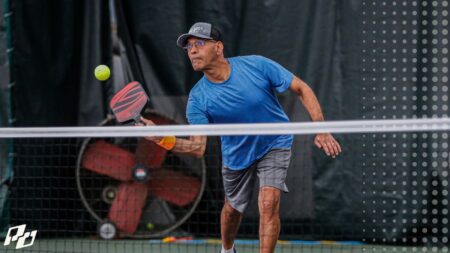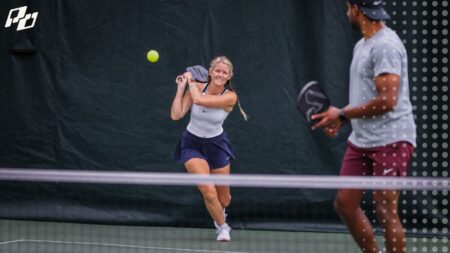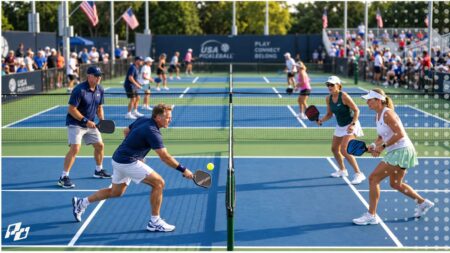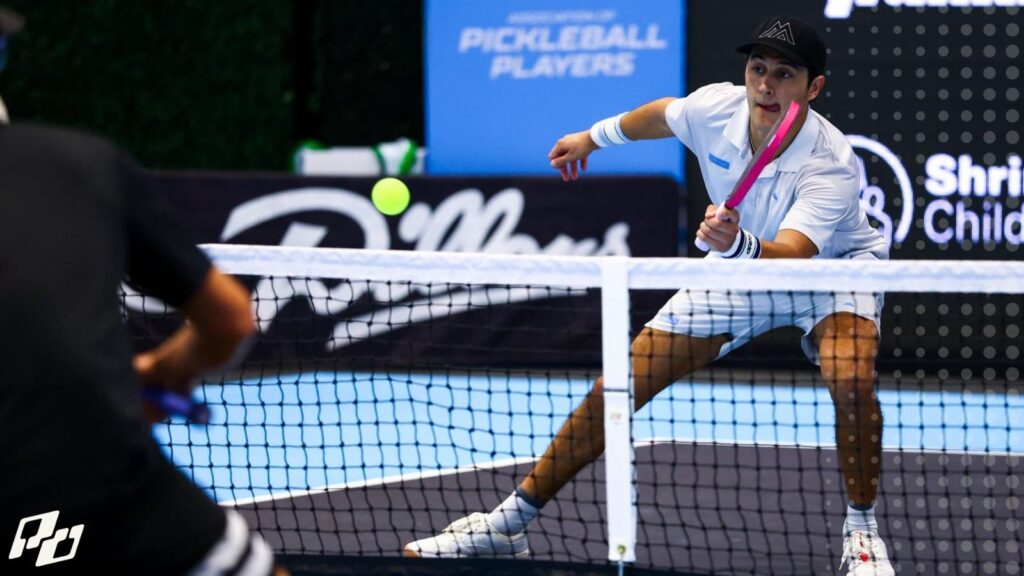
Body speed-ups are easier to defend when you read the attack early, create a little space, and meet the ball in front. The goal isn’t faster hands—it’s avoiding the jam with better positioning, balance, and a compact counter.
There’s a particular kind of speed-up that makes intermediate players feel helpless.
You’re at the kitchen.
The dink looks harmless.
Then suddenly the ball is coming directly at your hip, shoulder, or chest.
You don’t have room to swing.
You don’t know whether to use forehand or backhand.
And by the time you decide, the ball is already behind your paddle.
Most players come away thinking: “I need faster hands.”
But after looking at how coaches and high-level players handle these attacks, there’s a more useful way to think about it: Don’t try to react faster. Create a better contact window before the ball gets to you.
That’s the real skill.
The attacker is trying to remove your space. Your job is to quietly put that space back.
Body speed-ups are frequently aimed at awkward zones such as the dominant shoulder and hip, and one counter is to slide the body away so the ball can be contacted in front instead of getting trapped inside the body.
That changes the whole problem.
You’re no longer thinking: “How do I block this missile?”
You’re thinking: “Where do I need my body so this becomes a normal volley?”
Start Reading the Attack Before the Ball Leaves the Paddle
The best body defense often starts before contact. At the kitchen line, good players usually don’t announce a speed-up with a huge backswing. The useful clues are subtler:
- a little more shoulder or torso commitment
- a firmer-looking setup
- the paddle accelerating earlier
- the contact point moving slightly farther in front
- the hitter’s weight beginning to drive through the ball
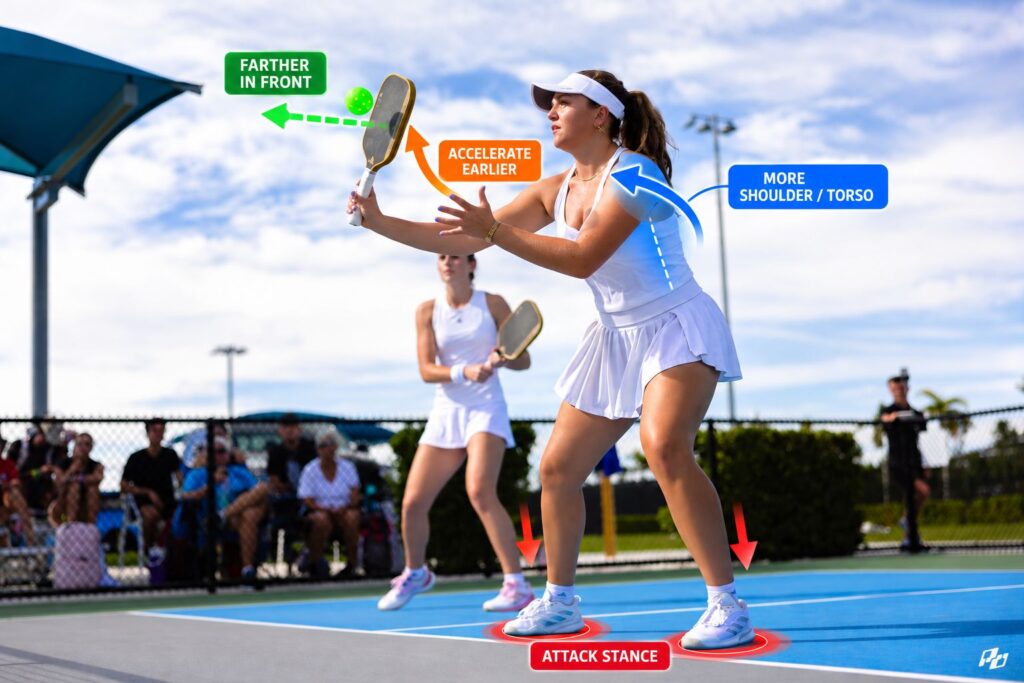
The idea is not to guess the exact target. It’s to recognize that the opponent has shifted from soft-ball mechanics to attacking mechanics.
At kitchen distance, that tiny early read matters because waiting until the ball is already flying at your hip or shoulder leaves almost no time to create space.
Think: read the hitter → prepare for pace → then solve the target
Not: see the ball → panic → react late
You’re simply changing from dink-ready to counter-ready a fraction earlier. That fraction is often enough to turn a jammed body ball into a playable counter.
The Sneaky Fix: Move Your Body, Not Just Your Paddle
Suppose the ball is coming at your paddle-side hip. Most rec players try to solve the entire problem with their hand.
They pull the paddle inward.
They jam the elbow against the ribs.
They flick.
They panic.
The better solution may be a tiny body adjustment. It’s called a slide or fade: push laterally just enough to move your torso away from the incoming ball, creating a clean contact point in front of you.
This is subtle. You are not running away from the ball. You’re moving six inches of body so you can create twelve inches of paddle space. That is a much more useful way to defend body attacks.
Think: Move the jam zone away from your body.
If the attack is arriving into your right hip, a small shift can turn: cramped body ball into an ordinary backhand counter.
Here’s how to do it:
Your Chest Position Can Remove the Guess
After you dink, position the center of your chest roughly behind where your dink lands. Why? Because if the opponent attacks hard through that same lane, you’re already positioned behind the likely speed-up.
And if they try to redirect too sharply outside that lane, they may be flirting with the sideline.
This is a very different philosophy from: “Stand still and react to everything.”
Your previous shot gives you information about what can happen next. If you dink wide, your defensive position should change. If you dink middle, it changes again.
The better question after your dink is: “Where is the most natural hard ball from here?”
Then organize yourself around that lane. You’re not predicting perfectly. You’re reducing the number of reasonable answers.
@tanner.pickleball Do you struggle with handling speed-ups? ☄️💨 👉 Get the center of your body in front of where the ball bounces on their side. 👉 This takes away the angles and makes them have to attack ‘through’ you. #pickleball #pickleballtiktok #pickleballislife #pickleballrocks #pickleballaddict #pickleballtournament ♬ original sound – Tanner.pickleball
Not Every Body Ball Should Be Defended the Same Way
This is where “keep your paddle up” becomes uselessly vague. Different body targets create different problems.
1. Ball into the chest
For many players, this can actually be a comfortable backhand punch if the paddle is already centered.
A speed-up directly into the body backhand can be an easier countering position for many players—which is one reason attackers are often taught to avoid feeding that exact zone.
So if the ball comes into your chest and you already have the paddle there: don’t manufacture movement.
Compact block or counter. Let their pace work for you.
2. Ball into the paddle-side hip or shoulder
This is the nasty one.
The attacker is trying to put the ball where neither a full forehand nor a clean backhand fits. That’s when the small slide becomes valuable.
Create enough separation between your torso and paddle so you can contact the ball in front, rather than letting it bury itself beside you.
Cue: Space first. Counter second.
3. Ball crossing your body
This is where many players panic and switch paddle sides too late.
Give yourself space, especially when you know an opponent loves the speed-up, and allowing the body to open so the cross-body ball can be played inside-out rather than getting trapped.
That creates an interesting offensive possibility too.
If your crosscourt opponent is shading toward the middle expecting your defensive counter, the inside-out reply can sometimes send the ball behind them:
@richard_pickleball The Cross Body Speed Up! ⭐️ When players get chicken winged on the left side, this is the fix ⭐️ Instead of fighting it, continue with the ball path — this lets you cover more with your backhand and stay aggressive ⭐️ Extend your arm toward the cross court player — that’s what allows you to handle and counter heavy speed ups 🔥 Comment “HYPE” and I’ll DM you a discount on all Engage products! 🔥 ….. #pickleballislife #pickleball #pickleballtips #pickleballcoaching #propickleball ♬ original sound – Richard_pickleball
So the goal isn’t merely survival. A well-handled body ball can become your counterattack.
Should You Back Up?
Sometimes. But this needs nuance.
Backing away from the kitchen every time someone looks aggressive creates a different problem: now they have more court to work with, more time to dip the ball at your feet, and you’ve surrendered your best position.
On the other hand, if you’ve floated a dink, are already leaning or reaching, or know an opponent is about to unload from a strong forehand, a small step back can buy meaningful reaction time.
Think of backing up as a specific defensive adjustment, not your default ready position.
If you are balanced and the incoming attack is ordinary: hold your ground.
If you are already compromised and the opponent has a clear green light: buy yourself a little space.
Stop Trying to “Win” the First Counter
A body speed-up is already arriving fast. You do not need to add another heroic swing. That is how hands battles turn into chaos.
At close range, compact mechanics matter more than generating your own pace. You need a stable base, paddle out in front, and short jab-like actions rather than large swings. This is especially important when you’re jammed.
Big swing = more paddle travel.
And more paddle travel is exactly what the attacker is trying to deny you.
Think:
catch the pace
rather than
create more pace
If you can redirect their attack down, through the middle, or into an awkward lane, you may get the next attackable ball.
Watch Pickleball Union’s coach Marco show why better kitchen defense starts with balance, quiet feet, and compact blocks—not faster hands:
The Elbow Is Often the Hidden Escape Hatch
Here’s another small technical detail that can change body defense. When a ball comes straight toward your torso, don’t glue your hitting elbow against your ribs.
A useful technique is to create a little space with the elbow rather than making a big foot adjustment once the ball is already on you.
That’s a good distinction:
early read → body can move
late read → elbow creates space
If you notice the attack early enough, slide. If you’re already late, don’t attempt a dramatic dodge.
Clear the elbow and make the smallest possible contact.
A Better Drill Than “Hit Balls at Me”
If you want this to transfer into games, don’t simply stand at the kitchen while your partner fires twenty balls at your chest. You already know they’re coming. The difficult part is recognizing when dink becomes attack.
Try this instead.
Dink normally. Your partner can speed up any ball they believe is attackable. Your only job is to notice the preparation and call: “Attack.”
Ideally, call it just before their contact. Then play the point. Once that gets easier, add a second layer:
When you recognize the attack, deliberately choose between:
- hold
- slide
- small step back
depending on your balance and where their attack is coming from.
Now you’re training the real skill: recognition → positioning → counter
rather than just hand speed.
The Cue I’d Keep
When somebody keeps jamming you, don’t tell yourself: “Hands up.” That doesn’t solve enough.
Use: Read. Make space. Meet it in front.
- Read the attack from their preparation.
- Make space with a tiny slide, elbow adjustment, or occasional step back.
- Meet it in front before the ball collapses into your body.
Because the best body-ball defenders aren’t necessarily reacting faster. They’re quietly turning an awkward ball into a normal one before they ever have to hit it.