Eyesight matters more in pickleball than many rec players realize. Clear vision helps with ball tracking, timing, depth, contrast, and line calls. If you normally need glasses or contacts, playing without them can make the game harder. For protection, use impact-rated sports eyewear, not ordinary glasses.
Most rec players will spend $200 on a paddle without hesitation. But ask them when they last updated their prescription and the answer is often: “Uh… I can still see fine.” That may be good enough for driving, reading menus, or watching TV.
Pickleball is different.
The ball is small, moving quickly, changing depth constantly, crossing backgrounds, bouncing unpredictably, and sometimes reaching you from only a few feet away.
Research on pickleball vision specifically identifies visual acuity, dynamic visual acuity, and contrast sensitivity as important to performance. In plain English: you need to see clearly, track a moving ball clearly, and distinguish that ball from the background quickly.
And that leads to a question rec players rarely ask: If your vision isn’t perfectly corrected, does wearing your prescription actually make you play better?
For many players, yes—it can make a very real difference.
A Slightly Blurry Ball Is Still Playable. That’s the Trap.
Poor vision in pickleball usually doesn’t feel dramatic. You don’t suddenly lose the ball completely. Instead, things become slightly less precise. You read the bounce a fraction later.
A fast ball looks a little softer until it suddenly isn’t.
You misjudge how quickly a dink is dropping.
The baseline becomes slightly less distinct.
The ball blends into a bright wall, cloudy sky, fence or indoor background.
You still play. You just start calling the errors:
- bad timing
- slow hands
- poor footwork
- late preparation
when part of the problem may simply be that your brain received less precise visual information.
The International Olympic Committee’s sports-vision consensus places basic visual acuity and contrast sensitivity at the foundation of the visual process athletes use to judge depth, make decisions and coordinate movement. That matters even if you’re playing Wednesday rec games instead of a PPA final.
Your brain still has to solve the same problem: Where is the ball going, when will it arrive, and where should my paddle meet it?
Yes, Your Prescription Can Matter in Rec Play
Suppose you normally wear glasses for distance but sometimes play without them because:
“They’re annoying.”
“I can see well enough.”
“It’s only open play.”
The court does not suddenly become less demanding because the score isn’t going into DUPR.
A prescription that sharpens your distance vision can help you see the opponent’s paddle, ball trajectory, court lines and changing depth more clearly.
For players who need correction, properly fitted glasses or contacts are not really “extras.” They are part of getting the visual system back to its best baseline.
The AOA notes that appropriate refractive correction—through glasses, sport-specific eyewear or contact lenses—can reduce problems from blur and glare and may improve visual performance in sports settings.
That doesn’t mean updating your prescription instantly gains half a rating point. It means you stop asking your timing and coordination to compensate for blurry input.
That’s a much more reasonable expectation.
Contacts Can Be Excellent for Pickleball
For some players, contacts are especially convenient on court. The National Eye Institute notes that contacts stay in place during activity, preserve peripheral vision, and don’t fog the way glasses can.
Those are real advantages in pickleball. You’re constantly using peripheral vision to sense:
- your partner
- the opponent shifting
- the open middle
- and movement around the kitchen
Contacts also eliminate frame edges from your field of view. And if you play outside, you can pair them with good non-prescription sunglasses.
But there is an important catch: Contacts do not protect your eyes from a pickleball.
Neither do ordinary prescription glasses.
Prescription Glasses Are Not the Same as Protective Sports Eyewear
If you need vision correction, you want clear vision. But pickleball also adds another job: protecting your eyes from impact.
Regular prescription glasses, sunglasses, and contacts may help you see better, but they are not automatically designed to protect against a hard pickleball or paddle impact.
We’ve written several times about the rise in pickleball-related eye injuries, so this is one area where the certification really matters.
Look for an actual sports-impact standard—not just words like “shatterproof” or “sports glasses.”
ASTM F803 is the standard most sports eyewear is rated to. ASTM F3164 is a related standard written specifically for racquet sports, including pickleball, though it’s less commonly seen on eyewear currently marketed to pickleball players.
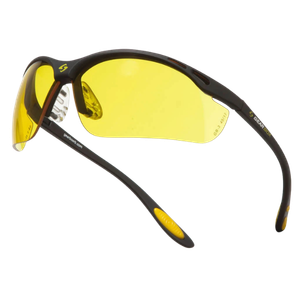
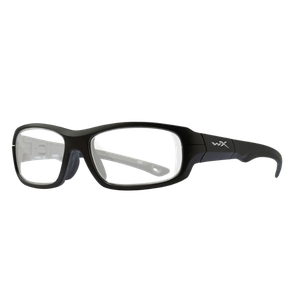
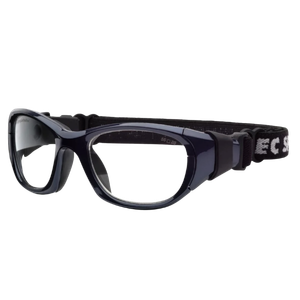
The 3 Pickleball Glasses We’d Trust With Our Eyes
|
|
|
|
Pros:
|
Pros:
|
Pros:
|
- ASTM F803 impact protection
- Anti-fog lenses
- Anti-scratch coating
- UV400 protection
- ASTM F803 impact protection
- Shatterproof polycarbonate lenses
- Prescription-ready
- Adjustable sports strap
- ASTM F803 impact protection
- Prescription-ready
- Helmet-compatible fit
- 100% UV protection
1. Gearbox Vision: Our top pick. ASTM F803-rated, with strong impact protection and a lightweight pickleball-friendly design.
2. Wiley X Gamer: Rated to ASTM F803 + ANSI Z87.1+, with an optional strap for a more secure fit.
3. Rec Specs Maxx 31: ASTM F803-rated, prescription-ready, padded, and strap-secured—especially useful if you need vision correction.
The key takeaway: Seeing clearly is one job. Protecting your eyes is another. Ideally, your eyewear does both.
What About Prescription Sunglasses?
For outdoor players, these can make a lot of sense. Bright sunlight creates another visual problem: glare.
If you’re squinting into the sun, losing the ball against a bright sky, or struggling when one side of the court is shaded and the other isn’t, good sunglasses can make the game visually more comfortable.
The AOA recommends sunglasses that block 100% of UVA and UVB, and for potentially hazardous outdoor sports it favors impact-resistant materials such as polycarbonate or Trivex.
If you need a prescription, that can be built into appropriate sport eyewear. But don’t fall into the trap of thinking darker is always better.
A lens that is too dark can make the ball harder to pick up once you move into shade or play under mixed lighting.
For pickleball, clarity and contrast matter more than looking cool.
The Weirdest Clue: You Play Worse on Certain Courts
Here is where rec players can actually diagnose this themselves. Pay attention to whether your game changes depending on:
- indoor vs outdoor
- bright sun vs cloudy conditions
- dark fence vs light wall
- yellow ball vs orange ball
- daylight vs evening lights
If you consistently say: “I just don’t see the ball well in this gym.” Believe yourself.
Contrast sensitivity is your ability to separate the ball from whatever is behind it. USA Pickleball specifically recommends choosing a ball color that contrasts strongly with the court surface; the more contrast, the quicker the eye can pick up the ball.
So there is no single “best” ball color for every court.
Outdoors, bright optic yellow or neon yellow-green is usually the safest starting point and yellow is the most popular outdoor color. But on a yellow-green or very light court, orange can be easier to track because it creates more separation.
Indoors, bright lime/optic green, yellow, or orange tend to work well, but the walls and floor matter just as much as the lighting. A lime ball can disappear against a green floor or curtain, while orange may pop beautifully against blue or green surfaces. Indoor balls are sold in several high-visibility colors for exactly this reason.
A simple rule:
Blue/green court → try yellow or orange.
Yellow/light court → try orange or a contrasting bright color.
Dark indoor background → bright yellow, lime, or orange usually works best.
Avoid a ball that closely matches the court, walls, curtains, or even surrounding foliage.
And conditions can change the answer. One outdoor group reported orange was easiest to see on their courts until autumn leaves made it blend into the background.
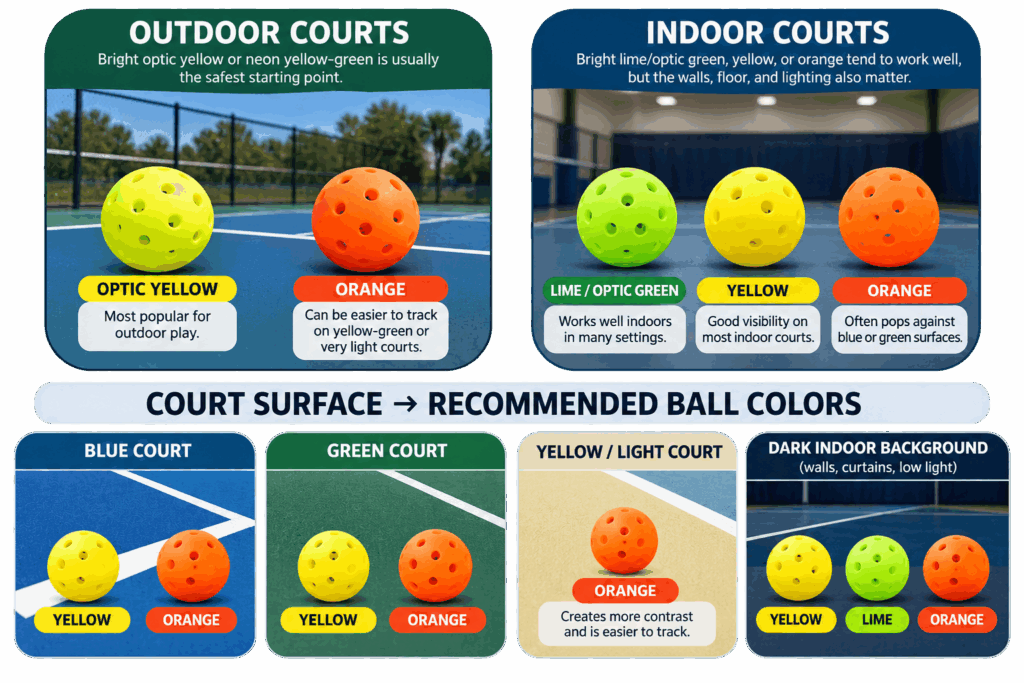
That is the real point: visibility is about contrast, not loyalty to one ball color.
This can become more noticeable with age, even when ordinary eye-chart vision still seems decent. So if your timing suddenly gets worse on one court, at dusk, or under bad indoor lighting, don’t immediately rebuild your forehand.
Try a different ball color first.
Should You Try a New Prescription Right Before a Tournament?
Probably not. This is a small point, but a useful one.
A change in glasses or contacts can initially alter how distance and depth feel while your visual system adapts.
Sports-vision guidance from the AOA specifically recommends trying a new correction during practice before introducing it in competition, especially after a significant prescription change.
So if new glasses arrive Friday and your tournament is Saturday morning: test them first.
Hit returns.
Dink.
Track lobs.
Move through the transition zone.
Make sure the court looks normal before you put your entry fee on it.
A Simple Rec-Player Test
If you’re wondering whether your eyesight is affecting your pickleball, ask yourself:
Do I sometimes lose the ball against certain backgrounds?
Do fast balls seem to “jump” on me unexpectedly?
Do I struggle more at dusk or indoors?
Do I find myself squinting?
Do line calls become noticeably harder from one side of the court?
Do I wear a prescription normally but skip it for pickleball?
Has it been a long time since my vision was checked?
One “yes” doesn’t prove you have a vision problem. But several of them are a pretty good reason to stop blaming your paddle and get your eyes checked.
So What Should a Rec Player Actually Wear?
If your eyesight needs correction, the best solution depends on what feels comfortable and what your eye-care professional recommends.
A few common setups make sense:
Contacts + impact-rated sports eyewear
Good peripheral vision, no prescription frame, plus actual eye protection.
Prescription sports eyewear
Correction and protection combined.
Prescription sports sunglasses
Useful outdoors when they provide the correct prescription, UV protection and suitable impact resistance.
What I’d avoid assuming is enough:
❌ ordinary fashion sunglasses
❌ regular everyday glasses
❌ contacts alone
Those may correct vision or reduce glare, but they are not automatically designed to protect your eyes from a ball or paddle impact.
The Bigger Point
A paddle can only react to the information your eyes give your brain. If that information is slightly blurry, late or low-contrast, your hands don’t get an exemption. They still have to make the shot.
That’s why vision correction isn’t just an “eyesight issue.” For a pickleball player, it can affect:
- timing
- ball tracking
- depth judgment
- line calls
- reaction
- confidence
And yes, that matters even at Saturday open play.
So if you normally need prescription glasses or contacts but leave them in the car because pickleball is “just recreational,” you may be making the game unnecessarily difficult.
Your next equipment upgrade might not be another paddle. It might simply be seeing the ball as clearly as you’re supposed to.