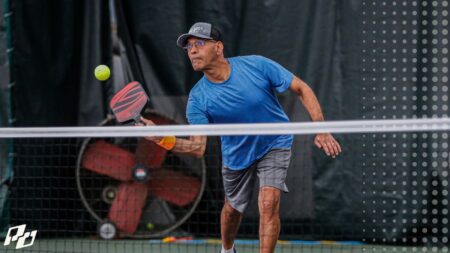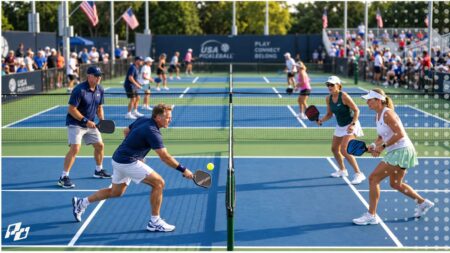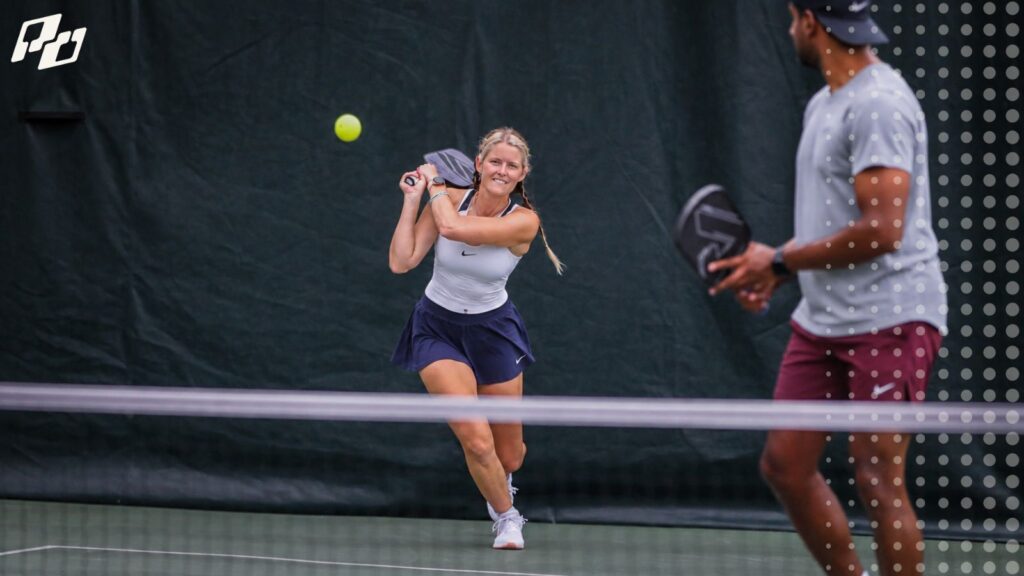
Players who sprint to the kitchen without split-stepping are often vulnerable side to side. Instead of always hitting at their feet, keep the ball low and move it outside their forward path. The goal is simple: make them brake, change direction, and hit off balance.
A lot of 3.0–3.5 players learn the same rule: hit your drop, then get to the kitchen. The problem is that many interpret that as: run forward as fast as possible.
That creates a very specific weakness.
If a player is still charging forward when you contact the next ball, they may actually be comfortable handling something hit straight at their feet. Their momentum is already carrying them toward it.
Ben Johns recently highlighted the better response: make that player change direction. Instead of feeding the path they’re already running, keep the ball low and move it to the side.
In this article, we’ll break down how to recognize the runner, when to go wide instead of at the feet, why the split step changes everything, and how to use their momentum against them without trying to hit a winner.
This Is Mostly an Intermediate Problem
This mistake shows up constantly around the 3.0–3.5 level, and it can persist well into stronger recreational play. Players learn an important principle: get to the kitchen. Then they over-apply it.
Third shot goes over.
GO.
They run straight through the transition zone as though reaching the kitchen line itself earns the point.
Transition footwork is commonly identified as one of the major gaps between roughly 3.0–3.5 and 3.5–4.0 play. Players in that range often sprint forward instead of advancing, splitting, and reading the next ball.
Even instruction aimed at 4.0 players warns about players continuing to run through the court rather than stopping before the opponent strikes.
So if you see this at open play, don’t just think: They’re out of position.
Think: They’re committed to one direction.
That’s much more useful.
Why the Normal “Hit Their Feet” Advice Can Fail
Let’s say the player is halfway through transition and running straight toward the kitchen. You hit softly toward the center of their body.
By the time the ball arrives, they have continued moving forward. In effect, they may run themselves into a better contact point.
That’s the subtle part of Johns’ example.
Your placement looked good when the ball left your paddle. But you targeted their current location, not their future movement.
Now change one thing.
Instead of placing the ball directly in front of them, dink or roll it several feet to their side. Suddenly they have two jobs:
stop their forward momentum
and
redirect it sideways.
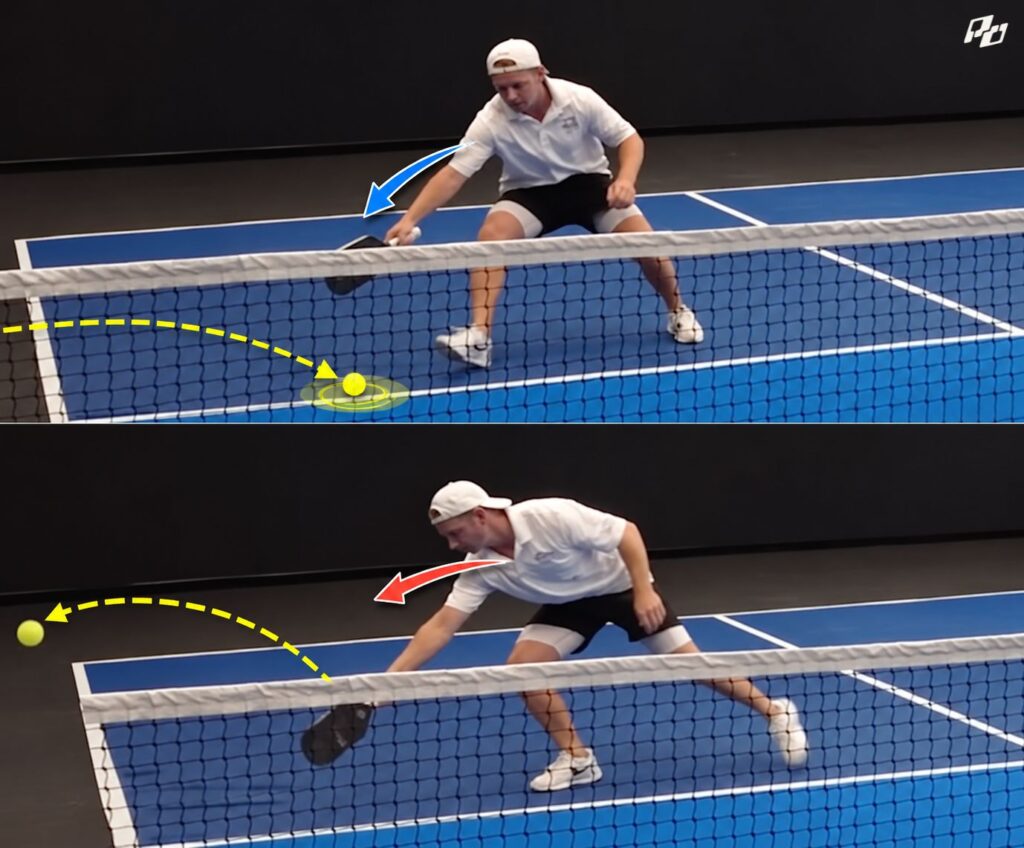
That is much harder. Their problem isn’t simply reaching the ball. It’s reorganizing their feet quickly enough to reach it balanced.
Think in Movement Vectors, Not Just Targets
This is the more advanced way to understand the tactic.
A player charging toward the kitchen has already committed most of their movement forward.
Forward is easy.
Sideways is expensive.
To move laterally, they first have to brake the forward movement, load one leg, push laterally, regain spacing, and then hit.
You don’t need to make them run 10 feet. Sometimes three or four feet sideways is enough to ruin the contact.
That’s why Ben’s example uses something that almost looks harmless:
a relatively soft ball,
kept low,
with a little angle.
The shot itself isn’t spectacular. Their movement makes it difficult.
That is the aha:
You don’t always need a better shot. Sometimes you just need a shot that disagrees with their momentum.
The Split Step Is What They’re Missing
This entire tactic works because the advancing player skipped an important movement step. A proper split step briefly kills the forward rush and leaves the player ready to move left, right, forward or backward.
Good transition movement therefore looks more like: advance → split → read → move
than: advance → advance → advance → hope
Multiple coaches teach essentially the same timing: move forward while you have time, then stabilize as the opponent is about to make contact.
So when somebody doesn’t split?
That is information. They have sacrificed lateral readiness for forward speed. Use it.
Here’s Ben Johns showing exactly how he punishes that mistake—by taking the ball away from the runner’s forward path and making them move sideways:
Your Read Is the Feet, Not the Rating
Don’t decide before the rally:
“This guy rushes, so I’m going wide every time.”
Watch what actually happens. There are three different transition players.
Player 1: Still sprinting forward
This is Ben’s target.
Their feet are traveling quickly toward you as you’re preparing to hit.
Response: make them change direction.
Think: low + soft + away from their path
You don’t need a heroic angle. A controlled dink or soft roll toward either sideline can be enough.
Player 2: They stop and split
Different problem. Now they’re balanced.
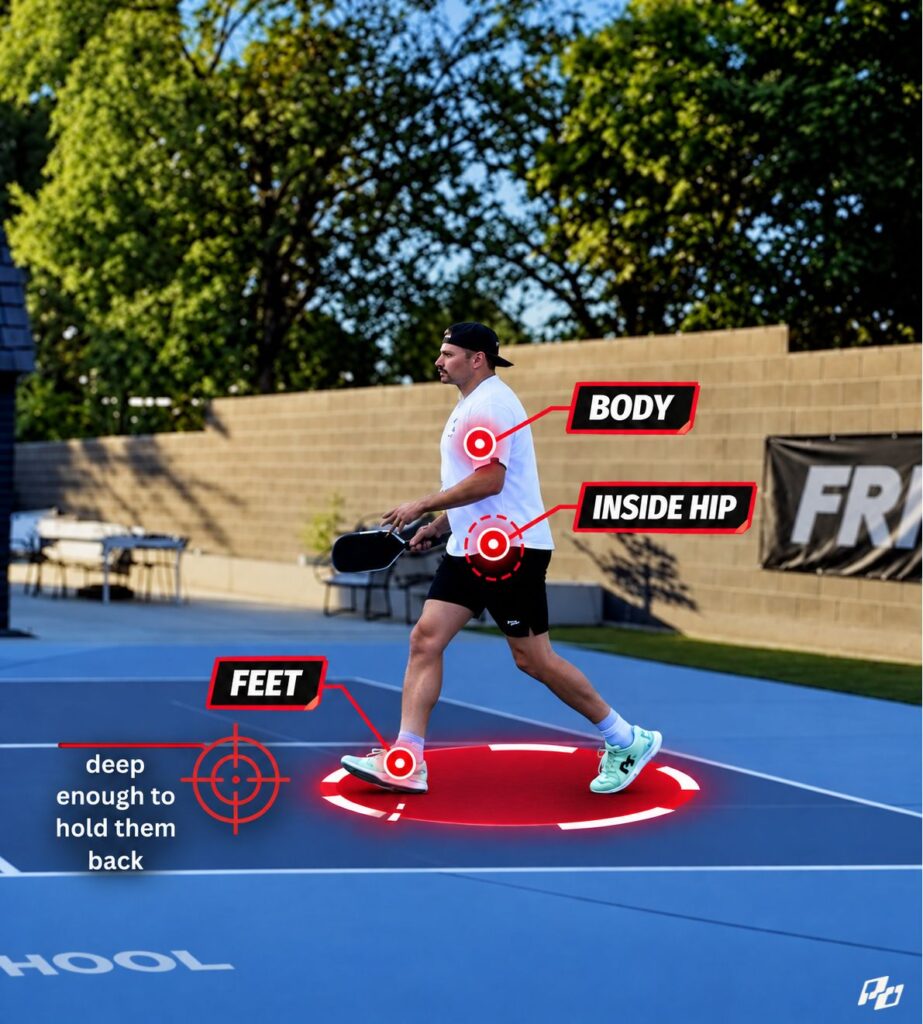
A wide ball isn’t automatically difficult because they have loaded their legs specifically so they can push laterally. Against this player, traditional transition targets become more useful:
- feet
- inside hip
- body
- deep enough to hold them back
You no longer have the same movement mismatch to exploit.
Player 3: They sprint, but their partner stays back
Now you also have a positional gap.
Instead of thinking purely about the runner, notice the space opening between the two players. You may have:
wide angle
or
middle separation
The important point is that your target comes from what their movement has exposed—not from a memorized rule.
Why Ben Says Keep It Soft
This may be the most counterintuitive part.
You’ve caught someone running through transition. Why not blast the ball past them? Sometimes you should.
If the ball is high and attackable, take the attack. But on a lower ball, adding maximum pace can actually remove some of your advantage.
A hard ball reaches them quickly—but it can also rebound cleanly off the paddle. And if you chase a tiny sideline target with full pace, you increase your own error risk.
A softer angled ball does something different. It gives gravity time to pull the ball down. It stays below their comfortable attacking zone. And because they are already moving forward, you make their feet create the difficulty for you.
That’s why this isn’t really a winner attempt.
You’re asking: Can I make this player hit while braking, reaching, or changing direction?
If yes, you have probably won the important part of the exchange. The next ball may be the one you finish.
Don’t Confuse “Wide” With “Sideline”
This is where rec players can take a smart concept and immediately make it low percentage. Ben isn’t saying: Paint the line. You don’t need to.
Imagine the opponent’s forward path as a narrow hallway. Your goal is simply to make the ball leave that hallway.
If they’re running directly up the middle of their side, you might only need to move the ball a few feet toward either side.
That creates the directional change.
So the target isn’t: the sideline
It’s: outside their current movement lane
Much bigger target. Much safer shot.
Here’s the Read I Want You to Practice
The next time an opponent is transitioning, stop staring only at the ball. As you’re preparing to hit, glance at their lower body.
Ask: Are their feet still coming forward?
If yes:
MOVE THEM SIDEWAYS
If they’ve already stopped:
PLAY THE BALL THEY HAVE TO DEFEND FROM THAT POSITION
That is much simpler than trying to calculate eight different transition-zone patterns. And it follows the same principle good tactical players use everywhere: movement first, target second.
Try the “Runner Drill”
This one teaches the concept quickly.
Put one player at the baseline. The feeder starts at the kitchen. The transitioning player hits a drop and moves forward.
For the first five reps, require them to run continuously without split-stepping. The kitchen player must hit the next ball:
- low
- soft
- left or right
Don’t try to win. Just make the runner change direction. Watch how often a completely ordinary-looking ball produces:
a reach,
a late paddle,
a popup,
or a weak reset.
Then repeat the drill—but now allow the advancing player to split before contact. The exact same balls become noticeably easier to handle. That’s the lesson.
It isn’t really about your angle.
It’s about their feet.
Coaches who teach transition play consistently emphasize exactly that advantage of the split: it stops forward momentum and restores the ability to react laterally.
The Rule to Take Into Open Play
Most intermediate players see someone advancing and think: Hit at their feet. Add one more question: What are their feet doing?
If they’re balanced, attack the vulnerable ball or target.
If they’re sprinting straight forward without a split step, don’t necessarily help them by putting the ball directly into their path.
Make them brake.
Make them turn.
Make them move sideways.
Runner coming forward → take them sideways.
It’s not about hitting harder. It’s about making their next step harder.