
Pickleball pop-ups aren’t just caused by an open paddle face. Late contact, tight grip, poor spacing, rising through the shot, reaching, and bad shot selection can all send the ball too high. The fix starts by identifying where the extra upward energy came from.
Most intermediate players know the standard explanation: “Your paddle face was too open.”
Sometimes that’s true.
But it’s also incomplete.
A pop-up can happen with a reasonably good paddle angle because something else quietly added too much upward energy to the shot.
Your legs stood up.
Your contact drifted behind you.
You reached instead of moving.
Your grip tightened and the paddle stopped absorbing pace.
You took a ball out of the air that should have bounced.
Or you turned a simple dink into a tiny rescue swing at the last second.
That’s why some players keep “fixing” their paddle face and continue feeding shoulder-high balls.
The better way to troubleshoot a pop-up is to ask: where did the extra energy come from?
That’s the framework we’re going to use.
Why Pop-Ups Show Up So Much Around 3.0–3.5
Pop-ups happen at every level, but they become especially frustrating around 3.0–3.5. That’s because players at this level can usually dink and reset—but they’re also starting to do more with those balls.
They’re trying to:
- take dinks out of the air
- change direction
- hold the kitchen line
- reset harder drives
- add spin
- reach farther
- speed up selectively
Now spacing, timing, balance and incoming pace matter much more.
So instead of treating every popup as the same technical mistake, diagnose which part of the shot broke down first.
Pop-Up Cause 1: Your Body Went Up
This one fools a lot of players because the paddle itself may look fine.
- You bend for the dink.
- The ball arrives.
- And as you hit, your knees straighten and your chest rises.
- Your paddle comes up with you.
Suddenly a stroke that should have moved mostly forward has gained an extra vertical component.
Ball goes up.
You blame the paddle face.
But the paddle may simply have followed your body.
Several coaches specifically identify standing up through contact as a major popup cause.
What to do instead
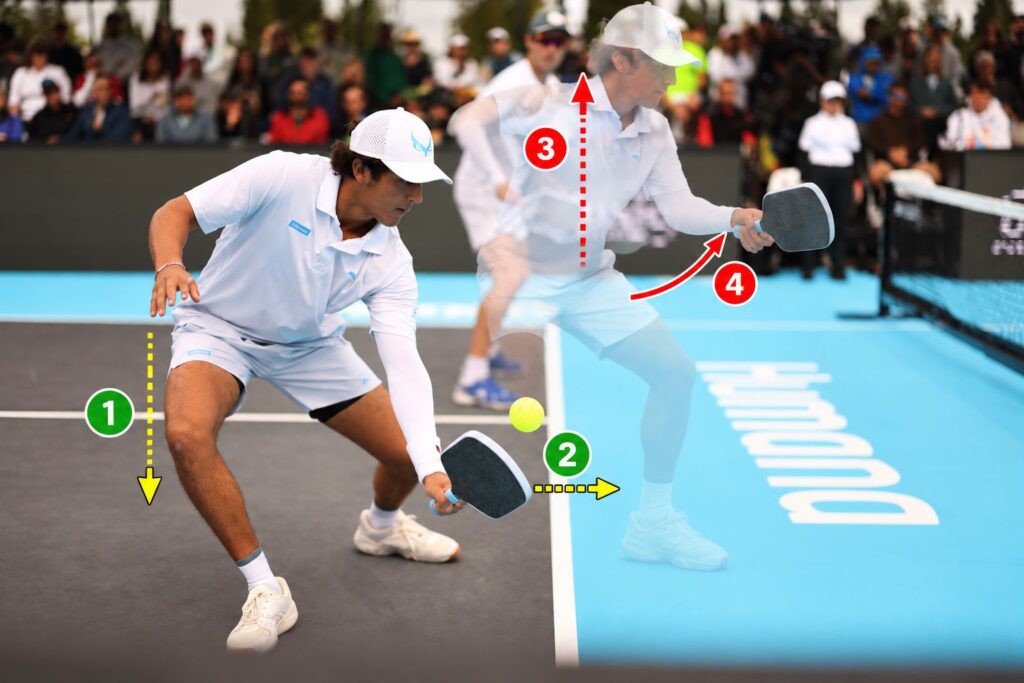
Get to your contact height before you swing. Then stay there through contact.
Think: down → hit → then rise
not: down → rise while hitting
You don’t need to squat dramatically. You just don’t want your entire body climbing while the ball is on the paddle.
Cue:
“Stay the same height.”
If your head rises six inches during the dink, there’s a good chance your paddle did too.
Pop-Up Cause 2: Your Spacing Broke Down
This may be the biggest non-obvious cause.
The ball gets slightly too close.
Or slightly behind you.
Or you’re late getting there.
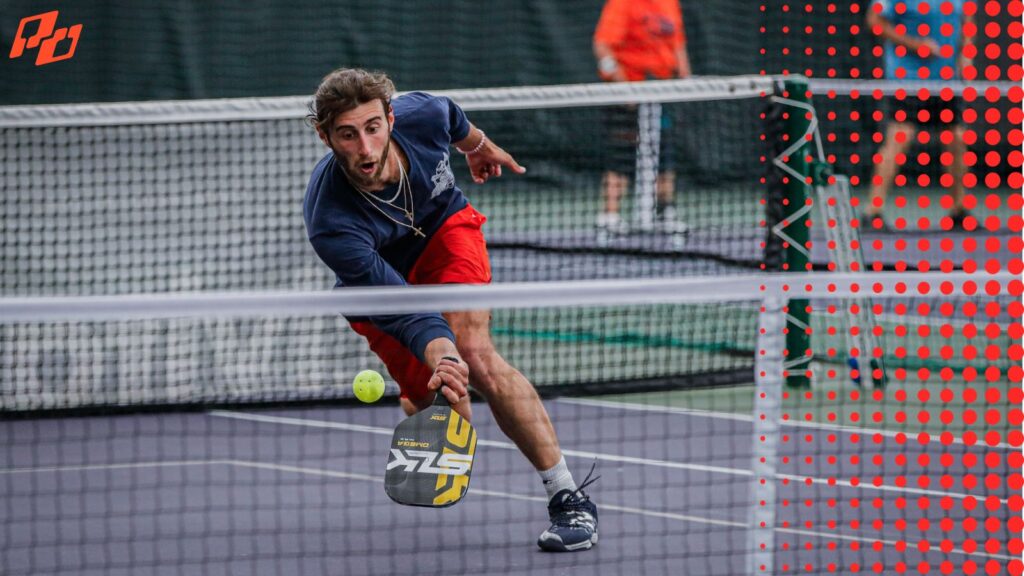
Now the contact point drops lower and moves farther back. At that point, your body starts trying to rescue the ball.
You open the face.
You scoop.
You flick.
You lift.
Not because you deliberately chose bad technique. Because the ball is now in a position where up feels like the only way to get it over the net.
That’s why simply telling yourself to “close the paddle face” can actually make things worse. If the ball is beside your hip or behind you, a closed face may just put it in the net.
What to do instead
Move earlier. Create enough space so the ball stays comfortably in front. The goal is not to reach farther. It’s to get your body into position before you need a rescue stroke.
Think: move → set → hit
Not: reach → rescue
Cue:
Meet it—don’t save it.
A lot of pop-ups are really spacing mistakes that show up as paddle mistakes.
Pickleball coach Marko Grgic shows how keeping the ball in front can help reduce pop-ups, along with two more simple ways to keep resets and dinks lower and more controlled:
Pop-Up Cause 3: Your Grip Got Too Tight
This one becomes obvious against harder hitters.
The opponent drives at you.
You think: soft hands.
But the moment the ball arrives, your fingers squeeze.
Now the paddle behaves more like a rigid wall.
The incoming pace rebounds off it instead of being absorbed. And the ball floats higher or deeper than intended.
A useful starting point for dinking is relatively light grip pressure. Against harder incoming pace, you may need even softer hands.
The important distinction is: Soft swing ≠ soft contact.
You can barely move your arm and still pop the ball if your hand is squeezing the paddle.
What to do instead
Against pace, think less about adding force and more about receiving the ball.
The paddle should stay stable.
Your hand does not need to be rigid.
Cue:
Catch, don’t punch.
Especially when the opponent has already supplied all the pace you need.
Pop-Up Cause 4: You Took a Volley You Didn’t Really Own
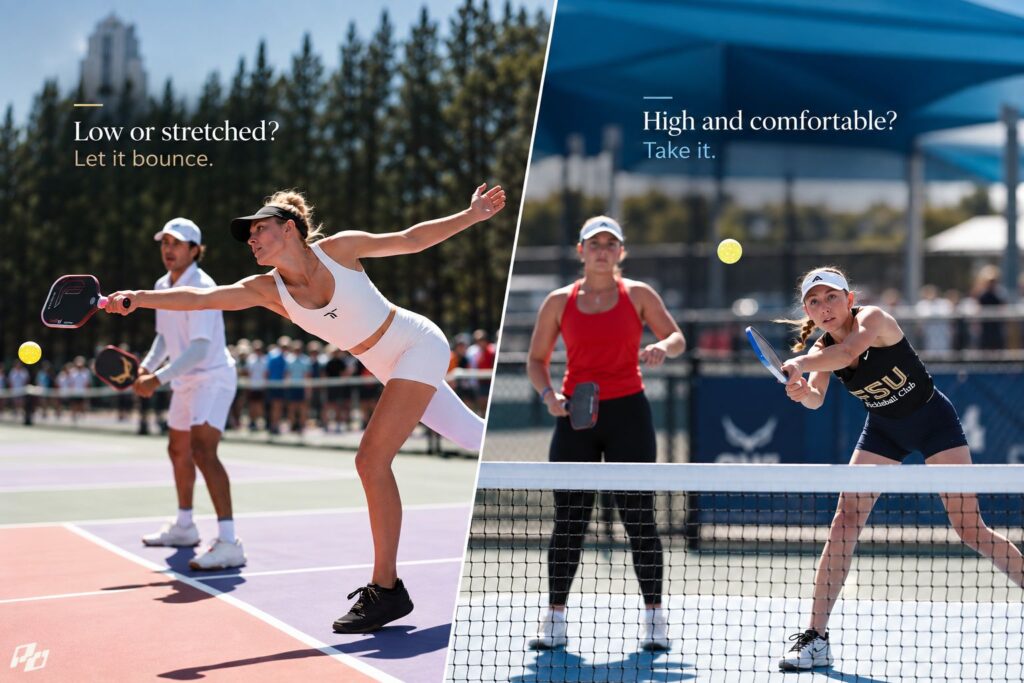
This one is tactical.
The ball is dropping into the kitchen.
You could let it bounce.
But you think: Take it early.
So you stretch.
Your arm separates from your body.
Your balance moves forward.
Your paddle reaches the edge of your comfortable range.
And the ball floats.
Taking dinks out of the air can be a great way to hold the kitchen line and apply pressure. But only when you can do it without losing your structure.
A useful intermediate rule is:
High and comfortable → consider taking it out of the air.
Low or stretched → letting it bounce may be cleaner.
The real question is: Can I volley this while staying balanced and contacting the ball comfortably in front?
If yes, take it.
If you have to lunge, fully extend the arm, or tip your body forward, the bounce may give you a much cleaner contact.
Cue:
High and comfortable? Take it. Low or stretched? Let it bounce.
And remember: Reachable isn’t always playable.
Pop-Up Cause 5: Compact Turned Into Stabby
A lot of players are told to keep their dinks and resets compact. Good advice. But some players hear compact and translate it into jab.
Now the paddle moves abruptly toward one tiny point instead of smoothly through the contact window. Then the hand has to manufacture the trajectory at the last second.
That can create sudden face changes and inconsistent height.
So yes, keep the stroke small.
Just don’t make it abrupt.
Think: short + continuous
not: short + stabby
Cue:
Small swing. Smooth path.
You want a compact stroke that still flows through contact.
The Fastest Way to Diagnose Your Own Pop-Ups
Don’t immediately change five things. Look at where the ball went and what your body was doing.
- If the ball floats high and long after a hard incoming shot: check grip tension and whether you punched at it.
- If it pops after a low dink: check whether contact got too late or too low.
- If it happens while reaching: check your feet and spacing.
- If it happens when you’re stretched over the kitchen: ask whether that volley should have bounced.
- If it happens even during easy dinks: check whether your body is rising or your stroke is becoming jabby.
That’s much more useful than automatically adjusting the paddle face.
The ball is giving you evidence. Use it.
Try This Drill: Diagnose Before You Fix
Have a partner feed you 20 dinks. Your goal isn’t merely to keep all 20 low. After every popup, immediately call what you think caused it:
“Late.”
“Reached.”
“Stood up.”
“Tight.”
“Too much swing.”
Don’t change anything yet. Just identify the pattern.
After 20 balls, you’ll usually discover that your pop-ups aren’t random. Maybe 70% happen when you reach. Or whenever the feed gets faster, your grip tightens. Or you’re excellent from a stationary position but start floating balls when moving laterally.
Now you have something specific to fix.
That is much better practice than spending 30 minutes telling yourself: “Keep it low.”
The Better Pop-Up Checklist
Next time one floats up, don’t immediately blame the paddle face. Check these first:
- Balance: Was I stable?
- Contact: Was the ball in front?
- Spacing: Did I move—or reach?
- Body: Did I stand up through contact?
- Grip: Did I tighten?
- Stroke: Did I jab at the ball?
- Shot choice: Should I have let it bounce?
Then look at paddle angle.
Because the open face may be the last thing that went wrong. The real mistake may have happened a second earlier.
Think of a popup as an energy problem: something added more upward force than you wanted.
Find the source.
Fix the cause—not just the face angle.