Five pickleball mistakes quietly cost rec players points: forcing attacks from poor balance, aiming too fine on resets, driving too many balls in a row, rushing through transition, and playing balls that were going out. Fix those decisions first, and your game can improve without learning a single new shot.
We see the same handful of mistakes in rec games all the time—and the good news is, most of them are surprisingly easy to fix.
They’re not advanced technique problems. They’re small decision-making habits that quietly give points away and keep players stuck at the same level.
Clean up just a few of them and your game can feel calmer, smarter, and a lot more consistent almost immediately.
Here are five of the biggest ones—and the simple adjustment that fixes each.
1. The Short Return Makes You Sprint—and the Sprint Ruins the Shot
A short return looks like a gift.
So the instinct is immediate: GO.
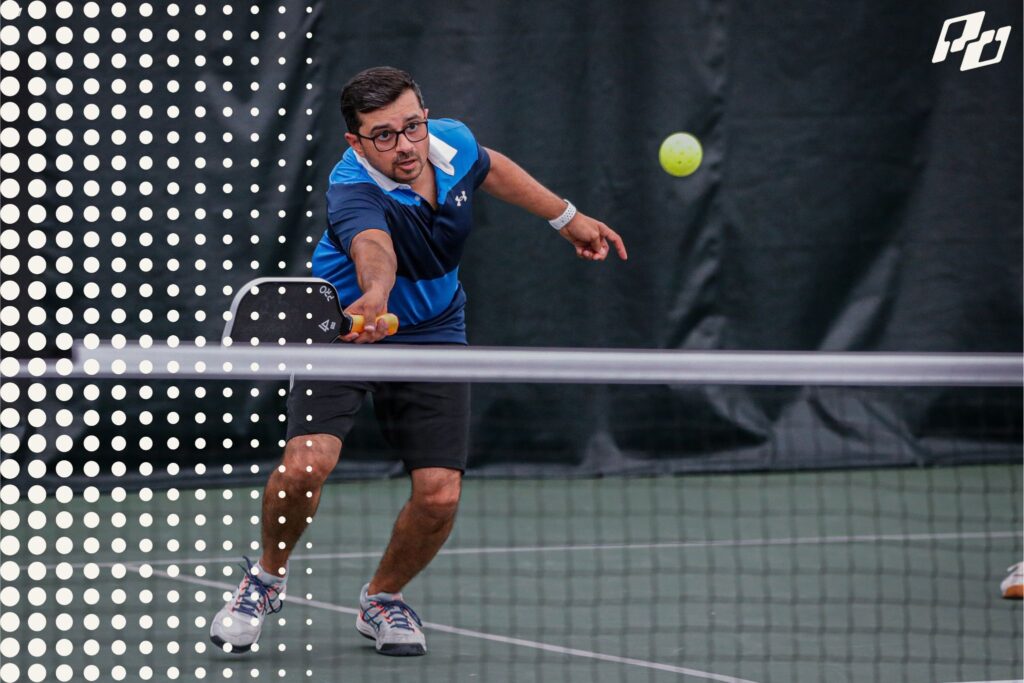
The player races forward, reaches the ball while still moving, and takes a huge swing because they’re now closer to the net. Then the drive hits the tape or sails long.
The problem wasn’t necessarily that they attacked a short return.
In fact, a short, high return that you can step into while balanced is one of the better opportunities to drive. You’re closer to the opponents, have less court to cover, and can make contact farther forward.
The problem is confusing short with attackable.
A return can land short and still stay low. Or it can pull you forward so quickly that the ball ends up jammed beside your hip. Basically the ball may invite an attack while the hitter’s spacing takes that attack away.
So when that return lands halfway up the court, don’t make your decision from its location alone.
Look at three things:
- How high is the bounce?
- Can I get behind it rather than beside it?
- Can I be balanced at contact?
High + forward + balanced?
Absolutely consider the drive.
Low, rushed or stretched?
Now a controlled drop may be the much better ball.
The useful upgrade is not “always drop short returns.”
It’s: Get there early enough that you still have a choice.
That’s a much more advanced skill.
2. When We’re in Trouble, We Somehow Start Aiming Smaller
This one makes almost no logical sense—and we all do it.
You’re halfway between the baseline and kitchen. The opponent drives at your feet. You stretch to the side, barely get your paddle under the ball…and attempt a beautiful sharp crosscourt reset six inches over the net.
Why?
You’re already in the worst position in the rally. This is exactly when your target should become bigger, not smaller.
The purpose of a reset is not to produce an impressive shot. It is to remove the opponent’s ability to keep attacking you.
That usually means absorbing pace with a compact paddle and getting the ball softly back into the kitchen. Transition coaching commonly favors stable contact, soft hands and plenty of margin rather than trying to create offense while stretched.
And when you’re badly extended, the middle becomes particularly useful.
Why?
Because the middle gives you a bigger court window and reduces the angles available on the next ball.
There’s a useful principle hiding here: the worse your balance, the less ambitious your target should become.
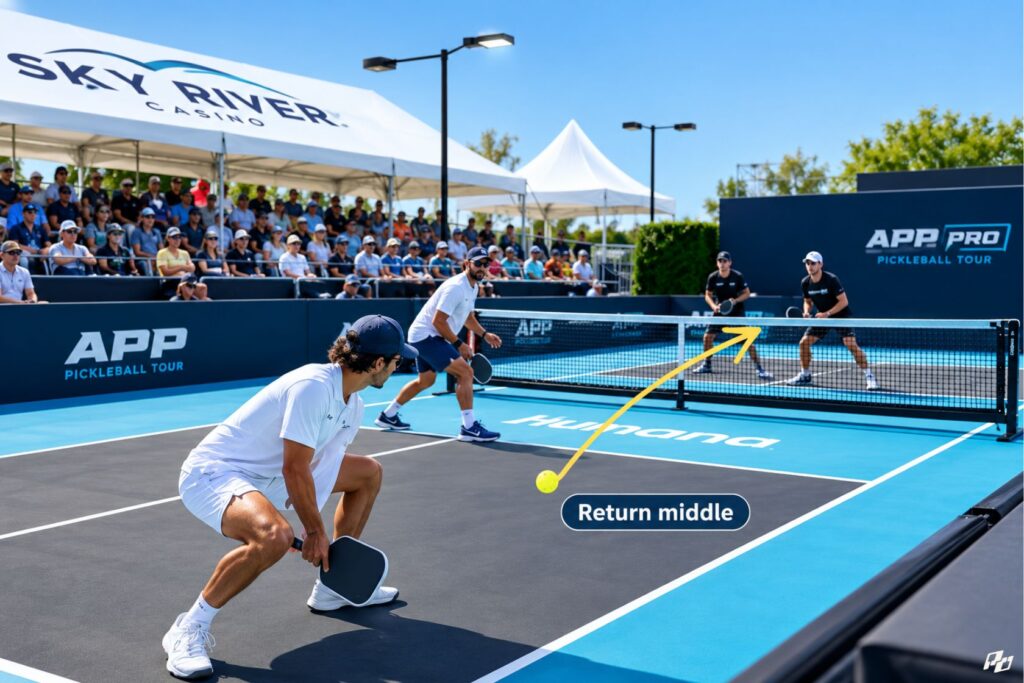
If you’re perfectly set, maybe you can do something clever. If you’re reaching with one foot halfway to the parking lot? Middle of the kitchen looks pretty beautiful.
3. One Good Drive Turns Into Three Drives
This might be the most recognizable 3.0–3.5 pattern of all.
Third shot: DRIVE.
Opponent blocks it back.
Fifth shot: DRIVE AGAIN.
Another block.
Seventh shot: NOW I’M REALLY DRIVING IT.
Eventually the ball either hits the net, goes long, or comes back even harder.
What happened?
The player treated the drive as a strategy rather than the first shot in a sequence. A third-shot drive often works best because of what it creates.
Hit a controlled drive into the feet, hip or body of a player at the kitchen and they may have to block it. That block frequently comes back slower, shorter or more predictably.
And now something important has changed: your next drop is easier.
That’s why the third-shot drive → fifth-shot drop pattern is so widely taught. The drive pressures the fourth ball; the fifth then uses that weaker reply to get you forward:
Think about the drive differently:
It doesn’t always need to win.
It can simply buy you a better ball.
So after a good third-shot drive, actually look at what comes back.
If it pops up, attack it.
But if you get the softer, lower block you were hoping for? That may be the perfect moment to take pace off and drop.
The point of the first drive may be to make the second drive unnecessary.
That is a big strategic jump for recreational players.
4. We Keep Running Because We Think Forward Is Always Better
“Get to the kitchen.”
Wonderful advice. Also responsible for a lot of terrible pickleball. Players hear it and interpret it as: never stop moving forward.
So they hit a decent drop, start sprinting, and are still moving when the opponent contacts the next ball. Now the shot arrives at their feet while their body is traveling forward.
That is a brutally difficult ball to control.
Advancing through midcourt is not one continuous run. You move forward, split or stabilize as the opponent hits, handle the next ball, then continue if you’ve earned more space.
This changes the whole idea of transition.
You’re not running from the baseline to the kitchen.
You’re moving there in installments.
Maybe:
- three steps
- stop and reset
- two steps
- stop again
- then kitchen
And there’s another part rec players miss: your shot decides how far you’re allowed to go.
A beautiful low drop gives you permission to advance. A floating drop does not.
If your ball is sitting up and your opponent is about to attack it, blindly charging forward simply brings you closer to the incoming punishment.
Your movement should be a response to the quality of your shot, not to your desire to reach the line.
That is a very different mindset.
5. You Volley Balls That Were Already Going Out
This one is massively underrated, especially around 3.0–3.5.
You’re in transition, moving forward, paddle up, ready to defend.
Opponent drives.
Ball comes chest-high.
And almost automatically, you stick the paddle on it.
The problem? That ball may have been sailing long anyway.
This happens constantly because players use kitchen-line instincts from the middle of the court. At the kitchen, a chest-high drive can still dip into the baseline because it has a lot of court left to travel. In transition, that same ball has much less room to come down. A hard ball still rising around chest or shoulder height is often a very good candidate to let go.
And this mistake is expensive because you’re taking a ball your opponent may already have missed and turning it back into a live rally — often from an awkward position.
The useful skill is not simply “let out balls go.” It’s learning to read trajectory earlier.
Pay attention to three things:
Is the ball still rising when it reaches me?
How high is it relative to my body?
How much court is left behind me?
If you’re several feet inside the baseline and a hard drive reaches you high while still climbing, you should at least be thinking:
“Do I actually need to touch this?”
That becomes even more valuable as you move forward through transition. The closer you are to the net, the less court the ball has available to drop into.
So sometimes the smartest defensive shot is no shot at all.
A simple way to practice it
Have a partner drive balls while you stand in transition. Before each ball reaches you, call:
“IN” or “OUT.”
Then don’t hit it.
Just watch where it lands.
Do 20 balls.
You’ll start calibrating height and trajectory surprisingly quickly.
This is one of those small skills that doesn’t look impressive — but it can eliminate several unnecessary contacts every game.
And unlike learning a new shot, you can improve it almost immediately.
There’s Really One Mistake Behind All Five
Look again at these situations.
The short return appears, so we decide attack before knowing whether we’re balanced.
We get stretched in transition, so we still try to hit a great shot even though the situation calls for survival.
We hit one drive and decide the next ball must also be another drive.
We start moving toward the kitchen and decide we must keep moving, regardless of what happens next.
A hard ball comes at us in transition, so we automatically stick a paddle on it — even when it was probably sailing long.
Different mistakes.
Same problem.
We decide before we read the situation.
Better pickleball is much more conditional.
- A drive isn’t automatically followed by another drive.
- A drop isn’t automatically followed by a sprint.
- A short ball isn’t automatically an attack.
- A defensive position isn’t the time to search for a winner.
The ball comes in.
Your feet tell you what you own.
Your opponent’s position tells you what is available.
Then you choose.
A Simple Way to Practice This Without Learning Five New Techniques
For one game, forget about winners.
Instead, after every rally, ask yourself only: “Did I try to do more than my position allowed?”
You’ll start noticing things quickly.
The desperate crosscourt reset.
The third consecutive drive.
The forehand you hit while sprinting through contact.
The advance you made behind a terrible drop.
Those points often feel like execution errors.
A surprising number are actually decision errors that happened before the paddle ever touched the ball.
And that’s good news. Because you may not need a new shot to clean up a lot of these points.
You may simply need to stop asking every ball: “What can I do with this?”
and start asking: “What has this ball actually earned?”
That little change—from forcing your preferred shot to accepting the shot the situation gives you—is one of the clearest differences between chaotic rec pickleball and the much calmer game you start seeing as players move beyond 3.5.