
The “pet the dog” pickleball cue helps set up a better forehand by getting your paddle below the ball, slightly closed, and ready before the bounce. It’s most useful on drives and topspin groundstrokes, where earlier preparation can create cleaner low-to-high swings, easier topspin, and more consistent contact.
We love these quirky pickleball tips. Not because they sound clever, but because every once in a while a strange little image fixes three mechanical problems at once.
Coach Preston Bies’ “pet the dog” cue is one of those.
It’s mainly a forehand groundstroke preparation cue — especially useful on drives from the baseline, where you have time to organize the paddle before the ball bounces.
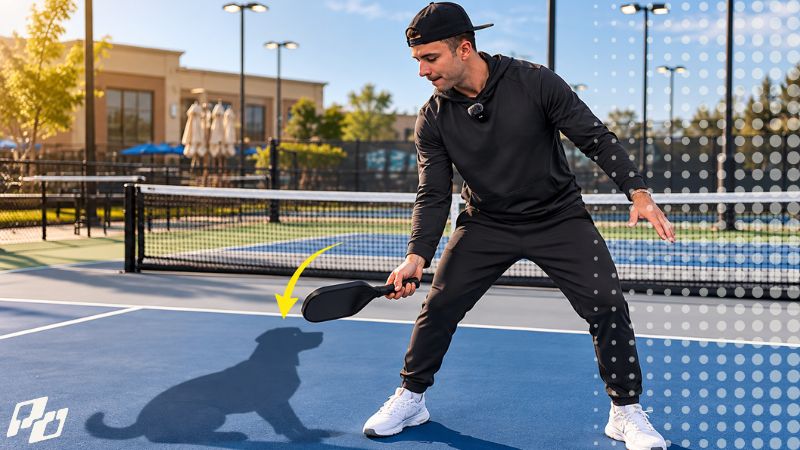
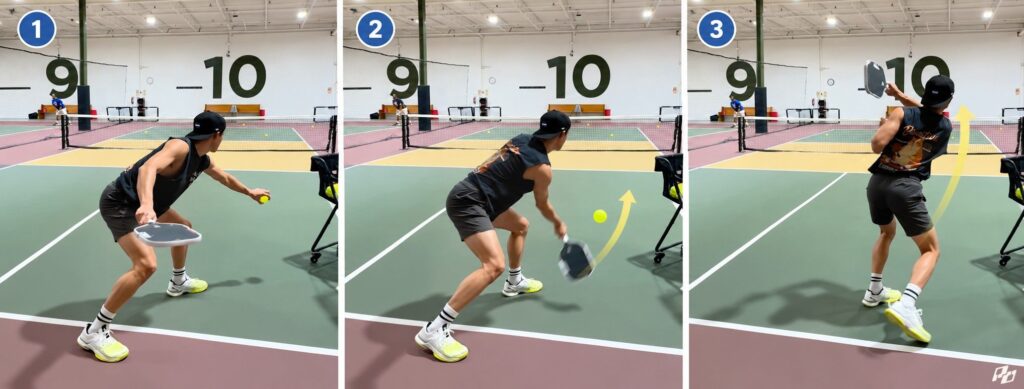
The idea is simple: before the bounce, lower the paddle as if you’re reaching down to pet a dog beside you.
That one move can help you:
- close the paddle face
- get the paddle below the ball
- lower your body into a more athletic position
That sets up the low-to-high swing path you want for topspin.
The same preparation idea can also carry over to serves and topspin third-shot drops, but the swing itself is different. A drive accelerates harder and finishes fuller; a drop uses a much softer, shorter motion.
So think of “pet the dog” as a baseline preparation pattern, not a universal pickleball move.
Best use: forehand drives, topspin groundstrokes, some serves, and topspin drops.
Not for: volleys, counters, blocks, or fast kitchen exchanges.
Why This Cue Works So Well
A lot of players try to create topspin too late.
The ball bounces.
Then they suddenly think: “Brush up!”
By then, the paddle may still be high, the face may be open, and the legs are still upright. Now the player has to manufacture the entire low-to-high swing in a fraction of a second.
That usually produces one of two things:
🚩 a rushed wrist flick
🚩 a ball that floats
Good forehand instruction is much more consistent than that. The paddle should already be below the contact point, the face should be controlled or slightly closed for topspin, and the body should be balanced before the forward swing begins.
That is why the timing in Bies’ cue matters so much: pet the dog before the bounce.
Not after. You are using the bounce as your deadline for preparation.
What “Pet the Dog” Should Actually Look Like
For a right-handed forehand, imagine a dog standing just outside your right leg. As the ball travels toward you:
- you turn
- the paddle drops beside the leg
- the face turns slightly toward the ground
- the knees soften
- the torso lowers with it
Then, after the bounce, you can swing forward and upward instead of scrambling to get the paddle underneath the ball.
That creates a much cleaner sequence: prepare low → ball bounces → swing through
Rather than: ball bounces → drop paddle → bend knees → close face → panic
The cue basically moves your setup work earlier. And that is probably the biggest reason it feels so effective.
Check it out:
This Is Mostly a 3.0–3.5 Fix
Beginners often struggle simply to make consistent contact. Better 4.0+ players usually prepare earlier and create their swing shape more naturally.
The sweet spot for this cue is the player who already has a decent forehand but keeps getting inconsistent results:
- drives fly long
- serves come off too flat
- topspin disappears under pressure
- third-shot drops feel arm-heavy
- contact point changes every ball
Those are often setup problems disguised as swing problems. If the paddle starts in a better place, the swing has less work to do.
Why the Closed Face Matters
This part needs a little clarification. A closed paddle face does not mean dramatically pointing the paddle at the ground.
It means the face is organized so that when the paddle travels low-to-high, you can brush through the back of the ball without launching it.
Forehand-drive coaching repeatedly emphasizes the combination of:
paddle below contact
+
low-to-high path
+
controlled closed face
That is what gives you topspin without simply hitting the ball upward.
If the paddle is below the ball but the face is wide open, you may create height without useful spin. If the face is closed but the paddle never gets underneath the contact point, you may dump the ball into the net.
You need both.
That is exactly what the cue is trying to organize before the ball arrives.
The Hidden Benefit: It Gets Your Legs Involved
This may be the smartest part of the cue.
Try “petting the dog” while standing completely upright. It feels awkward. To actually reach down comfortably, your knees and hips have to soften.
That naturally lowers your center of gravity.
And that matters because good forehand mechanics rely on more than just the arm.
Balance, leg engagement, spacing, and body rotation all help create cleaner contact and more paddle speed.
For drops, the same pattern shows up again. Good third-shot-drop instruction repeatedly emphasizes getting low with the legs and establishing the paddle below the ball before lifting through it.
So the cue quietly solves a common rec problem: standing tall and trying to create the entire shot with the arm.
Where It Works Best
The cue is most useful when you have time to prepare. That means especially from the baseline.
Bies specifically points out that you have more time back there, and that is exactly where I would use it.
1. On the serve
The cue can help you lower the paddle and body before accelerating upward through the ball. That can make topspin feel more natural because you are already starting underneath the eventual contact point.
The key is not to pause awkwardly at the bottom.
Think: lower → load → swing, one continuous sequence.
2. On a forehand drive
This is probably the clearest use. If you tend to take the paddle straight back at waist height and then swing flat, the dog cue gives the backswing some shape.
The paddle drops.
Your body lowers.
Then you swing through and up.
That matches the low-to-high pattern coaches commonly teach for controlled topspin drives.
It can also help prevent one of the classic 3.5 mistakes: trying to add topspin with the wrist instead of the swing path.
3. On a topspin third-shot drop
This is where you need more restraint. The same general setup can work:
- paddle lower
- body lower
- controlled face
- low-to-high movement
But the swing itself should be much slower and smaller than a drive.
Topspin-drop coaching recommends getting the paddle down around the knee and using a controlled brushing motion rather than whipping the paddle aggressively.
So the preparation may look similar.
The acceleration does not.
Where I Would NOT Use It
This is not a universal ready-position cue. Do not start “petting the dog” on:
❌ fast kitchen exchanges
❌ counters
❌ blocks
❌ volleys
❌ emergency resets
Why? Because now you do not have time.
At the kitchen, dropping the paddle before the opponent attacks you is usually the exact opposite of what you want.
The cue works because you have time before the bounce. If the ball is already being volleyed at you, keep the paddle available in front.
That is one of the most important clarifications.
Baseline cue, not firefight cue.
Don’t Turn It Into a Giant Loop
This is the mistake I would expect after someone learns the cue. They exaggerate.
The paddle drops almost to the court.
The backswing gets huge.
The whole stroke becomes a looping production.
That defeats the purpose.
You only need enough lowering to:
✅ get under the contact point
✅ organize the paddle face
✅ load the body
So think: small dog.
Not: Saint Bernard lying on the floor.
The cue should simplify your swing, not make it longer.
The Bounce Is Your Timing Check
This may be the most practical piece of the entire idea.
Film yourself from the side.
Pause the video at the moment the ball bounces.
Now look at yourself.
For a forehand groundstroke, ask:
Is the paddle already below where I expect to contact the ball?
Is my face organized?
Are my knees flexed?
Am I balanced?
If the answer is yes, the forward swing becomes much easier. If the bounce happens and you are still upright with the paddle near your chest, you are already late.
That makes “pet the dog” a useful timing cue rather than just a funny phrase.
How You’ll Know It’s Working
Don’t judge it by whether you suddenly hit more winners. Look for these changes:
✅ contact starts happening farther in front
✅ balls stop launching as high
✅ topspin feels easier rather than forced
✅ you use less wrist
✅ your legs feel involved earlier
✅ you stop rushing after the bounce
This isn’t just a forehand fix. On the backhand, good setup creates the same clues: earlier contact, quieter wrists, more body rotation, and topspin that happens naturally instead of being forced.
Those are the signs that the setup is improving. The shot itself usually gets better afterward.