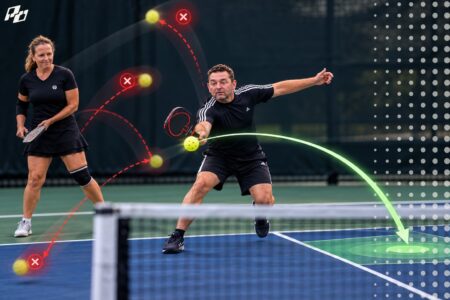
Popular pickleball and Youtuber Ed Ju just launched a new video showing off what he’s calling the choked-up serve, and… wow. It jumps off his paddle, stays ridiculously low, and has that “did he just break physics?” kind of spin. Check it out:
So today, we’re breaking it down, analyzing exactly why this serve works, who should use it, and when to pull it out in a match.
Grab your paddle. This one’s fun.
What Is the Choked-Up Serve? (And Why Does It Feel So Freaking Fast?)
If you saw his clip, you know the vibe: Ed and his friend Ryan giggling because the serve just comes off the paddle like a bullet. It skids. It bites. It dips. And it makes you understand why Ed jokingly says it “might get banned.”
So… what’s happening?
You literally choke up on the handle.
Instead of holding the paddle at the very bottom, you slide your hand higher up the grip, leaving part of the handle hanging out below your palm.
That tiny change does three big things:
1. It lowers the swing weight (huge deal).
Swing weight = how “heavy” the paddle feels when you swing.
Choke up → more of the paddle’s mass is closer to your hand → the paddle suddenly feels lighter and faster.
2. Your hand speed increases — a LOT.
Lower swing weight means you can:
- accelerate faster
- change direction quicker
- snap your wrist with less effort
You don’t have to muscle the serve. It just whips.
3. You gain control while still generating spin.
You lose a little leverage, yes — but you gain:
- precision
- stability
- quicker acceleration
Result: a super-whippy, super-spinny, low-trajectory serve that jumps at your opponent.
No wonder Ed burst out laughing in the video.
Why the Choked-Up Serve Is So Nasty
Let’s break it down in a way rec players will actually feel on the court.
It comes off the paddle faster than you expect.
Because your hand speed is higher, the ball jumps off the paddle quicker — even with a smaller swing.
It dips earlier thanks to extra topspin.
All that wrist and forearm acceleration turns into spin.
Spin pulls the ball down.
So you can aim lower over the net, hit harder, and still land it deep.
It stays low after the bounce.
Spin + speed + lower launch angle → the ball skid-slides instead of popping up.
Rec players HATE low, skidding serves.
It makes your serve placement sharper.
Choking up shortens your “lever,” which actually makes small adjustments easier.
Wide slice serve?
Jumping topspin at the hip?
Short kicker?
You now have the finesse to pull it off.
Who Should Try This Serve? (Be honest with yourself.)
3.0–3.5 Players
Try it only if:
- You already land 8/10 basic serves.
- You want an easy way to add spin without learning complicated mechanics.
- You don’t try to blast winners off your serve — just solid pressure.
If your serve still floats or sails long, this serve might actually help you dip the ball in.
Strong 3.5–4.0 Players
This is the sweet spot. You should absolutely test drive this serve if you:
- like mixing pace and spin
- want more control without feeling stiff
- enjoy attacking weak returns
This serve gives you more patterns, not just power:
- serve wide → get pulled off the court → open third shot
- serve deep into the body → jam them → get a pop-up
- serve short spinny → force a bad footwork adjustment
4.0+ and Tournament Players
This is a variation weapon.
You won’t replace your full-power serve.
But you will gain:
- a better slider
- a more accurate short serve
- a heavy topspin option that stays legal
Against returners who stand too deep? This serve is free points.
When Should You Use the Choked-Up Serve?
✔️ Use it early in games
Test your opponent immediately.
Does the ball skid under their paddle?
Do they pop it up?
Do they return short?
Use that info.
✔️ Use it against stiff hitters
People with flat, rigid strokes hate spinny, skidding serves.
✔️ Use it when wind is in your face
Topspin + wind = the ball drops like a stone.
You can swing harder and still stay in bounds.
✔️ Use it as a change-up
After a few normal serves, hit this:
- lower trajectory
- faster spin
- different bounce
It messes with timing instantly.
✖️ When NOT to use it
- On game point if you’re not dialed in
- If you’re nervous and tend to hit the net
- If your wrist is tired (the extra whip can irritate tight joints)
- If your fundamentals aren’t consistent yet
It’s a weapon, not a crutch.
How to Learn the Choked-Up Serve (5-Step Mini-Lesson)
You can literally take this straight to the courts.
1. Slide your hand up the grip.
Start with 1 inch. Enough to feel lighter, not so much you lose stability.
2. Keep a relaxed wrist.
This is critical. If you choke up but stay tight, you lose all the benefits.
Think: loose whip, not rigid hammer.
3. Aim for topspin first.
Forget pace.
Brush up on the ball.
Let the spin pull it down.
4. Add placement variety.
Try three targets:
- deep middle
- wide backhand
- short, low, heavy topspin
Choking up makes controlling these easier.
5. Build in power last.
Once your mechanics feel good:
- increase wrist speed
- keep the upward brushing
- accelerate through contact
You’ll suddenly notice the ball “jumping” off your paddle the same way it did for Ed.
Pros & Cons of the Choked-Up Serve
✔️ Pros
- Faster hand speed
- More natural spin
- Lower, nastier bounce
- Easier angle control
- Compact, reliable mechanics
- Great variation for pressure situations
✖️ Cons
- Slight loss of max power
- Smaller timing window
- Can dip into the net if rushed
- Wrist-heavy if your technique is tight
- Not great as your only serve
Should YOU Try It?
If you’re a rec player who loves experimenting and wants a serve that:
- jumps,
- dips,
- skids,
- and annoys the heck out of your opponents…
YES. Try it tonight.
If you’re still learning basic mechanics or struggle to keep serves deep…
Try it slowly. Use it for spin, not raw pace.
Either way — it’s a fun, modern, easy-to-learn serve variation that can give you free points without breaking any rules.
(At least… until Ed really does get it banned.)