Most recreational players shop for paddles the same way:
“What’s the hottest paddle right now?”
“What are the pros using?”
That’s understandable—but it’s also why many players end up with paddles that look great on paper and feel unpredictable on court.
Here’s the reality: pros and rec players are solving different problems.
Pros train daily, strike the center more often, move faster, and can manage demanding specs. Recreational players need paddles that reduce chaos, not reward perfection.
So instead of asking “Is this a power or control paddle?”, a better question is:
What paddle specs help my body stay stable, consistent, and fresh late in games?
Once you frame the decision this way, the specs start making sense.
Ten questions, three paddles matched to how you play, scored on lab data.
1. Paddle Weight vs Swing Weight (What to Choose, Exactly)
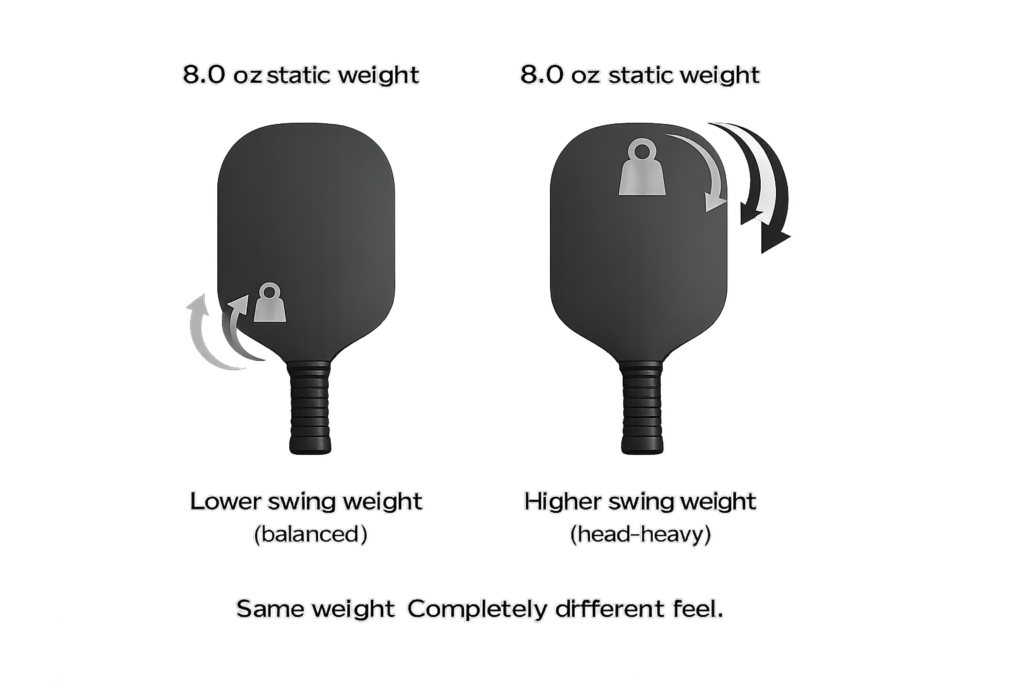
When players say a paddle feels “too heavy,” they’re almost never talking about the number on the scale.
There are two different variables:
- Static weight – what the paddle weighs sitting still
- Swing weight – how heavy it feels when you move it
Two paddles can both be 8.0 oz and feel completely different in play.
What to choose based on your body and symptoms
👉 If your hands feel late at the kitchen
→ Choose a lower swing weight, even if static weight stays the same
→ Target static weight: 7.6–8.0 oz
→ Look for: balanced or handle-weighted paddles (avoid head-heavy balance)
👉 If your shoulder gets tired before your legs
→ Choose lower swing weight, not necessarily a lighter paddle
→ Target static weight: 7.8–8.3 oz
→ Avoid: head-heavy builds, which increase deceleration load on the shoulder
👉 If the paddle feels fine early but sluggish late
→ Choose midweight with controlled swing weight
→ Target static weight: 7.6–8.1 oz
→ Avoid extremes: ultra-light (<7.3 oz) or very head-heavy paddles
Key takeaway: if speed-up reactions or hand battles break down late in sessions, swing weight is your first adjustment—not brand, material, or surface hype.
2. Height, Arm Length & Leverage (Choose Based on Reach vs Timing)
Your height and arm length quietly change how a paddle behaves.
Taller / longer-armed players
You already generate pace and reach. Your risk is timing and over-leverage.
👉 If you’re tall and miss long or feel late under pressure
→ Choose a balanced paddle, not an elongated, head-heavy one
→ Prioritize: face stability over extra reach
👉 Avoid:
- very head-heavy paddles
- extra-long shapes “just because”
Shorter / compact players
You may need help with reach—but stability matters more than length alone.
👉 If you’re shorter and feel stretched or jammed
→ Choose a slightly longer shape OR longer handle, with high stability
→ Prioritize: higher twistweight (≈ 6.5+ on common lab scales) or strong perimeter reinforcement
→ This reduces paddle twisting when contact isn’t perfect and keeps blocks from floating or leaking wide
If you would rather skip the theory, the paddle quiz turns your answers into three lab-scored picks in about 90 seconds.
👉 Avoid:
- narrow faces with low forgiveness
- long paddles that twist easily on mishits
Rule of thumb:
- If your misses are directional, you need stability.
- If they’re late, you need balance.
3. Body Mass, Strength & Endurance (Not “Fitness”)
A paddle that feels great for 20 minutes can quietly sabotage you by game three.
What to choose, specifically
👉 If you’re lighter-framed or fatigue quickly
→ Choose midweight + low swing weight
→ Target static weight: 7.6–7.9 oz
→ Target swing weight: 110–115 (on common lab scales)
→ This keeps hands quick without forcing you to over-swing to create depth
👉 If you’re stronger but play fast, hands-heavy games
→ Choose mid-to-heavy paddle with controlled swing weight
→ Target static weight: 8.0–8.4 oz
→ Target swing weight: 115–120
→ Stability matters more than raw mass; avoid head-heavy builds that slow reactions
👉 If you find yourself swinging harder just to get depth
→ Your paddle is likely too light (<7.4 oz) or too soft
→ Add mass gradually: move into 7.8–8.2 oz range
→ Or choose a slightly firmer face / thinner core (≈14mm) before changing technique
Counterintuitive truth: too-light paddles often increase fatigue, because your body has to do more work.
4. Grip Size & Joint Health (Choose This Before Power vs Control)
Grip size changes mechanics. Period.
What to choose based on symptoms
👉 If the paddle feels unstable on routine shots (even on dinks or easy volleys)
→ You’re likely squeezing the handle to control the face, which creates tension
→ Choose:
• a slightly larger grip (or add 1–2 overgrips)
• a paddle with higher face stability / perimeter reinforcement (wider face, foam-supported or reinforced perimeter that resists twisting on off-center hits)
→ Goal: let the paddle stay square without extra hand pressure
👉 If you have elbow discomfort (especially after play, not during)
→ The issue is usually vibration + grip tension, not total weight
→ Prioritize:
• correct grip size first
• paddles with better vibration damping or foam-perimeter builds
→ Avoid chasing ultra-light paddles—they often increase shock on off-center hits
Simple test: if your hand relaxes and the paddle still behaves, you’re fitted correctly.
5. Paddle Thickness (Choose Based on Chaos Level)
Thickness isn’t about skill—it’s about how messy your games get.
What to choose
👉 If you absorb pace, reset often, or feel rushed
→ Choose 16mm (thicker)
→ Benefits: plush feel, calmer resets, more forgiveness
👉 If you already feel stable and want faster counters
→ Choose 14mm (mid)
→ Benefits: quicker response, cleaner counters
👉 If you pop balls up under pressure
→ Thicker usually helps more than switching brands
Paddle Fit Cheat Sheet (With Numbers You Can Use)
| If this happens… | Choose this | Look for these numbers / details |
|---|---|---|
| Late hands at the kitchen | Lower swing weight | Swing weight ≈ 110–115; balanced or handle-weighted feel |
| Paddle twists on blocks | Higher twistweight / stability | Twistweight ≈ 6.5+; wider face; perimeter foam or reinforcement |
| Shoulder fatigue | Balanced build, not lighter | Static weight 7.8–8.3 oz with controlled swing weight (<120) |
| Forearm tightness | Larger grip / better fit | Grip size + 1–2 overgrips; relaxed hold without squeezing |
| Over-swinging for depth | Slightly heavier or firmer face | Static weight 7.8–8.2 oz; firmer face or ~14mm core |
| Floating counters | More stability, not more power | Higher twistweight; thicker feel (15–16mm) for calmer rebound |
| Rushed on “easy” balls | Forgiving, balanced specs | Midweight 7.6–8.1 oz; balanced swing weight; stable face |
| Short reach issues | Slightly longer shape with stability | Elongated or long-handle shape plus twistweight ≈ 6.5+ |
| Tall player missing long | Avoid head-heavy designs | Balanced build; avoid high swing weight (>120) |
How to use this table (important): don’t try to “optimize” everything at once. Find the one row that describes your most common late-game problem, and adjust that spec first. That’s how paddle changes actually translate to better play.
Why Pro Paddles Often Fail Rec Players
Pro paddles are built for players who arrive early, hit clean, and swing on time—almost every rally. High swing weight, tighter sweet spots, and lower forgiveness aren’t problems when your footwork and contact are elite.
Rec players live in a different world. Points are decided under pressure, while moving, reaching, or reacting late. That’s where pro-style paddles quietly turn against you. The paddle that feels amazing when you’re fresh starts twisting, floating, or taxing your arm once rallies speed up.
What rec players need isn’t “more performance.” It’s predictability—a paddle that behaves the same on good contact and slightly imperfect contact, and that doesn’t demand perfect timing just to stay in the point.
If a paddle only rewards your best swings and punishes everything else, it’s not helping your game. The right paddle makes average swings safer and late swings survivable—that’s the difference.
How to Know It’s Actually Right for You
The right paddle doesn’t announce itself. It doesn’t feel wild, flashy, or “next level” in the first ten minutes. It just keeps things from falling apart when your timing isn’t perfect.
Here’s a simple, honest check: halfway through a long session, notice what your body is doing. If your grip is tightening, your swing is getting bigger, or you’re rushing easy balls, the paddle is making the game harder than it needs to be.
A better way to test paddles: don’t judge your best shots. Pay attention to the ones you hit a little late, a little tired, or slightly off-center. If those balls still come off clean and predictable, that paddle is helping your game.
The goal isn’t to copy a pro’s setup. It’s to find a paddle that lets you play your normal game longer, calmer, and with fewer breakdowns. That’s the upgrade most recreational players are actually looking for.