
Every pickleball player has an opinion about what it takes to improve.
Watch more YouTube videos.
Buy a better paddle.
Practice your third-shot drop.
Play more games.
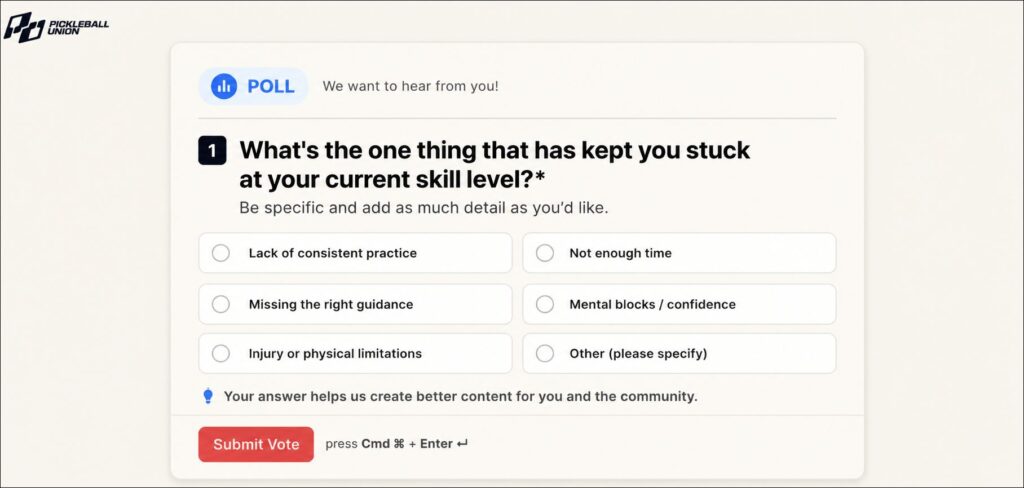
So we decided to ask our newsletter subscribers a simple question: “What’s the one thing that’s kept you stuck at your current skill level?”
The responses were fascinating.
We expected players to blame specific shots. Instead, five clear themes emerged—and they reveal a lot about why so many recreational players plateau.
Even more importantly, they point to what actually helps players improve.
1. Consistency Is a Bigger Problem Than Technique
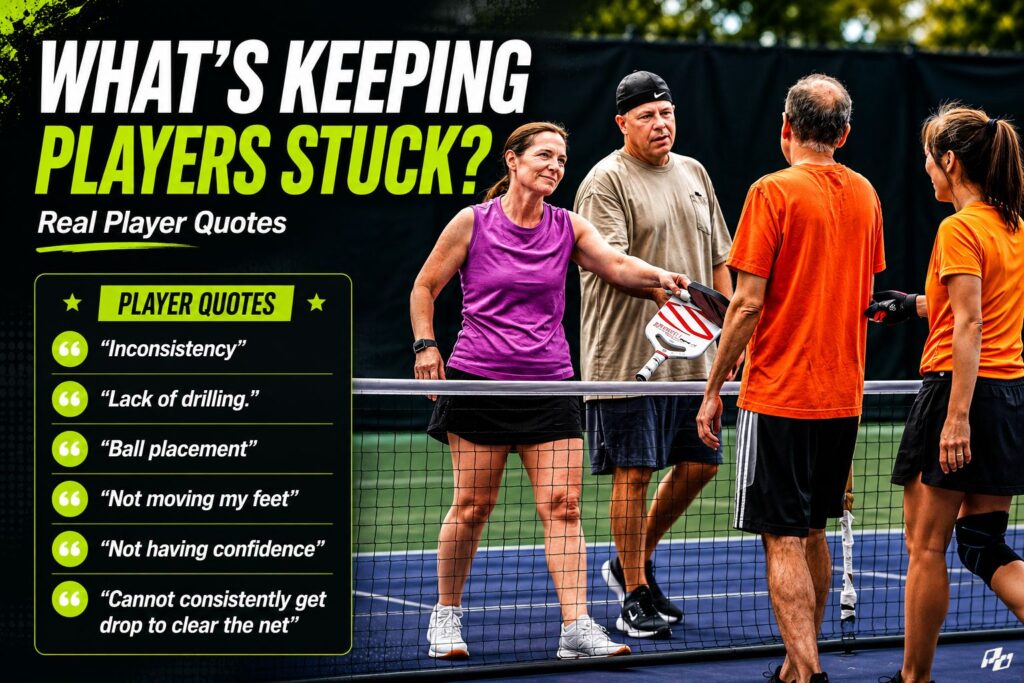
The most common theme wasn’t a particular shot. It was inconsistency. Some readers simply wrote “consistency.”
Others mentioned struggling with shot execution, hitting balls too high, poor ball placement, backhand dinks, third-shot drops or making bad decisions under pressure.
Those sound like different problems, but they’re closely related.
Experienced coaches often say intermediate players rarely lose because they don’t know what to do. They lose because they can’t reliably execute the right decision when the rally speeds up.
One response summed it up perfectly:
“Choosing the right shot to hit but not executing it at a high enough percentage.”
That’s an execution problem—not a knowledge problem.
⮕ What to do instead
Don’t spend the next month chasing another new shot.
Instead, identify the one shot that breaks down most often under pressure and build it until you trust it.
For most recreational players, improving one weakness from 60% to 85% consistency produces a much bigger jump than learning a completely new skill.
2. Open Play Isn’t the Same as Practice
The second theme appeared again and again. Readers mentioned:
- lack of drilling
- difficulty finding drilling partners
- not enough playing time
- work commitments
- limited court availability
Notice what almost nobody said.
“I don’t know what to practice.”
The problem isn’t information.
It’s deliberate repetition.
Open play is fantastic for exercise, competition and having fun. It’s terrible for repeating the same skill enough times to improve it.
That’s why so many top coaches recommend combining game play with focused drilling. Even 20 to 30 minutes of intentional practice before open play can produce more meaningful improvement than another two hours of random games.
Ask yourself: did you actually practice today—or did you just play?
They’re not the same thing.
3. Most Players Know What to Do—Until the Score Matters
One response stood out more than any other:
“Taking the skills I learn in videos and lessons and actually using them in a match. I either forget to use them, or I’m too worried to make a mistake.”
This is incredibly common.
Sports psychologists have long observed that players under pressure tend to default to their strongest existing habits—not the newest technique they learned last week.
That’s why your third-shot drop looks great during drilling but disappears at 10-10. Your brain isn’t forgetting. It’s protecting itself by choosing the movement pattern it trusts most.
The solution isn’t another instructional video.
It’s learning to apply new skills inside realistic games.
That’s exactly why we recently published The No-Bullshit Guide to Leveling Up on the Pickleball Court, where we explain how small-group coached game sessions help players bridge the gap between practice and competition far faster than open play alone.
4. Better Players Make You Better
Another recurring theme surprised us.
Many readers didn’t complain about their own game. They complained about not having access to stronger players.
Some said they always play with people at the same level. Others simply wanted more opportunities to compete against better opponents.
That instinct is correct.
Good players expose weaknesses that equal-level players often don’t.
- They attack the floaters you usually get away with.
- They punish poor court positioning.
- They recognize predictable patterns almost immediately.
But here’s the important part:
Don’t measure those games by the score.
Measure them by what you learn.
After every game, ask yourself:
✔️ Which shot did they attack most often?
✔️ Where did they consistently move me?
✔️ Which mistakes actually cost me points?
Those answers are worth far more than winning another recreational game.
5. Sometimes Your Biggest Limitation Isn’t Physical
A surprising number of readers mentioned knee replacements, arthritis, hip problems, foot pain or simply getting older. Others believed they lacked the speed or athleticism to reach the next level.
Physical limitations are real.
But experienced players often point out something interesting: many players who appear “fast” aren’t actually moving faster.
They’re moving earlier.
Better anticipation means fewer emergency movements. Reading your opponent’s paddle angle, body position and court balance gives you a valuable head start before the ball is even struck.
That extra half-second often matters more than raw speed.
If your mobility isn’t what it used to be, spend as much time improving your reads as you do improving your movement.
You’ll often find yourself arriving earlier without moving any faster.
The Bigger Picture
Looking through all of the responses, one thing became very clear. Almost nobody said:
“I need to learn another shot.”
Instead, they described problems like:
- executing under pressure
- making better decisions
- finding stronger practice environments
- drilling consistently
- trusting their skills in real matches
That’s encouraging. It means most recreational players aren’t stuck because they lack information. They’re stuck because they haven’t created the right environment for improvement.
The fastest path forward probably isn’t another YouTube tip or another premium paddle. It’s building better habits through deliberate practice, immediate feedback and competitive repetitions that challenge you to use what you already know.
Because improving at pickleball isn’t about collecting more advice.
It’s about finally turning good advice into winning habits.