

Pickleball serving yips often come from pressure, overthinking, and trying to guide the ball. Simplify your motion, use the same pre-serve routine, focus on a clear target, and practice under mild pressure to rebuild trust in your serve.
You walk to the baseline with a serve you’ve hit thousands of times. Then something strange happens.
Your arm stiffens. The ball suddenly feels awkward in your hand. You become hyperaware of your paddle. Instead of seeing a big service box, you see the net, the sideline and every possible place the ball can miss.
So you tell yourself: Just get this one in.
And somehow that makes the next serve even harder.
Welcome to the pickleball serving yips.
The frustrating part is that most players experiencing them haven’t forgotten how to serve. They may hit 30 perfectly good serves during practice and then lose the motion at 9–9.
That’s the clue.
For many rec players, the solution isn’t another six-point mechanics checklist. It’s almost the opposite: remove decisions, reduce conscious control and give your brain something simpler to do.
Three fixes do that particularly well.
First, Understand What You’re Actually Fighting
“Yips” gets used loosely in pickleball.
For most recreational players who serve normally in practice but suddenly tighten up during games, the problem resembles choking under pressure: attention moves away from the target and into the mechanics of a movement that normally happens automatically.
You start monitoring everything.
Is my paddle low enough?
Where’s my elbow?
Don’t hit the net.
Did I drop the ball correctly?
Please just go in.
The result can be exactly what you’re trying to prevent. Sports research describes one form of choking as excessive self-focus: pressure causes an athlete to consciously supervise a well-learned movement that normally runs with little conscious interference.
That explains one of the strangest features of serving yips: trying harder can make the serve worse.
It also explains why endlessly repairing your mechanics in the middle of a game is usually the wrong response.
You need a reliable motion, obviously. But once you have one, the goal under pressure is to stop conducting it like an orchestra.
Fix No. 1: Make the Serve Almost Boringly Simple
This is the most consistent technical advice across pickleball coaches. When the yips appear, remove moving parts.
Forget the aggressive topspin serve for a moment. Forget the last-minute wrist action. Forget painting the sideline. You want a serve that feels almost impossible to misunderstand.
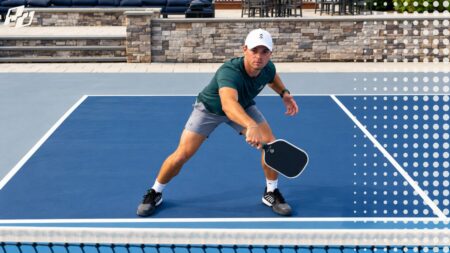
For a right-handed forehand serve, think: Ball comfortably in front. Paddle comfortably back. Swing through.
Not six checkpoints.
Three.
If your normal volley serve has become completely contaminated by anxiety, the drop serve can also be a useful temporary reset because the bounce removes part of the timing problem. Interestingly, USA Pickleball originally cited helping players with “server’s block,” or the yips, as one reason for introducing the drop serve.
Don’t mistake simplification for deceleration, however.
This is where players often create another problem. They get nervous and begin pushing the paddle toward the ball at half speed, trying to guide it safely into the box.
Now their smooth swing has become a steering motion.
The better cue is:
Easy swing—not slow swing.
When the yips hit, many players instinctively decelerate and try to guide the ball safely into the service box. That usually makes the motion less natural and more tentative.
A better cue is to commit to the forward swing and accelerate smoothly through contact. The goal is not to swing harder. It is to avoid steering, poking, or slowing the paddle just before impact.
Think “smooth through the ball,” not “hit it harder.”
For a 3.0–4.0 player fighting the yips, 70 percent speed with a committed follow-through is far more useful than either a 95 percent missile or a 40 percent poke.
Fix No. 2: Give Every Serve the Exact Same Beginning
If there is one habit worth stealing from high-level servers, it is not their spin. It’s their routine.
A simple routine can look like this: bounce the ball a few times, pick your target, take a breath, then exhale as you serve. The key is using the same routine in practice and matches.
Check out pro player Lea Jansen’s pre-serve routine and how she gets herself ready before every point:
@deadliftsanddinks look at Lea's serve ritual … ive notoce most touch paddles to the backboard … Lea's is certianly unique … what's yours? Fahey vs Jansen #ppa #picklebal #pickleballtiktok ♬ original sound – DeadliftsandDinks
A routine isn’t something you pull out at 10–10 because you’re nervous.
It should be the doorway through which every serve passes.
Sports-science evidence supports this unusually well. A meta-analysis examining 112 effect sizes found pre-performance routines improved performance under both low-pressure and pressurized conditions. Under pressure, the experimental studies produced a substantial overall effect.
The goal is to make that routine so familiar in practice that pressure doesn’t create a completely different motion in matches.
Your version can be much simpler.
Try this: Bounce. Look. Exhale. Go.
- Bounce the ball once or twice.
- Look at the area you’re serving to.
- Exhale.
- Serve.
That’s enough.
The number of bounces is irrelevant. Touching the fence isn’t magic. Neither is tapping your paddle against your leg.
What matters is repeatability.
Your routine tells your nervous system: Nothing unusual is happening. We’ve done this exact sequence before.
And there’s one important rule:
Don’t add steps when you’re nervous.
If your routine is two bounces at 2–2, it should not suddenly become seven bounces, two practice swings and a motivational speech at 10–10.
Pressure should not get a different routine.
Fix No. 3: Stop Thinking “Get It In”
This may be the most counterintuitive fix. When players begin missing serves, their target usually gets bigger: Anywhere in the box.
That sounds safer.
Mentally, it can be worse.
“Get it in” isn’t actually a target. It’s an outcome. And it leaves your attention free to wander toward everything you’re trying to avoid.
The net.
The baseline.
The possibility of another miss.
Instead, give your brain somewhere positive and external to aim.
One coach we asked about the yips recommends choosing wide, middle or T and concentrating on that target instead of merely trying to make the serve. Another recommends the “bounce-hit” technique adapted from Timothy Gallwey’s The Inner Game of Tennis: say “bounce” when the ball bounces and “hit” at contact so attention locks onto rhythm rather than mechanical commentary.
Those ideas attack the same problem from opposite directions.
One gives your eyes a destination.
The other gives your brain a rhythm.
Both stop it from micromanaging your arm.
For most yippy rec players, I’d combine them:
Pick a big target, then use one rhythm cue.
Not a six-inch cone. Choose a generous window several feet inside the lines.
A deep-middle target is excellent because it gives you substantial lateral margin while still producing a useful serve.
Then use one cue: “Bounce-hit.” “Smooth.” “Through.”
Just one.
Not: Loose grip, bend knees, paddle back, stay low, contact forward, finish high.
That’s no longer a cue.
That’s a committee meeting.
Watch coach CJ Johnson explain the “bounce and hit” rhythm trick in a super simple way you can use right away:
The Trick That Ties All Three Fixes Together
If there is one idea that gets closest to a “trick,” it is this:
Stop trying to make the serve go in.
Your job is to execute a familiar process.
Target.
Routine.
Swing.
Whether the previous serve went into the net or landed perfectly three feet inside the baseline, the next serve begins exactly the same way.
This breaks the feedback loop that makes yips so persistent: Miss → worry → control the swing → tighten → miss → worry more.
Replace it with: Target → routine → committed swing → observe result → repeat.
Notice the word observe. Don’t judge every serve.
If it misses long, that’s information.
If it catches the net, that’s information.
The Inner Game approach behind the “bounce-hit” exercise is based largely on this idea: place attention on what is actually happening rather than giving yourself constant technical instructions and judgments.
That is particularly useful for players who can serve beautifully from a basket but suddenly “forget” how when somebody starts keeping score.
Don’t Practice the Cure Only Without Pressure
Here is where a lot of players accidentally invite the yips back.
They go to an empty court.
Hit 100 serves.
Everything feels wonderful.
Then two days later they are serving at 9–9 with three people watching and the arm locks again.
Why?
You practiced the stroke, but not the situation that triggers the problem.
Research into performing under pressure repeatedly points toward not only routines but also acclimatization or simulated-pressure training. Athletes appear to benefit from practicing skills in conditions that reproduce at least some of the pressure they will eventually face.
So build the serve back in stages.
Start with 20 relaxed serves using the exact same routine.
Then hit 20 more at one big target.
Next, add pressure: start each rep at 9–9. Make two serves in a row and you “win.” Miss one and your imaginary opponent gets the edge.
Then make it uncomfortable: have a partner watch, switch serving sides, serve after a tiring rally, or let someone interrupt you before you reset.
The goal isn’t punishment. It’s teaching your brain: This motion still belongs to me when something matters.
What to Do When the Yips Suddenly Return Mid-Game
Don’t diagnose your entire forehand at the baseline. Use this emergency reset:
Step away. Loosen your fingers. Choose the middle third. Exhale. Routine. Swing through.
That’s it. If necessary, take some pace off—but keep the motion flowing. And after you make one? Don’t immediately announce, They’re gone!
That’s another form of monitoring. Just turn toward the next rally.
Can You Make Sure They Never Return?
Not literally. And anyone guaranteeing that is selling certainty that sports science doesn’t provide.
A 2026 meta-analysis found that interventions such as pre-performance routines, self-talk, mindfulness and attentional strategies meaningfully improve performance under pressure, with particularly consistent effects in closed-skill tasks. But improvement is not the same thing as permanent immunity.
What you can do is make recurrence much less powerful.
Keep your base serve technically simple.
Use the same routine in practice that you use at 10–10.
Practice under pressure occasionally.
And most important, never respond to one ugly serve by immediately rebuilding your entire motion.
One miss is a miss.
Two misses are two misses.
The yips gain power when every miss becomes evidence that something is wrong with you.
One Important Exception
One quick clarification: not every case of “serving yips” is the same. For most rec players, it’s a pressure problem. You serve fine in practice, then tighten up in games and suddenly start steering the ball.
But true yips can sometimes involve involuntary shaking, jerking, spasms, or freezing. If that’s happening—especially away from pickleball too—it’s worth talking to a medical professional rather than assuming it’s just nerves.
For the much more common rec-player version, keep the fix simple:
- Simplify the motion.
- Use the same routine every time.
- Focus on the target, not your mechanics.
Then commit to the swing.
Because the best long-term cure for serving yips isn’t learning how to think about your serve better.
It’s learning when to stop thinking about the swing and simply serve the ball.