Midcourt drives usually fly long because players use too much swing for the shorter court space. As you move closer to the kitchen, your backswing, forward extension, and finish must shrink. Use earlier contact, more topspin, and a compact swing to attack without launching the ball deep.
There is a reason midcourt drives feel so tempting.
- You are closer to the net.
- The ball sits up a little.
- You see open court.
- Your brain says, “Attack.”
- Then your paddle says, “Baseline forehand.”
- And the ball lands somewhere near the back fence.
That miss is not random. It is usually a geometry problem disguised as a technique problem.
Most rec players understand that a baseline drive needs shape. They understand that a kitchen speedup has to be compact. But the midcourt sits in that awkward middle zone where players often use the wrong swing size for the amount of court they have left.
A drive from 22 feet behind the net and a drive from 11 feet behind the net cannot be the same shot.
Same paddle. Same player. Same intention.
Different runway.
And when the runway gets shorter, your swing has to shrink, your launch window has to tighten, and your spin-to-pace ratio has to change.
So the question is: How much swing can this part of the court actually support?
The Real Reason Midcourt Drives Sail Long
When a midcourt drive flies long, most players blame power.
“I hit it too hard.”
Sometimes that is true. But often, the bigger problem is that the swing delivered too much forward carry for the distance available.
At the baseline, a full drive has time to work. The ball can leave your paddle with speed, clear the net, travel deep, and still dip before the baseline.
In the midcourt, that same ball has less time to dip.
So if you keep the same swing length, same follow-through, and same forward extension, the ball does not have enough court left to behave.
That is why a drive that feels great off the paddle can still miss long. Your body remembers the baseline swing. The court demands a smaller one.
The biggest midcourt error is not always “too much pace.”
It is too much paddle travel after the ball already has enough speed.
That extra 8–12 inches of forward swing is often what turns a good attack into a long miss.
The Court Shrinks Faster Than Your Swing Does
Here is the part rec players underestimate.
From the baseline, you have about 22 feet to the net and 22 more feet to the opposite baseline.
From the middle of the transition zone, you may only be about 10–14 feet from the net. That means the ball has a much shorter landing window after it crosses.
From near the kitchen line, you are only 7 feet from the net. At that range, a “drive” is not really a drive anymore. It is a speedup, roll, punch, or brush.
The closer you get, the more your shot has to be shaped by:
- contact height
- paddle-face angle
- spin rate
- swing length
- finish height
- and recovery time
That is why the phrase “midcourt drive” can be misleading. There is not one midcourt drive.
There are at least three.
- A deep transition drive.
- A true midcourt roll-drive.
- A near-kitchen speedup.
They live in different parts of the court, and they should not use the same swing.
The Swing-Length Map: How Big Your Swing Should Actually Be
Use this as a practical starting point.
| Court Location | Distance From Net | Backswing | Total Paddle Travel | Finish | Shot Shape |
|---|---|---|---|---|---|
| Baseline | About 22 ft | 12–18 inches | 36–48 inches | Shoulder-high or across body | Full drive with depth |
| Deep transition | 14–18 ft | 8–12 inches | 24–36 inches | Chest-to-shoulder height | Controlled drive |
| True midcourt | 10–14 ft | 4–8 inches | 18–28 inches | Chest height, in front | Roll-drive to feet |
| Near kitchen line | 7–10 ft | 0–4 inches | 8–16 inches | Short, in front | Speedup or brush attack |
| Kitchen-line bounce attack | 7 ft or less | Almost none | 6–12 inches | Tiny upward finish | Disguised spin attack |
This table is where a lot of players have the “oh, that’s why” moment.
If you are 10–14 feet from the net and your paddle travels 40 inches, you are asking a midcourt ball to behave like a baseline ball.
It probably will not.
The better cue is: Your backswing should shrink before your confidence does.
Compact does not mean scared. It means the swing matches the court.
The “Paddle Length” Rule
Here is a simple checkpoint that works well for rec players. A standard pickleball paddle is roughly 15–16 inches long.
- From the baseline, your backswing may be about one paddle length or a little more.
- From the deep transition zone, think about half to three-quarters of a paddle length.
- From true midcourt, think one-third to half a paddle length.
- Near the kitchen line, think one paddle face, not one paddle length.
That is a big difference.
Most midcourt drives should not start with the paddle wrapping behind your hip. If the paddle disappears behind your body, you are probably loading too much.
A good midcourt backswing should feel like the paddle is being pulled back into a small pocket beside your body, not taken back into a full forehand loop.
Think:
Baseline: paddle length.
Midcourt: half paddle.
Kitchen line: paddle face.
That is a usable scale.
The Launch Window: Why Aiming Lower Is Not Enough
A lot of players try to fix long midcourt drives by aiming lower. That helps sometimes, but it can also create net errors. The better fix is to control the launch window.
Your launch window is the combination of:
- how open the paddle face is
- how much upward path you create
- how much forward force you add
- and how high the ball is at contact
From the baseline, you can get away with a slightly larger launch window because the ball has time to dip.
From midcourt, your launch window is smaller. If the paddle face opens a few degrees too much, the ball floats. If the swing moves too forward, the ball carries. If you brush too vertically without enough forward energy, the ball sits up.
So the midcourt drive is not just “shorter swing.”
It is: shorter swing, cleaner face, earlier contact, and more spin relative to pace.
That is the difference between a controlled roll-drive and a panic slap.
The Spin-to-Pace Ratio
This is the technical concept most rec players are missing.
At the baseline, you can hit with more forward pace because the court gives you room. You still need shape, but you can send the ball deeper.
In the midcourt, your shot needs a higher percentage of spin compared with forward force.
Think of it this way:
| Shot | Pace vs. Spin Feel |
|---|---|
| Baseline drive | 60% forward pace / 40% spin |
| Deep transition drive | 50% forward pace / 50% spin |
| Midcourt roll-drive | 35–40% forward pace / 60–65% spin |
| Near-kitchen speedup | 20–30% forward pace / 70–80% brush/acceleration |
These are not laboratory numbers. They are feel numbers. But they help.
If your midcourt drive feels like 70% forward push and 30% brush, it will probably fly.
If it feels like a heavy roll with just enough forward pressure to reach the opponent’s feet, you are closer.
The goal is not to hit a slower ball. The goal is to hit a ball that spends less time rising.
A good midcourt roll-drive should feel like it climbs over the net, then immediately starts hunting the opponent’s shoelaces.
Contact Height Decides Whether You’re Driving or Lying to Yourself
Not every midcourt ball is attackable. This is where intermediate players get into trouble. They see “midcourt” and think “green light.”
But the real green light is not location. It is contact height plus balance.
Here is a better framework:
| Contact Height | Your Best Option | Swing Size |
|---|---|---|
| 6+ inches above net height | Drive or firm roll | 6–10 inch backswing |
| 0–6 inches above net height | Compact roll-drive | 4–8 inch backswing |
| At net height | Short roll, block, or controlled pressure | 2–6 inch backswing |
| Below net height | Reset, dink, or very spinny brush only if balanced | 0–4 inch prep |
| Below knee height / at feet | Reset | No drive swing |
That last row matters.
A lot of “bad midcourt drives” are actually bad shot selection.
If the ball is below knee height and you are still moving, the compact swing is not the fix. The fix is to stop pretending that ball is a drive.
A better cue: Midcourt location gives you permission to look. Contact height gives you permission to attack.
The 7-to-11 Paddle Path
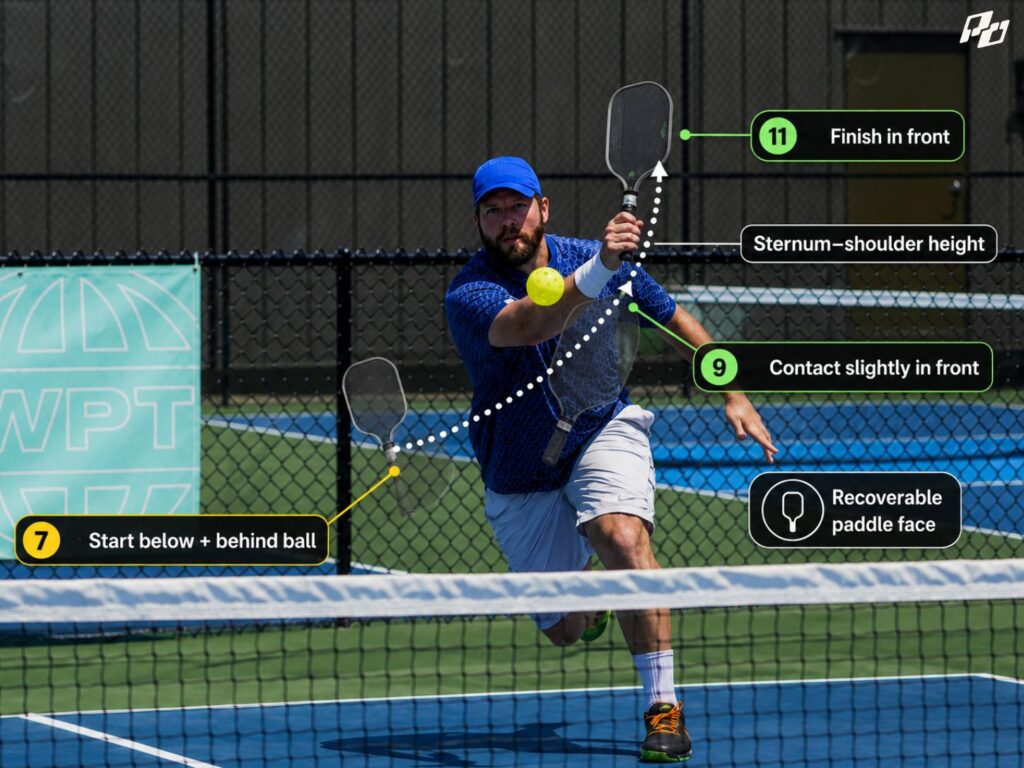
For many midcourt roll-drives, the paddle path should feel like a clock.
Not 9-to-3.
Not straight forward.
Not a giant low-to-high loop.
Think: 7 o’clock to 11 o’clock.
The paddle starts slightly below and behind the ball, then works up and forward through the back outside quadrant of the ball.
That creates a drive that has spin and pressure without too much carry.
⮕ If the ball is higher, the path can move a little more forward, closer to 8-to-2.
⮕ If the ball is lower, the path becomes more vertical, closer to 6:30-to-11.
This is where the shot becomes more advanced.
You are not just swinging shorter. You are changing the angle of the swing path based on ball height.
- Higher ball: more forward press.
- Lower ball: more vertical brush.
A simple cue: Height buys forward swing. Low contact demands brush.
The “No Extension Past Contact” Mistake
Rec players often shorten the takeback but still push through the ball too long. The paddle keeps traveling forward after contact, and that extra extension adds carry.
From the baseline, extension is useful. From the midcourt, too much extension turns into a launch problem.
For a true midcourt roll-drive, the paddle should accelerate through contact, but the finish should rise and fold back into ready position quickly.
It should not chase the ball toward the opponent.
A good checkpoint: After contact, your paddle should finish up, not out.
⮕ If the paddle finishes pointing deep through the court, the ball probably carried.
⮕ If the paddle finishes in front of your chest with the face ready to recover, you probably used the right size swing.
The Finish Position Tells You If the Swing Was Too Big
Your finish is like a receipt. It tells you what you actually bought. For a controlled midcourt drive, your paddle should usually finish:
- in front of your body
- between sternum and shoulder height
- with the paddle face recoverable
- and without your hitting shoulder fully rotated across your chest
⮕ If your finish wraps around your opposite shoulder, that is a baseline finish.
⮕ If it finishes down near your hip, you may have slapped or rolled over too much.
⮕ If it finishes so far across your body that your backhand counter is late, the attack may have created more risk than pressure.
A better finish cue: Finish where you can fight the next ball.
That is more important than making the swing look pretty. Because at 3.5 and above, many midcourt attacks come back.
Target Depth: Stop Aiming Like You’re at the Baseline
Another reason midcourt drives go long is that players aim too deep.
If you are attacking from 10–14 feet off the net, the best target is often not the back third of the court. It is the opponent’s feet, inside hip, or the space just below their contact zone.
If your brain chooses a deep target, your body often chooses a bigger swing.
If your brain chooses a foot target, your body is more willing to brush and shorten.
Use this cue: From midcourt, attack down, not deep.
“Down” does not mean into the net. It means into the opponent’s lower contact zone.
The “Red-Yellow-Green” Midcourt Attack Read
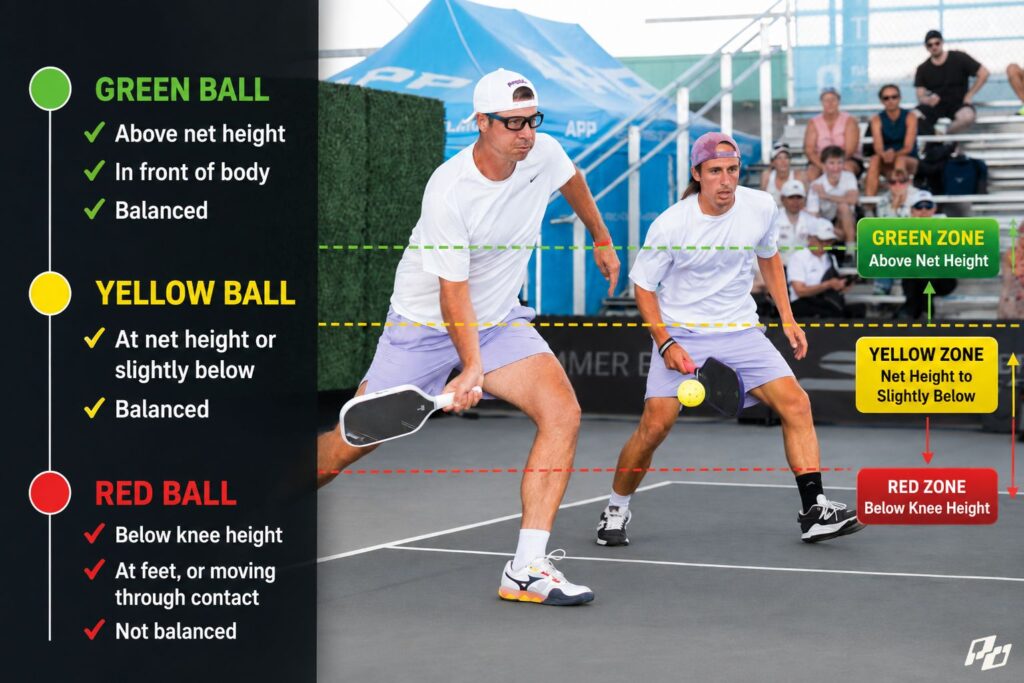
Instead of thinking “drive or don’t drive,” use a simple green-yellow-red read:
| Read | What It Looks Like | Best Choice |
|---|---|---|
| Green Ball | Above net height, in front of you, and you are balanced | Compact drive or roll-drive. Use a 6–10 inch backswing and target feet, hip, middle, or an open lane. |
| Yellow Ball | Around net height or slightly below, but you are still balanced | Spin-heavy roll, controlled block, or pressure dink. Use a 2–6 inch backswing and attack feet only if you can create dip. |
| Red Ball | Below knee height, at your feet, or you are moving through contact | Do not drive. Reset, dink, or block with almost no swing. |
The key is that ball quality and body quality both matter. A green ball with poor balance becomes yellow. A yellow ball with poor balance becomes red.
That is how better players avoid donating points.
The Recovery Clock: How Fast Must You Be Ready?
The closer you are to the kitchen, the faster the ball can come back. That means your swing length is not just about keeping the ball in. It is also about surviving the next shot.
From the baseline, you may have close to a full second or more before the next ball reaches you, depending on pace.
From the midcourt, that window shrinks. Near the kitchen, it can feel instant. So if your midcourt attack leaves your paddle unavailable for even half a second, that matters.
A practical test: After you swing, could you block a counter to your chest within 0.5 seconds?
If not, your swing is too big for that location. That number is not meant to be perfectly scientific. It is a useful coaching standard.
The Drill: Swing-Length Ladder
This drill fixes the problem better than just telling yourself to shorten up. Set up at four positions:
- baseline
- deep transition
- true midcourt
- near kitchen line
Hit five forehand drives or roll-drives from each position.
Your rules:
- Baseline: full swing allowed.
- Deep transition: 75% swing.
- True midcourt: 50% swing.
- Near kitchen line: 25% swing.
Now add a second rule:
Each ball must land in the same target zone: opponent’s feet or the back half of the kitchen-side transition area.
This forces you to change swing length and shape instead of changing only target.
Most players discover that their “50% swing” is actually still 80%.
That is the point of the drill.
The Advanced Cue: Compress, Then Brush
If I had to give one phrase for the whole shot, it would be this: Compress, then brush.
Compress means you load the body slightly into the ground. Knees flex. Center of gravity lowers. Feet stop drifting.
Brush means the paddle moves up and through the back of the ball with shape, not a long forward shove.
Most rec players do the opposite. They rise, drift, and push. Better midcourt attackers lower, stabilize, and brush. That is how you stop launching midcourt drives long without turning every attack into a harmless dink.
Compact is not cautious. Compact is how you attack when the court gets smaller.