If your pickleball partner is struggling, avoid overcoaching or taking over. Simplify patterns, use short supportive cues, poach selectively, and help create easier contacts. The goal is to reduce pressure, rebuild confidence, and keep your partner involved without making them feel like the weak link.
Every doubles player has been on both sides of this.
Your partner misses two drops, dumps a dink into the net, shanks a return, and suddenly you can feel them tightening up. Their shoulders rise. They stop trusting shots they normally make. Then opponents notice it too—and start sending them even more balls.
The instinct is to help.
But this is where many well-meaning partners make things worse.
They start coaching between every point. They poach too aggressively. They say “come on” after every miss. Or they try to carry the team by doing everything themselves.
A better approach is to reduce your partner’s mental load, technical difficulty, and court responsibility just enough to help them settle—without making them feel like the weak link.
That is the balance.
First, Don’t Diagnose Their Swing Mid-Match
If your partner is already playing badly, the middle of a game is usually the worst time to rebuild their technique.
A comment like:
“You’re opening your paddle face.”
may be technically correct.
But now your partner is thinking about mechanics while also trying to track the ball, move, choose a shot, read opponents, and manage the score.
That is a lot of attention competing for one rally.
Pressure can make it harder to focus and play naturally. Research suggests that simple tools like routines, self-talk, mindfulness, and attention training can help you perform better when the pressure is on.
Your role as a partner is therefore not to give them more things to think about. It is to give them fewer.
Instead of:
“Stop taking such a big backswing on your resets.”
try:
“Let’s just make the next three balls.”
That changes the goal without turning you into their coach.
Your Best Tool Is Often One Shared Cue
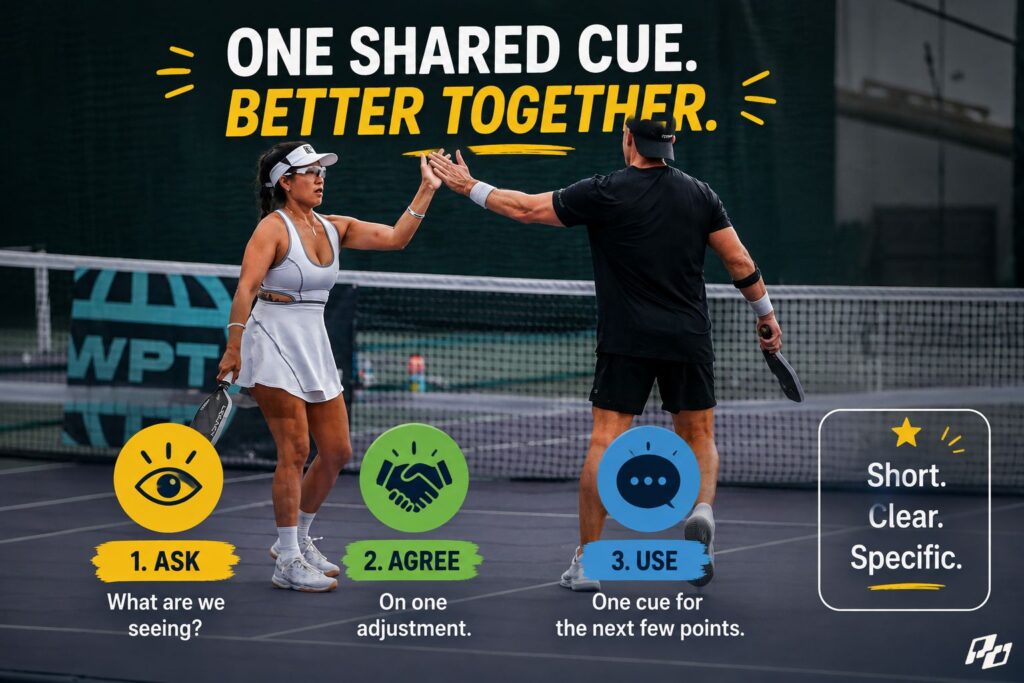
When a team starts unraveling, long strategy conversations usually hurt more than they help. A much better reset is:
- Ask what they are seeing.
- Agree on one adjustment.
- Use one cue for the next few points.
Good examples:
- “More middle.”
- “Make them hit one more.”
- “No rush.”
- “Let’s get both of us to the kitchen.”
- “I’ll take more middle.”
Good pickleball communication is usually short, clear, and specific. A simple cue works better than blaming your partner or giving them a constant stream of instructions.
There is a psychological reason that works.
Supportive communication has been associated with greater self-confidence and team cohesion, while controlling communication is associated with more anxiety and poorer performance profiles.
Don’t give your partner a lecture.
Give them one simple thing they can actually use.
Change the Pattern Before You Change the Player
This is one of the most useful but underused doubles adjustments. If your partner is struggling, do not immediately ask them to execute harder shots.
Change the geometry of the rally. Suppose their third-shot drops are falling apart.
Instead of telling them to “fix the drop,” consider:
- driving more thirds and looking for easier fifths
- returning deeper through the middle
- dinking middle instead of forcing sharp crosscourt angles
- keeping speed-ups away from the opponent with the fastest hands
You are reducing the number of difficult decisions your partner has to make. The goal is to get them back into repeatable, boring contacts.
Confidence rarely returns because someone tells you to be confident. It usually returns after you make two or three ordinary balls in a row.
Give Them an Easy Touch Early
If your partner is spiraling, one of the smartest things you can do is help create an easy first contact.
For example, on return:
- hit deep and give them time to establish the kitchen
- avoid a short return that forces them into immediate transition defense
On serve:
- choose a conservative serve that starts the point rather than chasing an ace
- be ready to handle more of the third ball if the return comes through your middle
At the kitchen:
- use a neutral middle dink that creates a predictable next ball
- resist forcing speed before your partner is settled
Think of it as building them a runway.
The first objective is not winning the rally instantly. It is getting your partner into a ball they already know how to hit.
Should You Poach More?
Sometimes. But this is where stronger partners often overdo it.
If opponents are targeting your partner relentlessly, stepping in on predictable middle balls can absolutely help. It changes the opponent’s target picture and reminds them that they cannot simply feed one player all game.
But indiscriminate poaching creates two problems. First, you may leave the sideline exposed. Second—and more importantly—you can accidentally send your partner the message:
“I don’t trust you to touch the ball.”
That tends to make a struggling player tighter, not looser. The better approach is selective protection.
Poach when:
- the ball floats toward your forehand
- opponents repeatedly use the same crosscourt pattern
- your partner has been stretched wide
- you can take the ball without opening a huge hole
Stay home when:
- you would have to cross your partner’s body
- the ball is clearly theirs
- you are guessing rather than reading
Cue
Take pressure off them—not possession away from them.
Give Them More Middle, Not Less Ball
This is a subtle but important difference. If your partner is struggling, you do not necessarily want to keep the ball away from them.
You want them hitting simpler balls. Middle targets are useful because they:
✔️ Reduce opponent angles
✔️ Create more predictable replies
✔️ Give both partners easier coverage
✔️ Reduce the need for fine-line accuracy
If your partner keeps missing sharp crosscourt dinks, do not tell them to hit the same shot better.
Tell them:
“Let’s live in the middle for a couple points.”
Now they are still involved—but from a lower-risk pattern. That is far more confidence-building than trying to hide them.
Help With the Decisions They Can’t See
One of the best things a doubles partner can do is provide information. You see things your partner cannot. When they are returning serve, you can help judge whether a deep ball is drifting long.
At the kitchen, you can call:
- “Bounce.”
- “Watch it.”
- “Mine.”
- “Switch.”
Players are allowed to communicate strategically with their partners during a point. The key difference is that partner communication is part of the game, while outside coaching is treated separately.
That means one of the easiest ways to help a struggling partner is simply to remove uncertainty.
Do not narrate the rally. Give them only information that changes the decision.
Watch Your Body Language
Your partner will notice your face before they hear your words.
You can say:
“No worries.”
while sighing, staring at the ground, and spinning your paddle in frustration. That does not feel like “no worries.”
Supportive communication in sport is linked to greater confidence and cohesion partly because athletes read the overall interaction, not just the literal sentence.
So after a miss:
- turn toward your partner
- make eye contact
- paddle tap
- say one normal sentence
- move on
You do not need fake enthusiasm. Sometimes a calm:
“Good idea. Next one.”
is much more effective than screaming:
“COME ON! WE’VE GOT THIS!”
Do Not Praise Everything
This sounds counterintuitive. Constant praise can feel patronizing if the player knows they are struggling. Instead, reinforce specific behavior.
Better:
“That was the right reset.”
“Great height on that drop.”
“Yep—that middle target is working.”
Less useful:
“Amazing!”
after every routine ball.
Specific reinforcement gives your partner evidence that something is improving. That is much more powerful than empty positivity.
Use a Timeout Before the Spiral Gets Expensive
In tournament play, timeouts are not just tactical tools. They interrupt momentum.
If your partner has lost five consecutive points and you can see their decision-making accelerating, use one.
Do not wait until the score is 2-10. During the timeout, keep the conversation simple:
“You’re fine. They’re targeting you because it’s working right now. Let’s change the pattern. More middle, and I’ll take the first obvious poach.”
That gives them:
- an explanation
- a plan
- a shared responsibility
It is much better than:
“You need to stop missing.”
Know When to Stop Talking
Some players recover through conversation. Others recover by being left alone. This is why the best partner question may be:
“Want me talking between points or should we just play?”
That one question can save an entire match.
Unsolicited coaching is a common source of tension in recreational pickleball, and experienced players often specifically recommend asking before giving technical advice.
You are their partner. Not automatically their coach.
A Simple Rescue Plan
If your partner is visibly struggling, I would use this sequence:
Point 1: Stabilize
Say:
“Let’s make three balls.”
Play middle. Reduce pace. Give them an ordinary contact.
Point 2: Simplify
Choose one tactical pattern.
Example:
Deep return → middle third → both advance together.
No hero shots.
Point 3: Protect selectively
If opponents target the same lane, shade toward it and take the obvious poach.
Do not cover everything.
Point 4: Reinforce one success
After a good decision:
“That’s it. Same thing.”
Now stop talking and let them play.
What I’d Remember as the Stronger Partner
When your partner is having a bad game, your job is not to rescue every point. It is to make the game feel manageable again.
That means fewer instructions.
Fewer dramatic reactions.
Simpler patterns.
A little more coverage when the read is obvious.
And enough trust that your partner still feels like part of the team.
The strongest doubles partners understand something recreational players often miss: confidence is rarely rebuilt with words alone.
You rebuild it by helping your partner get one clean contact. Then another. Then one good decision.
And suddenly the player who looked completely lost three points ago starts looking like themselves again.
That is when you stop helping.
And let them play.