
Most players make the same mistake with their off-the-bounce speed-ups: they try to smack the ball, roll over it with the wrist, or muscle it through their opponent.
That’s why it flies long, pops up, or gets countered right past their ear.
But there’s one tip that fixes everything — the simplest, most reliable way to hit a clean, dipping, hard-to-counter speed-up you can use right at the kitchen line.
⭐ **THE TIP:
Stop rolling over the ball — start brushing up the ball.**
That’s it. This is the whole transformation.
The moment you switch from “topspin flip” to a smooth low-to-high brush, everything changes:
- the ball dips back into the court
- you control trajectory even with pace
- your consistency skyrockets
- your attack becomes harder to read
- the ball jumps into your opponent’s body
- their counter becomes weaker and later
If you only fix ONE thing in your off-the-bounce attacks — fix this.
Here’s exactly how to do it:
1. How the Brush-Up Motion Actually Works
Most players “roll over” the ball by snapping the wrist over the top. This is the #1 cause of long balls and pop-ups.
Instead, your topspin should come from:
✔ a low-to-high paddle path
✔ your forearm turning up, not your wrist snapping
✔ a quiet, stable paddle face
✔ your arm naturally extending through contact
Think of brushing up the front of the ball — not spinning over the top.
Two key checkpoints:
① Your paddle doesn’t cross the plane of the net.
If it rises over the net, you’re rolling over — not brushing up.
② Your arm extends forward as you brush up.
Extension creates natural topspin without forcing it.
The result? A ball that accelerates forward but dips down sharply — the exact thing that makes off-the-bounce speed-ups so nasty.
2. When to Use This Speed-Up (And When NOT To)
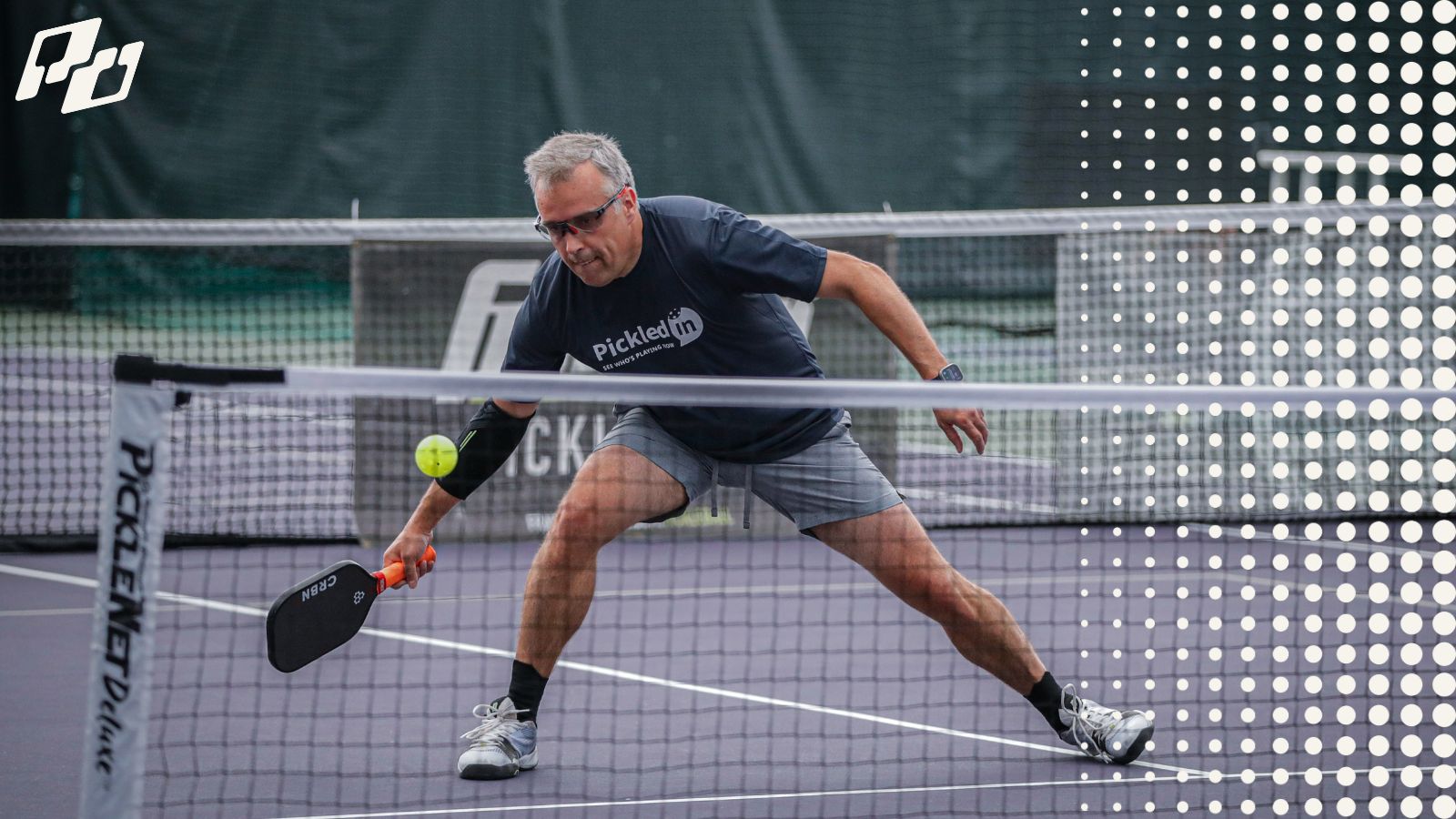
You cannot use this shot on every dink. You only attack “dead dinks” — balls that:
- bounce in front of your hip
- keep you stable at the kitchen line
- don’t push you backward
- don’t pull you wide
- sit up enough to brush up comfortably
A simple rule:
**If you’re balanced → green light.
If you’re moving → red light.**
Most intermediate errors come from attacking while shifting, reaching, or retreating. When you’re set, this shot becomes automatic.
3. The Deception Key
This is where many players get confused — and where the magic actually happens.
Your speed-up should NOT look like a dink at contact.
Of course it won’t. The ball leaves your paddle faster, higher, and more aggressively. But here’s the part that does need to look like a dink:
Your setup. Your posture. Your backswing. Your rhythm.
Those are the “tells” defenders read.
Most rec players telegraph the speed-up by:
- taking a bigger backswing
- changing their stance
- leaning back
- widening their chest
- freezing before swinging
- lifting their paddle too early
Those signals scream, “Here comes the speed-up!”
Instead, you want:
✔ the same compact paddle prep
✔ the same posture over the ball
✔ the same early paddle presentation
✔ the same movement pattern
✔ the same tempo
Then — at the last moment — you accelerate up through the ball with the brush-up motion.
It’s same start, different finish.
That’s real deception. And it makes your speed-up nearly unreactable.
Marko Grgić (coach, friend, and master of disguise-on-court) dropped some great pointers on hiding your attacks. Check this out:
4. Where to Aim for Maximum Difficulty
Once your brush-up is clean, your ball naturally dips into their body. Your highest-percentage targets:
✔ the paddle-side shoulder (the “jam zone”)
Hardest spot to counter. Forces awkward body rotation.
✔ the backhand hip
The most uncomfortable counter location for almost every rec player.
✔ the inside shoulder of the crosscourt opponent
Especially effective if they shade middle.
Your goal isn’t a clean winner — it’s a weak counter you can finish.
5. Timing Cue: Bounce → Lift → Extend
Here’s the simplest rhythm to internalize:
Bounce → Lift → Extend
Bounce: Let the ball settle. Don’t rush.
Lift: Start the low-to-high brush with your forearm — smooth, not jerky.
Extend: Finish with full arm extension, paddle slightly closed.
If it feels smooth, it will land. If it feels rushed, it will float.
6. The Easiest Drills to Lock It In
Drill 1: Brush-Up Feel Drill
Dink normally → pick one ball → brush up.
No wrist. Smooth lift.
Drill 2: Same Setup Drill
Three identical dinks → same setup → one speed-up.
The prep must match.
Drill 3: Balance-Only Attacks
Partner feeds random dinks. You may only attack if fully balanced. This engrains the decision-making.
The Takeaway: Your New Favorite Weapon
Here’s the truth: this one adjustment doesn’t just sharpen your speed-up — it changes how confident you feel at the kitchen. Because when you stop rolling over the ball and start brushing up the ball, the entire shot transforms.
Suddenly…
- you’re in control of the height and pace
- your attacks stay in, even under pressure
- your spin forces awkward counters
- your dinks and speed-ups share the same disguise
- you pick cleaner attack moments
- you finish points without swinging out of your shoes
It’s the rare technique that’s simple enough to learn today but good enough to stick with you for years.
Dial in this brush-up motion, and you’ll feel like you finally unlocked the version of your speed-up you always knew you had — precise, confident, and downright unpleasant for your opponents.
And the best part? You don’t need to hit harder… just smarter.