To read where your opponent will hit in pickleball, don’t just watch the paddle face. Read the contact window, shoulders, feet, balance, court geometry, and likely counter lanes. These cues help you narrow the possible shots earlier, react faster, and stop guessing during rallies.
Most rec players think anticipation means “watch the paddle face.”
That is partly true. The paddle face matters. The ball can only leave in a direction the paddle allows. But if you only watch the paddle, you are already late against better players.
At the 3.5–4.0 level, opponents start adding disguise. They hold the paddle longer. They use the same prep for multiple shots. They look one way and hit another. They speed up from neutral-looking positions. They also start punishing players who “guess” instead of reading the whole situation.
⮕ The better goal is not to predict every shot perfectly.
⮕ The better goal is to narrow the possibilities before the ball leaves their paddle.
Anticipation is less about raw reaction speed and more about reading the story early enough that you are already leaning toward the right answer. Pro player Ryan Fu has framed anticipation as a major part of what players call “fast hands” at the kitchen, and that idea lines up with modern pickleball coaching: better players are not just reacting faster — they are reading earlier.
So let’s get more useful than “watch the paddle.”
Here are the five cues that actually help 3.5–4.0 rec players read opponents better.
1. Read the Contact Window, Not Just the Paddle Face
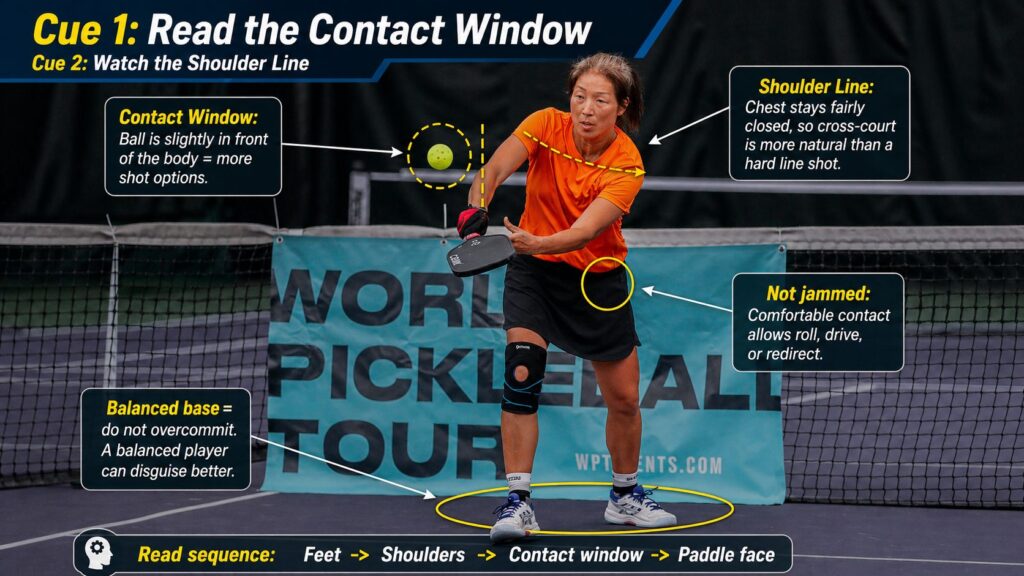
The paddle face matters, especially right around contact. But the better cue is the contact window: where the ball is in relation to the opponent’s body when they hit it.
Ask yourself:
Is the ball in front of them?
Is it beside them?
Is it jammed into their hip?
Is it low, stretched, or late?
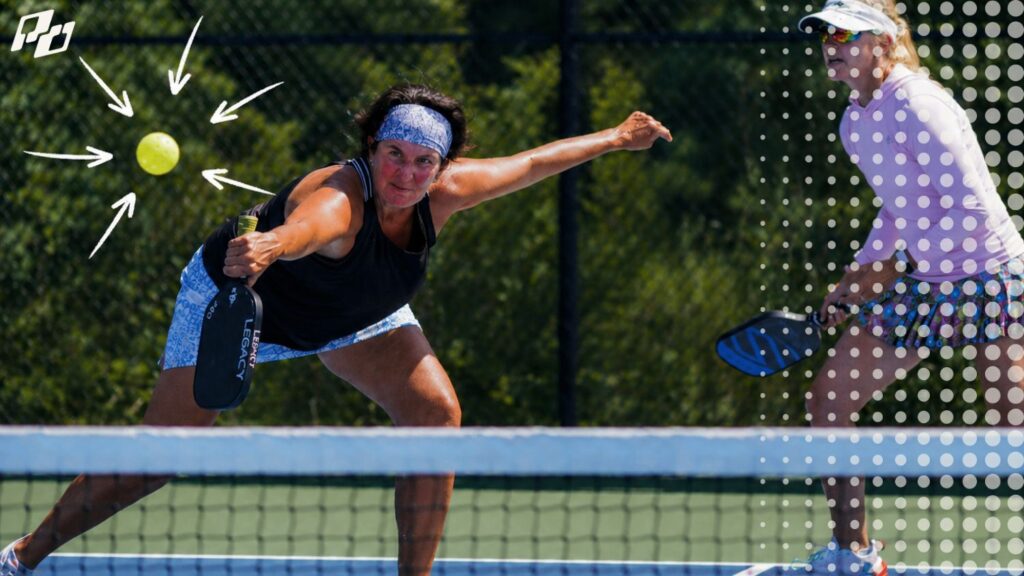
Are they balanced or reaching?
This gives you more information than the paddle face alone.
A player who contacts the ball comfortably in front of the body has options. They can roll, redirect, drive, dink, or disguise. But a player who is late, jammed, or reaching usually has fewer realistic choices.
The practical read
If the opponent is early and balanced, do not overcommit. They have options.
If they are late and reaching, expect a safer, more predictable ball: often cross-court, middle, or a defensive reset.
If the ball gets jammed into the body, expect a block, counter, or awkward push rather than a clean angle.
If the ball is below net height, the attack window shrinks. They may still speed it up, but it is a lower-percentage attack unless they have great hands.
This is where 3.5–4.0 players can make a big jump. Instead of thinking, “Where is their paddle pointing?” think, “What shots does this contact point actually allow?”
That keeps you from being fooled by fake eyes, late wrist movements, or dramatic paddle preparation.
2. Watch the Shoulder Line When They Have Time
When players have time, the shoulders can reveal a lot.
Not always. Better players can disguise with their wrist and paddle face. But most rec players, even solid 4.0s, still leak direction through the chest and shoulders when they hit drives, rolls, and aggressive dinks.
The shoulder line tells you where their body wants to send energy.
If their chest and lead shoulder are opening toward the sideline, they are more likely to go line or attack that side. If their shoulders stay closed longer, cross-court is usually more natural. If they rotate hard through the ball, expect pace. If the shoulders stay quiet and compact, expect dink, reset, or controlled roll.
The practical read
When the opponent is driving from the baseline or transition zone, scan their shoulder turn before the swing starts.
A big shoulder coil usually means they are preparing to hit through the ball. A smaller, quieter upper body often means they are preparing to soften, drop, or reset.
At the kitchen, shoulder movement is more subtle. A sudden shoulder lift, chest turn, or paddle lift can precede a speedup. A calm, square chest often means they are still in dink mode.
The trap to avoid
Do not stare at the shoulders so hard that you stop tracking the ball.
The best visual sequence is:
Ball → opponent setup → contact window → paddle face at contact.
You are not abandoning the ball. You are using the opponent’s body to interpret what the ball is likely to do.
3. Read Their Feet Before You Read Their Hands
This is one of the most underrated cues in rec pickleball.
Feet tell you whether a player is attacking, defending, neutral, or uncomfortable before their paddle does.
A lot of players can fake with the paddle. Far fewer can fake their balance.
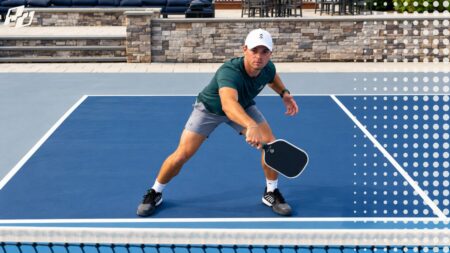
If their feet are planted and loaded, they can accelerate. If their feet are moving backward, they are less likely to attack cleanly. If they are stretched wide, they usually have fewer direction options. If they are stepping into the ball, they are probably more dangerous. If they are falling away, the ball is more likely to float, reset, or miss.
The practical read
Look for the opponent’s weight direction.
Weight moving forward usually means pressure: roll, drive, speedup, or aggressive dink.
Weight moving backward usually means survival: reset, block, lob, or soft ball.
Weight falling sideways usually limits their ability to change direction. A stretched forehand dink is often going back cross-court. A late backhand reach is often going middle or soft cross-court.
This is especially useful in the transition zone. If your opponent is moving forward comfortably, get ready for a more aggressive ball. If they are stuck, bending, or reaching, you can close space more confidently.
4. Use Court Geometry: Some Shots Are Available, Others Are Bait
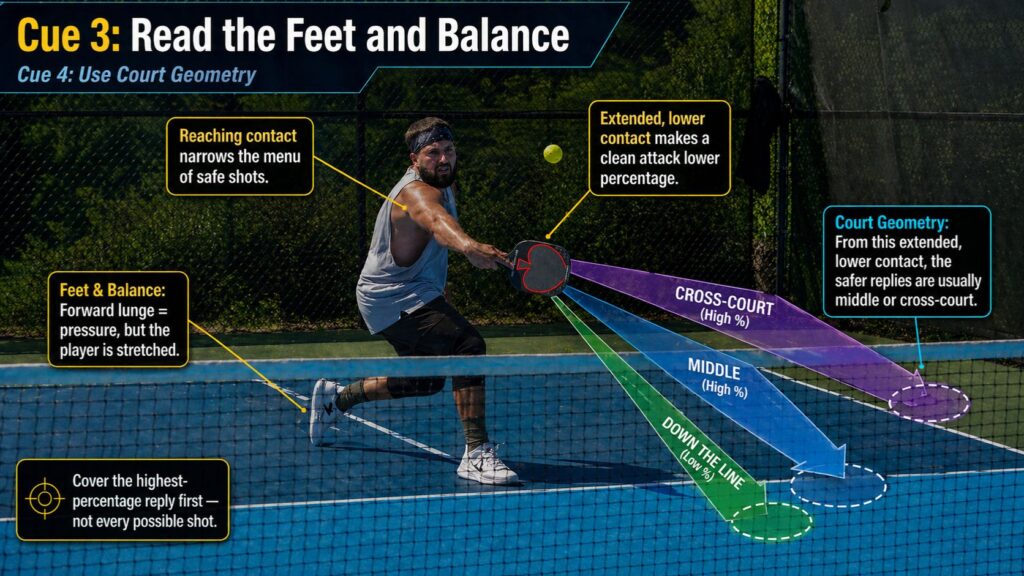
This is where better anticipation stops being “guessing” and starts becoming strategy.
Every shot you hit creates a set of likely replies. Your opponent is not choosing from unlimited options. Their best replies are shaped by court position, ball height, angle, and where you and your partner are standing.
For example, if you hit a good cross-court dink that pulls your opponent wide, their hard down-the-line attack may be available, but risky. Their safer reply is often cross-court or middle. If they are stretched and the ball is low, a sharp speedup may look tempting but has a small margin.
⮕ That means your job is not to cover everything equally.
⮕ Your job is to cover the most dangerous high-percentage options first.
This idea shows up often in advanced anticipation coaching: court vision is not only about seeing bodies; it is about understanding patterns, likely responses, and which spaces actually need defending.
The practical read
After you hit your shot, immediately ask:
What did my shot take away?
What did it leave open?
What is the opponent’s highest-percentage reply?
What is my responsibility?
What is my partner’s responsibility?
This is especially important in doubles. Many rec players get beat because both partners try to cover the same imaginary threat while leaving the obvious ball open.
If you hit cross-court and pull the opponent wide, do not assume you personally have to cover everything. Your team should shift together. One player protects the most dangerous middle/line pressure, while the other stays connected to the cross-court pattern and is ready for the softer reply. The exact responsibility depends on the ball height, opponent balance, and your team’s positioning.
If you hit a weak middle ball that sits up, both players need to expect an attack through the center or at the body.
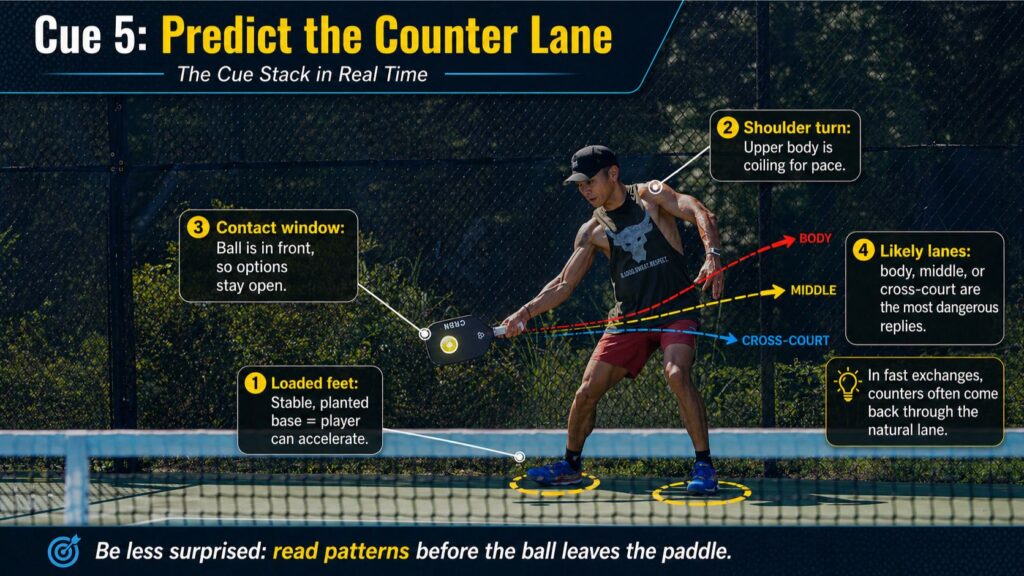
5. In Hands Battles, Predict the Counter Lane Before the Speedup Comes Back
At the kitchen, everything happens too fast to “see, decide, and move” after the ball is hit.
That is why fast hands are often really early reads.
When a player speeds up, the counter is frequently shaped by the original attack lane, the opponent’s paddle position, and whether the ball jams the body or catches a clean forehand/backhand. This is the idea behind many modern “triangle” or counter-lane concepts: the ball often comes back along predictable angles when the defender is reacting quickly rather than setting up fully.
You do not need to turn this into complicated geometry. Just understand the principle:
⮕ The faster the exchange, the more predictable the counter becomes.
Why? Because the defender has less time to disguise. They usually block or punch along the path their paddle and body naturally allow.
The practical read
If you attack into the opponent’s paddle-side hip, inside shoulder, or chicken wing, expect a shorter, jammed counter or a ball that leaks toward the middle.
If you attack wide to a forehand, expect a counter that can come back sharper or faster because they have more room.
If you speed up directly at a prepared paddle, expect the ball to come back quickly. Do not admire your attack. Reset your paddle immediately.
If you attack from too low, expect trouble. Better players are waiting to counter those low-percentage speedups.
The Cue Stack: What to Watch in Order
Here is the simplest way to train this without overwhelming yourself. Do not try to watch ten things at once. Use a cue stack.
Before they hit
Read their feet and balance.
⮕ Are they moving forward, falling back, reaching, or loaded?
As they prepare
Read shoulders and torso.
⮕ Are they rotating, staying quiet, opening line, or staying closed?
At contact
Read the contact window and paddle face.
⮕ Are they early, late, jammed, stretched, above net, or below net?
After your own shot
Read the geometry.
⮕ What reply did you make most likely?
That order matters because it keeps you from becoming paddle-face obsessed. Paddle face is the final confirmation, not the whole read.
How This Looks in Real Rec Play
Let’s make it practical.
You hit a decent cross-court dink to your opponent’s backhand. They are pulled slightly wide, the ball is below net height, and their weight is leaning outside the court.
A beginner read says: “Watch the paddle.”
A stronger 3.5–4.0 read says: “They are stretched, low, and wide. The dangerous speedup is lower percentage. The likely ball is cross-court dink, middle dink, or soft reset. I should hold my position, shade middle slightly, and not overreact.”
Now take another example.
You leave a dink a little high to your opponent’s forehand. Their feet stop moving, their chest gets taller, paddle comes up, and their weight shifts forward.
That is not just “maybe they’ll attack.”
That is a flashing yellow light.
You do not need to retreat. But you should widen your base, get your paddle ready in the likely counter window, and expect pace to your body, dominant-side shoulder, or middle.
This is how the game starts to slow down.
Not because your reflexes suddenly got superhuman. Because your brain has already reduced the menu.
How to Practice This in Your Next Rec Session
For one game, pick just one cue.
Not five. One.
Start with contact window because it gives the fastest payoff.
During every rally, quietly ask:
Was the opponent early or late?
Balanced or reaching?
Above net or below net?
Comfortable or jammed?
Do not worry if you miss shots at first. You are training your eyes.
Next game, add feet.
Are they moving forward or backward? Are they loaded or off-balance?
Then add patterns.
Does this player always speed up off a high backhand dink? Do they always go cross-court when stretched? Do they panic-reset when jammed? Do they counter better on forehand or backhand?
This is how advanced anticipation develops: one layer at a time.
The Real Goal: Be Less Surprised
If you want to read where your opponent is going to hit the ball, do not rely on one clue.
The paddle face matters, but it is only the last piece of the puzzle.
The real skill is reading:
- Contact window — what shots are physically available?
- Shoulder line — where is their body energy going?
- Feet and balance — are they attacking or surviving?
- Court geometry — what did your last shot make likely?
- Counter lanes — where does the ball usually come back in fast exchanges?
That is the difference between reacting late and arriving early.
For rec players, especially in the 3.5–4.0 range, this is one of the fastest ways to improve without changing your swing. You start getting to balls sooner. You stop being shocked by speedups. You cover smarter instead of running harder. And you begin to understand that anticipation is not magic.
It is pattern recognition, body reading, and court awareness working together.