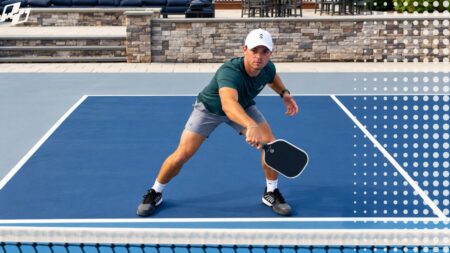
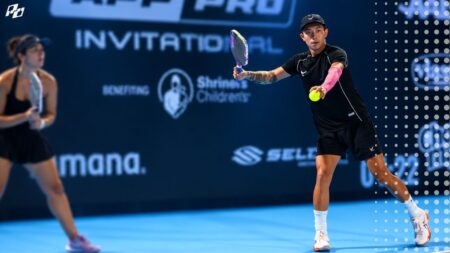
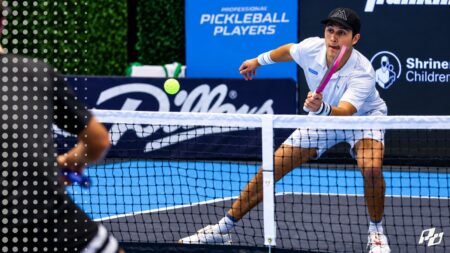
You lunge for a dink, feel your weight shift too far, and before you know it, you’re off balance, floating a ball that screams “PUTAWAY!” for your opponent.
Being off balance is one of the most common (and costly) problems in pickleball—and one of the most fixable.
Let’s break it down: why it happens, what it does to your game, how to avoid it, and most importantly, what to do when you’re already off balance and the ball is coming your way.
What Happens When You’re Off Balance
Let’s start with the obvious: when you’re off balance, you lose control. You can’t transfer weight effectively, your paddle control suffers, and you’re more likely to pop balls up, hit out, or dump shots into the net. Worse still? You’re more prone to injury.
Being off balance makes your shot selection desperate, not deliberate. That’s why you’ll see even experienced players speed up the ball out of position—it’s the All-Or-Nothing gamble, and most of the time, it ends badly.
Why You’re Off Balance in the First Place
There are a few usual suspects:
- Improper footwork – Running backward, hopping while dinking, or stepping into the kitchen and getting stuck.
- Poor court positioning – Overreaching instead of moving your feet.
- Fatigue – Tired legs lead to lazy recovery and slower reaction time.
- Too upright posture – Standing tall makes you unstable. Think “athletic squat” instead of soldier stance.
- Panic – Yep. The mental game matters. Reacting instead of anticipating often results in imbalance.
The fix starts with awareness, but it doesn’t end there.
What Not to Do When You’re Off Balance
First rule of the off-balance club? Don’t make it worse. That means:
- Don’t speed up the ball unless you have control.
- Don’t take wild swings at shots outside your strike zone.
- Don’t go for winners unless you’re re-centered.
Instead, pros do this: they reset. If you’re off balance, reset to the kitchen or lob high to buy time. It’s not passive—it’s smart.
What to Do When You Are Off Balance
Even with perfect form, it still happens. Here’s your recovery plan:
1. Reset to the Middle
If you’re off balance, avoid high-risk angles. A neutral shot down the middle gives you time to recover and doesn’t set your opponent up for an easy putaway.
2. Go Down the Line (Situational)
If the middle is blocked or you’re stuck in a cross-court rally, a simple down-the-line dink can shift the pressure. But be careful—if your opponent is an Erne threat, that line shot could be a trap.
Coach Kyle Koszuta breaks it down in detail:
3. Lob (Yes, Really)
A high, soft lob is one of the best ways to reset your balance. It gives you time to reposition and forces your opponent to play a less aggressive shot.
How to Stay On Balance in the First Place
✅ Drop Your Center of Gravity
A wide, athletic stance with bent knees keeps you grounded. Think “sit into the shot” rather than “reach for it”.
✅ Use Proper Footwork
Never backpedal. Let your partner cover lobs, and always move forward or sideways—not backwards in panic. Also, don’t step into the kitchen unless you can recover immediately. Step in, dink, and shuffle back.
✅ Pickleball-Approved Shoes
Tennis or pickleball-specific shoes matter. Running shoes are made for forward motion and can actually make you more likely to roll an ankle during lateral movement.
✅ Listen to Your Body
If you’re tired, you’re more likely to fall or misstep. Hydrate, fuel, and know when to call it a day. No point is worth an injury.
Train for Balance Off the Court
Want better balance? Build it. Here are some quick drills you can do at home:
- Side-to-Side Jumps + Hold – Lateral hops that mimic court movement. Land and freeze for control.
- Single-Leg Reach – Stand on one leg, extend the other slowly. Works your core and lower body stability.
- One-Leg Flamingo with a Ball Toss – Balance on one foot while gently tossing and catching a ball. Builds coordination and stabilizer muscles.
- Squat to Balance – Squat down, then rise and balance on one leg. Engages glutes and core—just like real movement at the kitchen line.
These exercises take 5–10 minutes, no gym needed. The more you do them, the more stable you’ll feel on court.
Balance Is a Skill, Not a Trait
Staying balanced in pickleball isn’t about being young or athletic—it’s about being smart, intentional, and body-aware.
The best players aren’t always the fastest. They’re the ones who move efficiently, recover quickly, and make great decisions when they’re not in the perfect position.
So next time you’re falling sideways trying to flick a backhand speed-up off your toes… maybe just reset. Stay grounded. And play the long game.
Your knees (and your doubles partner) will thank you.