
Most advice on defending the lob is too late to be really useful.
It usually starts after the ball is already over your head: turn, run, don’t backpedal, call switch. That advice is fine, but it misses the real skill. The best lob defenders are not just better at chasing lobs. They’re better at seeing them early.
At a higher level, the pattern is clear: recognition is everything. The paddle face has to open to hit a lob, and if you read it early and take a small step back, you can still recover easily if you’re wrong. More advanced cues also come into play—opponent tendencies, shoulder drop, weight shifting to the back foot, subtle “look up” tells, adjusting your position slightly against known lobbers, and the constant reminder not to backpedal.
That is where this topic gets interesting for rec players.
Because if you only think about lobs as a retrieval problem, you’ll always feel a half-step late. If you start thinking about them as a pattern-recognition problem, you begin to feel like you have more time—even when the opponent hits the same shot.
The first thing most rec players get wrong
A lot of players think lob anticipation is basically this: watch the paddle face. If it opens, retreat.
That’s not wrong. In fact, the open paddle face is one of the clearest visual giveaways that a lob is coming. But if that is your only read, you’ll still be late against better lobbers.
Good players can disguise the paddle face. Good touch players can make a lob look a lot like a dink until very late. A well-executed lob should resemble a normal dink for as long as possible.
So the real answer is this: you do not anticipate lobs from one cue. You anticipate them from a stack of cues.
That stack usually includes:
- opponent tendencies
- the kind of rally you’re in
- your own momentum
- subtle body-position changes
- then, finally, the paddle face
That sequence matters.
Start with tendencies, not technique
The best early read usually happens before the ball is struck. If you’re playing someone who likes to lob, you should already be mentally sensitive to that possibility before the rally even develops.
This sounds obvious, but most rec players don’t actually use it.
They treat every opponent the same. They stand in the same spot, with the same mindset, no matter who is across from them. Then they act surprised when the player who has lobbed multiple times already lobs again.
If someone has shown you three things early in a match—
they like the forehand dink lob,
they use it when pulled wide,
or they use it when you creep too aggressively onto the kitchen line—
that is not random anymore. That is a pattern. And once you have a pattern, your anticipation should change.
Not panic. Not retreating three feet off the line forever. Just a small mental shift: this player is willing to lob here.
That alone will sharpen your first step.
Read the rally, not just the paddle
This is where better anticipation starts to feel less mechanical and more tactical. A lob rarely appears out of nowhere. It usually appears in a rally context that makes it logical.
One of the most consistent patterns is this: lobs often come when your body weight is moving forward, because that’s exactly when it’s hardest to reverse momentum and recover. Long dink rallies and controlled, neutral exchanges can also create ideal lob opportunities.
That is a much better cue than “just look at the paddle.” Think about a few common rec-play situations:
Scenario 1: You’re creeping forward after winning the dink exchange
You’ve hit two good dinks. Your opponent is a little stretched. You smell a speed-up or pop-up, so you lean in.
That is exactly when some players lob.
Why? Because your feet are mentally and physically moving forward. The lob punishes that forward bias.
Scenario 2: Your opponent is under pressure but not broken
A lot of rec players expect either a reset dink or a speed-up from a player who is slightly out of position.
But better lobbers use the lob as a recovery shot. When players get pulled wide or off balance, they’ll often lob deep to buy time and recover court position.
That means if you force a player into a defensive stretch, don’t only hunt the weak dink. Stay aware of the escape lob.
Scenario 3: The rally has gone too comfortable
This one is underrated.
If a dink exchange has settled into a predictable rhythm, some players use the lob not because it is tactically perfect, but because it breaks rhythm. It’s a pattern interrupt. Many rec players get burned here because they stop actively reading and start “grooving.”
The best anticipators never fully go to sleep in a neutral dink pattern.
The body-position tells that matter more than people realize
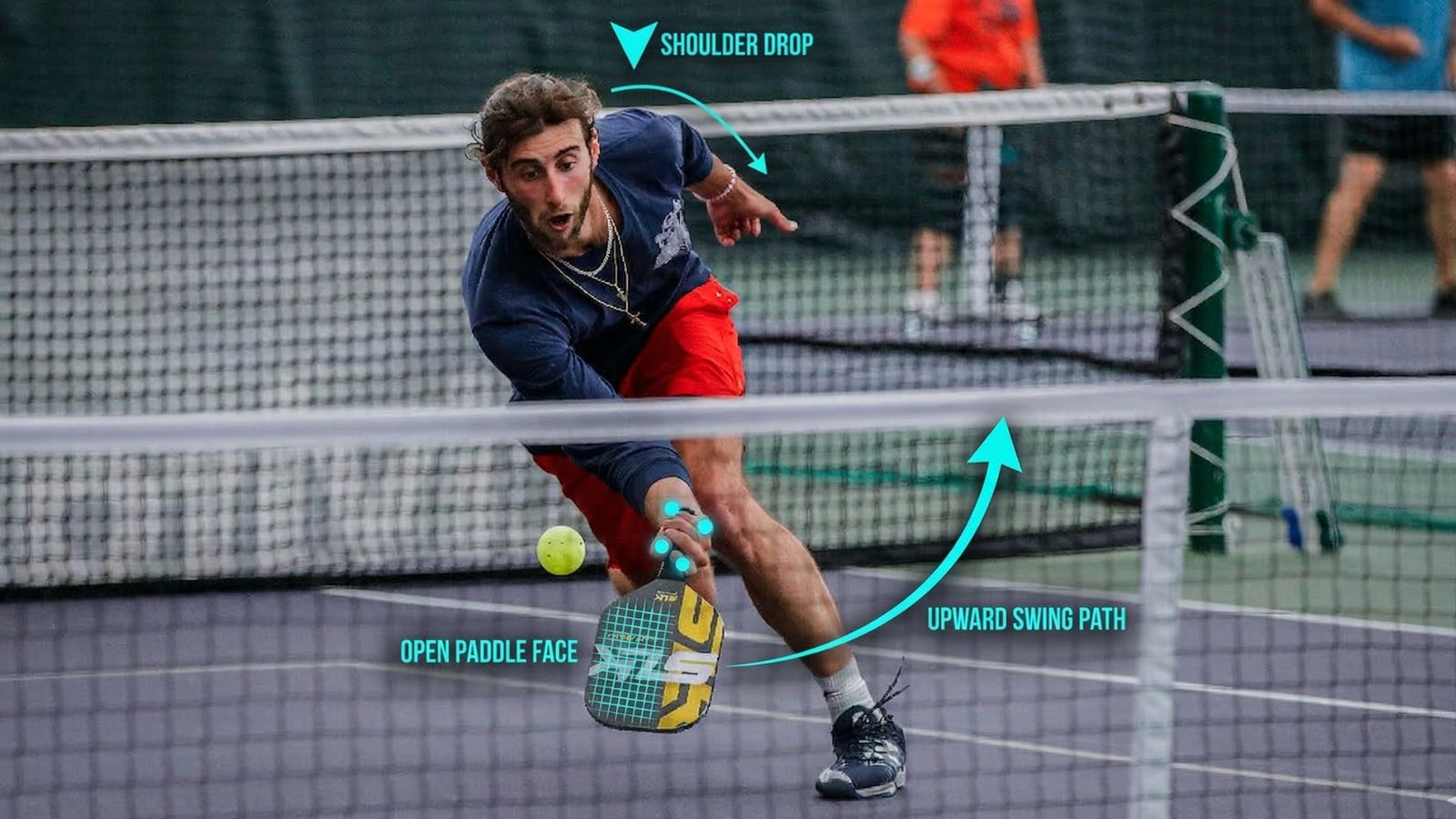
Several subtle cues show up consistently:
⮕ slight shoulder drop
⮕ bigger takeback than their normal dink
⮕ weight shifting to the back foot
⮕a brief look upward
⮕ the paddle face beginning to point up earlier than usual
Those are good cues—but they are only valuable if you compare them to that player’s normal dink. That’s the part most rec players miss.
A paddle face that looks “open” to you might simply be that player’s regular soft-dink mechanics. A little shoulder drop might be nothing. But if their normal dink is compact and quiet, and suddenly you see:
- a slightly deeper pocket under the ball,
- a little more lift from the legs,
- a bigger upward swing path,
- and the chest or eyes rising earlier,
then the chance of a lob jumps. In other words, don’t watch for “lob mechanics” in the abstract.
Watch for change from baseline behavior.
That’s a much more advanced read.
The paddle-face hack is real—but use it correctly
The idea is simple: to hit a lob, the face has to open, and when you see it begin to point up, you take a step back. If you guessed wrong, you just move back in.
That’s a great cue—but only if you keep the reaction small. The mistake is turning “take a step back” into “retreat every time I see anything soft.”
That creates its own problem. You start giving away the kitchen too easily, and now opponents can manipulate you with fake looks.
So the adjustment should usually be small and elastic:
- a little release step
- a tiny hop back
- a neutralizing shift that buys you time
Not a full surrender.
That’s why stronger players sometimes stand a step off the line against known lobbers—not because they’re scared of the lob, but because they’re buying a little extra reaction time without abandoning the kitchen altogether.
For rec players, that can be a huge practical fix.
The real anticipation skill: be ready before you confirm
This is where good lob readers separate themselves.
⮕ They don’t wait for certainty.
⮕ They move on probability.
If the rally context, the opponent tendency, and the body cues all suggest “lob might be coming,” you don’t need perfect confirmation. You just need enough information to start your first move.
That first move is often tiny, but it’s the whole point. Because a half-step taken early is worth far more than a desperate sprint taken late.
And if you’re wrong, you recover.
Too many rec players stay frozen because they want certainty. By the time certainty arrives, the ball is already behind them.
What to do with your feet when you read it
Once you recognize the lob early, the movement matters just as much as the read.
⮕ The biggest mistake: backpedaling while looking up.
A better movement pattern is to open the hips, turn, and run to space. For rec players, the cue is simple: turn first. Then chase.
Not:
see lob → shuffle blindly backward
But:
see lob → pivot → run behind the bounce
That one sequence change can save both points and ankles.
The part almost nobody drills enough: getting around the bounce
Once the lob is recognized, the next step is just as important: getting behind the ball instead of drifting under it.
That’s a big deal.
A lot of rec players chase the arc instead of the landing zone. They stare at the ball the entire time, arrive late, and then end up hitting while falling backward or off to the side.
Better lob defenders run to where the ball is going, then set the bounce in front of them.
That allows three things:
- a clean overhead if possible
- a stable defensive shot if needed
- or a controlled reset instead of a panic swing
In doubles, anticipation is not only yours
There’s often confusion about who should take the lob. The “right” answer depends on:
- who has the better angle
- who is moving forward
- court positioning
The important thing is not having one perfect rule. It’s having a default. If you have no default, both players hesitate—and hesitation is what really kills lob coverage.
For many rec teams:
⮕ if the partner has the easier forward angle, call “switch” early
⮕ if the original player can turn cleanly, they take it
The exact rule matters less than having one. And the call has to happen early—not when the ball is already landing.
A smarter practice plan than “just have someone lob me”
Most players practice lobs the wrong way. They know a lob is coming. That trains reaction—not anticipation. Instead, mix it up. Have a partner alternate between:
- normal dink
- speed-up
- lob
Now you’re reading context, timing, and cues. That’s real training.
The practical takeaway for rec players
If I had to simplify all of this into one practical idea, it would be this: you should not try to read the lob at contact. You should try to feel it coming before contact.
That means looking at:
✔️ who is hitting
✔️ what pattern the rally is in
✔️ whether they are pressured or balanced
✔️ whether your momentum is forward
✔️ whether their body looks different from their normal dink
✔️ then confirm with the paddle
That is the real anticipation stack.