
Playing with better pickleball players? Don’t try to prove you belong. Simplify your job, trust your best shots, communicate clearly, and focus on smart decisions instead of outcomes. The less you audition, the more likely you are to actually play your game.
There is a strange thing that happens when the best player at open play finally asks you to partner.
For weeks, you wanted this.
Then the game starts.
Your normal third-shot drop suddenly feels like a golf putt for $2 million. You stop attacking balls you normally attack. You apologize after misses. You start wondering whether your partner thinks your footwork is terrible.
Then you dump an easy return into the net.
What happened?
You did not suddenly become worse at pickleball.
You started auditioning instead of playing.
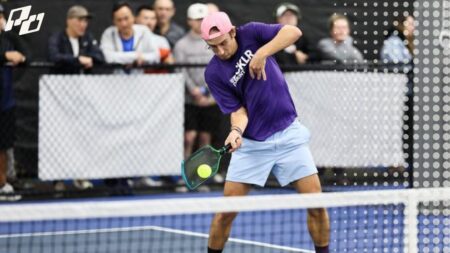
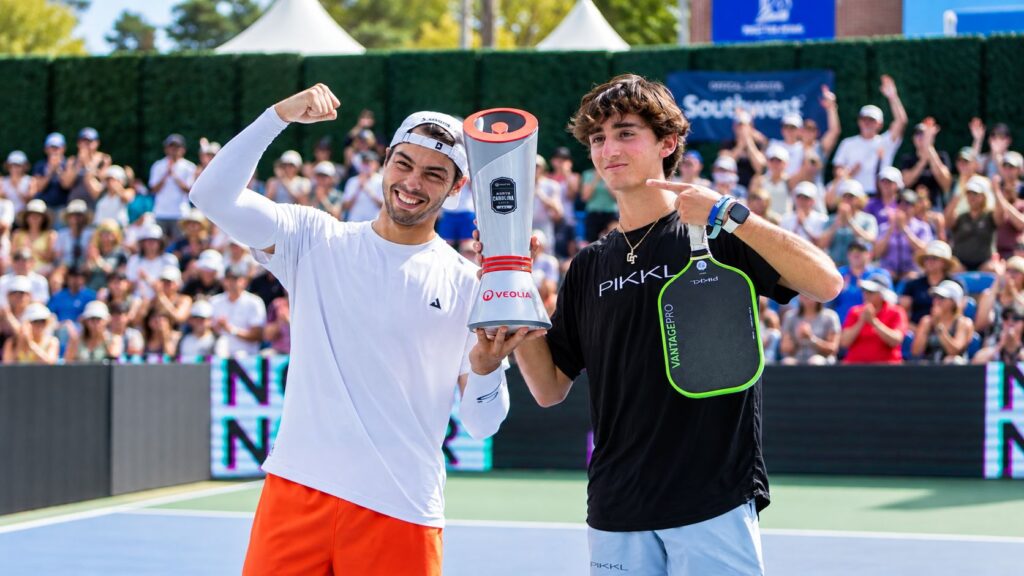
And even Gabe Tardio, currently the PPA’s No. 2 men’s doubles player, has been there.
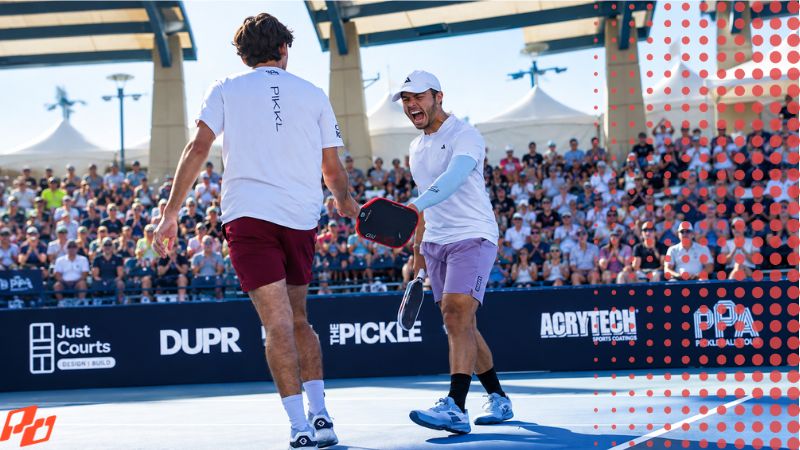
Tardio began partnering with Ben Johns at the 2025 Mesa Cup, and the pairing quickly became one of the dominant teams on tour. By 2026, they were the top-seeded men’s doubles team at major PPA events and had stacked up title after title together.
But the start was rough.
Tardio says his first match with Johns in Mesa was one of the worst performances he could remember. He felt extremely tight, and he says he played badly through roughly their first three tournaments together. One factor was Johns’ quiet demeanor: after Tardio missed, his new partner was not necessarily looking over and giving him constant reassurance.
Then Tardio figured something out.
Johns wasn’t silently grading every error. He understood that a partnership takes time. Tardio says realizing Johns believed in him—essentially, play your game and we’ll figure this out—gave him confidence and allowed him to play freely again.
That’s useful for pros. It may be even more useful for the 3.5 who suddenly gets invited into a 4.0 game.
Because the biggest mistake weaker players make around stronger players is trying to become a stronger player during the match.
Don’t.
The better-player tax
Playing with someone significantly better creates a weird mental tax.
You don’t merely think: Where should this return go?
Your brain adds: Don’t give them a reason not to invite me again.
Now your return has two jobs.
One is landing deep.
The other is protecting your reputation.
That second job is useless.
Sports-psychology research on choking gives us a good explanation for why. Under pressure, attention often gets pulled away from useful information and toward worries, consequences or excessive monitoring of skills that normally happen automatically.
In pickleball language: you normally just hit your drop.
Now you’re thinking: Stay low. Loose grip. Don’t pop it up. Ben—well, not Ben, but Steve the 4.6—is watching. Bend your knees. Don’t embarrass yourself.
And then you hit the ball four feet long.
Trying harder has actually made the task harder. The fix is counterintuitive: when the level of the court goes up, make your own job smaller.
Give yourself a three-ball contract
Before playing with significantly better players, decide what your game will be built around.
Not ten things.
Three.
For example:
- Deep return.
- Low transition ball.
- No attack from below the net.
That’s your contract. You are still allowed to do other things. But those three decisions are what you judge yourself on.
Why?
Because stronger players punish indecision much more efficiently than they punish ordinary, predictable pickleball.
A good 4.5 doesn’t need you to hit a brilliant ATP. They would much rather have you return deep, arrive at the kitchen, recognize an unattackable ball and keep the rally alive.
One recent coaching breakdown on playing superior opponents makes essentially the same point: choose one controllable execution goal rather than chasing the score. Examples include getting to the kitchen behind most returns or refusing to drive balls from below net height.
That sounds almost too simple. That’s why it works.
Don’t become “safe”
There is one complication. Some players respond to better competition by deciding: Fine. I won’t miss anything.
Then everything becomes cautious.
Soft return.
Tentative drop.
Passive dink.
No attacks.
And five rallies later the stronger opponents realize you are never going to hurt them. Now you get every ball.
This shows up repeatedly in experienced-player discussions. One player who entered a 4.0-plus bracket with a much stronger partner initially tried to survive with safe returns and safe drops. The opponents quickly identified him as the weaker player and targeted him relentlessly.
He eventually started using the one aggressive weapon he actually trusted—a hard backhand counter/block—and found the games became much more competitive. That’s one player’s experience, not controlled evidence, but the lesson is useful.
High percentage does not mean harmless. If you have one shot stronger players need to respect, use it.
Maybe yours is:
- a heavy forehand drive
- a very good backhand counter
- an aggressive forehand dink
- a reliable roll volley
You don’t need seven weapons. You need enough threat that the opponents cannot comfortably send every ball to you.
Pro Mari Humberg describes a similar idea when discussing being targeted in mixed doubles: knowing the ball is coming to her does not mean becoming passive. She still uses active footwork and intentional dinks to create pressure and eventually produce a ball her partner can attack.
Think stable, not timid.
Let the better player be better
This sounds ridiculous until you watch recreational doubles. Your stronger partner starts taking more middle.
So you think: I need to contribute.
You stretch for a ball they were going to crush. Or they poach once, so next rally you overcompensate and attack something silly.
Or you see them hit three winners and decide maybe tonight is finally the night to test that inside-out backhand speedup you watched on Instagram.
Stop.
Your partner does not need equality of touches. They need complementary touches.
Tardio’s own career is an extreme example. He realized early that many elite men’s players wanted the left side. Instead of fighting to be another left-side player, he deliberately built himself into an elite right-side partner. He studied film, worked heavily on getting to the kitchen and drilled his backhand counter repeatedly.
That is a much smarter question for rec players:
Not: “How do I prove I’m as good as my partner?”
But: “What does this team need me to do?”
If your partner has the better forehand in the middle, let them own more middle.
If they create pressure with drives, look for the next ball rather than trying to duplicate the drive.
If they’re attacking aggressively, perhaps your job is making resets and giving the team another chance.
An experienced-player discussion about partnering an aggressive player landed on exactly this: keep hitting high-percentage balls, reset when necessary, and look to capitalize on weak replies created by your partner’s pressure rather than competing with their aggression.
You are not disappearing.
You are playing doubles.
Stop reading your partner’s face
This one matters more than people admit.
You miss. Your stronger partner says nothing. Now you think: He’s annoyed.
Maybe.
Or perhaps he’s thinking about where the return came from. Perhaps she’s deciding whether to stack. Perhaps they always look like that.
Tardio essentially ran into this problem with Johns. His partner’s quietness initially felt uncomfortable because he was accustomed to more visible reassurance. Once Tardio understood that Johns’ silence did not mean loss of confidence, the pressure eased.
Do yourself a favor before playing with a stronger partner. Ask one useful question: “Anything specific you want me covering or looking for?”
Now you have information.
During the game, stop trying to decode eyebrow movements.
And stronger players: you can help enormously here too. Coaching advice for struggling partners consistently favors short, task-based communication over technical lectures:
“Deep middle.”
“I’ve got middle speedups.”
“Same ball.”
“One more.”
Not: “You’re opening your paddle face and you’re late with your split step.” Nobody needs a private lesson at 8-9.
After a miss, diagnose the decision—not yourself
This may be the most useful habit in the whole article. You miss a third-shot drop. There are two ways to process it.
Bad: “My drops suck tonight.”
Useful: “Correct shot. Three inches low.”
The outcome and the decision are separate things. A correct shot can still miss; abandoning the decision because of one bad outcome can make your strategy unravel.
So after an error, classify it quickly:
Decision error? Wrong ball to attack.
Execution error? Right shot, poor contact.
That is enough.
Do not turn a single miss into a personality diagnosis. And don’t rebuild your mechanics between points.
When the opponents are much better, change the math
Now let’s switch from a better partner to better opponents.
Most intermediate players make one of two mistakes. They either become ultra-conservative and let the stronger team slowly squeeze them…or they start attempting miracle shots because they feel they have “nothing to lose.”
Neither is particularly smart.
Pro Zane Navratil gave an interesting explanation when facing Ben Johns and Gabe Tardio. He essentially argued that if his team’s normal dink game had almost no chance of beating the superior team, increasing aggression and randomness could improve the underdog’s odds—even if that style would normally be less reliable.
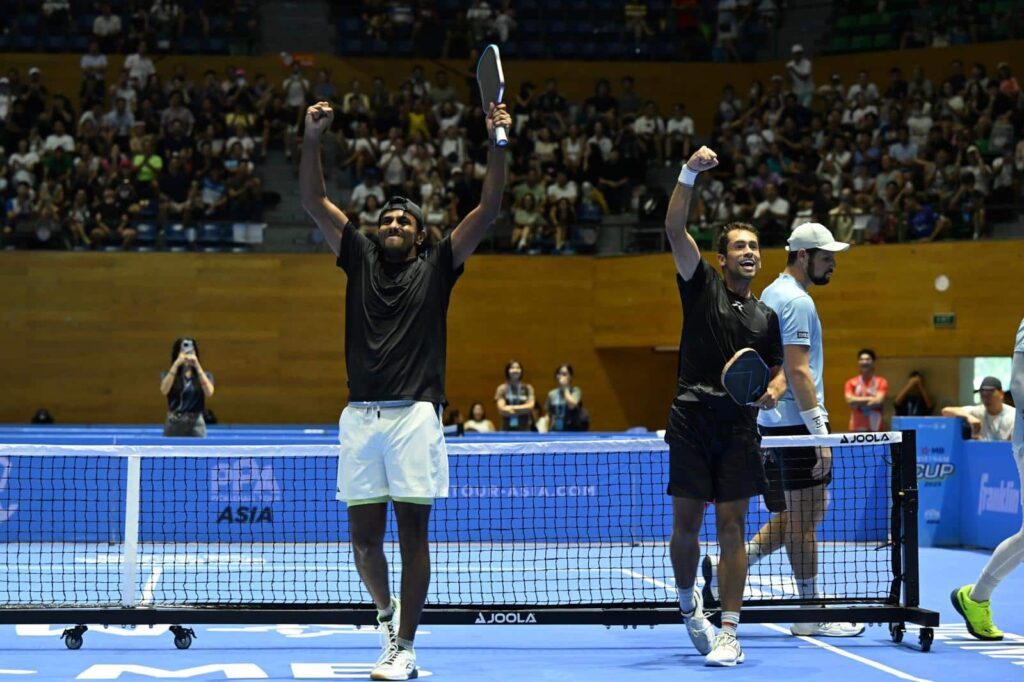
His rough illustration was that a 40%-effective aggressive strategy can make more sense than a 20%-effective attempt to beat an elite team at its preferred game.
That doesn’t mean: BANG EVERYTHING.
It means recognize where the skill gap actually lives. If they are vastly better in extended neutral dink rallies, shortening selected points may be rational.
If their hands are dramatically better than yours, randomly speeding everything up is probably suicide.
If they’re killing your short returns, depth matters more than adding another five mph to your serve.
Play the percentage that gives your team the best chance—not the percentage you’d normally use against your Wednesday-night group.
Use this 10-second reset when you start tightening up
Pressure interventions have genuine evidence behind them.
A 2026 meta-analysis of 21 studies found that techniques including pre-performance routines, attentional training, mindfulness and self-talk produced improvements in motor accuracy and execution under pressure, although results were less consistent in dynamic “open-skill” environments such as racket sports.
You don’t need a sports psychologist between rallies.
Try this:
1. Exhale
Take one genuinely long exhale. Nothing theatrical.
2. Loosen your paddle hand
Pressure usually shows up as grip tension.
3. Pick one external target
“Deep middle.”
“Backhand foot.”
“Two feet over the net.”
4. Play
Commit to the cue and let the point happen.
Notice what is missing?
No swing analysis.
No DUPR calculation.
No wondering if your partner regrets inviting you.
Your attention is back outside your head.
The better-player rule
Next time you step onto a court where you are clearly the weakest player, don’t ask yourself to “step up.” Ask yourself to shrink the game.
Three jobs.
One trusted weapon.
One target before each point.
And after a mistake, one diagnosis: Bad decision or bad execution?
Then move on.
Gabe Tardio did not start playing well with Ben Johns because he finally figured out how to impress Ben Johns. He started playing well when he stopped needing to.
That’s the part recreational players should steal.