

Let’s get one thing out of the way: there’s no single “best” grip in pickleball.
There’s only what works for you, your style, your physicality, and your goals.
In fact, many players—especially those coming from tennis—find themselves cycling through 2–3 grips depending on the shot, the situation, or even which side of the court they’re on.
So let’s break it all down: the main types of grips, who tends to use them, what they’re best (and worst) for, and when you might want to switch things up.
The Core Pickleball Grips (And What They’re Good For)

1. Continental Grip
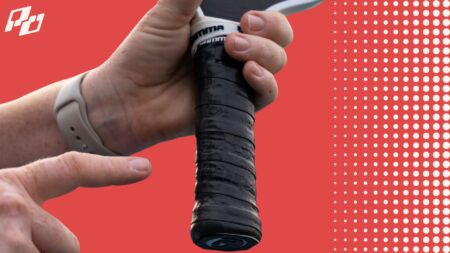
Think: Hammer grip, like you’re holding the paddle as if to bang in a nail.
Use It For:
- Dinks at the kitchen
- Volleys and resets
- Blocks and defensive shots
- One-handed backhand flicks
- Overheads
Why Players Love It:
It’s simple. Versatile. And easy to transition between forehand and backhand at the net. A ton of advanced players default to continental at the kitchen line because it minimizes movement and maximizes reaction time.
But…
It’s not ideal for topspin-heavy drives from the baseline. The paddle angle makes it hard to roll the ball without adjusting your wrist, and that can lead to inconsistent contact or pop-ups.
Who It’s Best For:
- Players who prioritize net play and consistency
- Those who love keeping things simple and compact
- Beginners learning to feel the ball off the paddle
2. Eastern Grip
Rotate your paddle a bit so your palm is more behind the handle. Similar to a classic tennis forehand grip.
Use It For:
- Drives from both wings
- Drops and dinks (especially backhands)
- Serves with control and some spin
Why Players Love It:
It’s a true all-rounder. Offers a naturally open paddle face for backhand dinks and slices. It’s great if you’re looking to develop control + moderate topspin without fully committing to a western-style swing.
But…
Some players find backhand flicks and resets trickier with an Eastern grip because the paddle face opens up too much, especially on the short hop.
Who It’s Best For:
- Intermediate players who want to develop both spin and precision
- Tennis converts who used a more neutral forehand grip
- Players who like variety without constant grip switching
3. Semi-Western Grip
Rotate the paddle even more under your hand—this grip is starting to feel “under” the handle.
Use It For:
- Topspin forehand drives
- Serves with heavy kick
- Two-handed baseline play
Why Players Love It:
This grip makes it easier to generate topspin and drive the ball aggressively. If you’re looking to shape shots, roll dinks, or hit heavy passing shots, this grip gives you the wrist mobility to do it.
But…
It’s not great for resets or fast hands at the net. You’ll often find yourself reaching awkwardly or popping up balls if you don’t shift grips.
Who It’s Best For:
- Players with a strong baseline game
- Aggressive hitters who favor spin over flat pace
- Tennis players with a modern forehand style
4. Western Grip
Your palm is almost completely under the handle. Think of heavy topspin tennis forehands.
Use It For:
- Ultra-topspin drives
- Extreme angles
- Surprise flicks with a 2-handed backhand
Why Players Use It (Even If It’s Not Recommended):
It lets you hit ridiculous topspin and late-contact shots. If you’ve got lightning-fast hands and an unconventional style, this grip might feel powerful and familiar (especially for former tennis players like Jack Sock fans).
But…
It’s a nightmare for backhand dinks, resets, and anything at the kitchen. The paddle face is closed, making soft game feel nearly impossible without constant adjustment.
Who It’s Sometimes Best For:
- Tennis players transitioning who can’t ditch the habit (yet)
- Baseline bashers who avoid the kitchen
- 2-handed backhand players experimenting with spin
Heads up: Even high-level players say “I wouldn’t recommend a full western for pickleball”—it creates more problems than it solves at the NVZ.
Should You Switch Grips During a Game?
TL;DR: Yes—if you’re comfortable with it.
Many 4.0+ players switch grips almost automatically:
- Eastern/semi-western for serves and baseline drives
- Continental at the net
- Adjusting on the fly for speedups, resets, or short hops
Some even split their grip strategy by side:
- Semi-western on the left side (more forehands)
- Continental on the right (more resets, backhands)
Others develop grip changes tied to specific patterns:
“I switch during my split step without even thinking about it.”
“If I see a pop-up, I rotate to eastern and crush it.”
“During hands battles, I go straight to continental for control.”
If you’re not comfortable switching yet, that’s okay. Many advanced players note:
“You don’t have to switch. But you should know when your grip is limiting you.”
Grip Recommendations by Play Style
| Player Type | Suggested Grips | Why |
|---|---|---|
| Beginner | Continental | Simple, versatile, easy to learn |
| Net Rusher | Continental + Eastern | Clean transitions, better resets |
| Spin Driller | Semi-Western + Continental | Max spin at baseline, control at NVZ |
| Power Baseline Player | Semi-Western or Western | Big drives, but consider 2HB for control |
| Touch Artist | Eastern + Continental | Best for dinks, drops, and placement |
| Two-Handed Backhand Fan | Semi-Western (forehand), Eastern or Continental (backhand) | Versatile and stable across shots |
Your Grip Is a Tool, Not a Rule
Here’s the thing: grips are personal.
Some players swear by never switching. Others treat the paddle like a Swiss Army knife. What matters is that your grip:
- Matches your goals for each shot
- Gives you control and confidence
- Doesn’t limit your ability to adapt
So try different grips. Film yourself. Experiment in rec play. And most importantly—pay attention to when a shot feels off. That’s often your grip talking.
Want more spin? Open the paddle.
Struggling with resets? Simplify to continental.
Popping up your dinks? Check your angle and grip pressure.
Your grip isn’t everything—but it can unlock a whole new level of feel, spin, and confidence on the court.