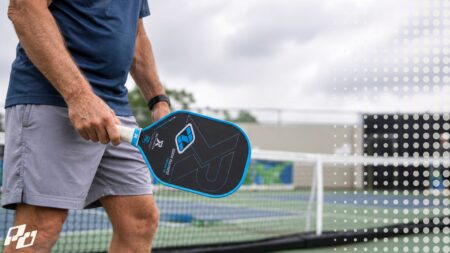
There’s a moment that every pickleball player hits—your timing feels off, your hands feel slow, and your arm is just… sore. The culprit might not be your mechanics, or even your schedule. It might be your paddle.
More specifically: your paddle’s swing weight.
Most players obsess over paddle weight because, well, it’s printed right on the label. But there’s a difference between how heavy a paddle is and how heavy it feels when you swing it. And understanding that difference might be the key to saving your arm—and improving your performance.
If you would rather skip the theory, the paddle quiz turns your answers into three lab-scored picks in about 90 seconds.
Let’s break it down.
Ten questions, three paddles matched to how you play, scored on lab data.
Static Weight vs. Swing Weight: What’s the Difference?
You’ve probably seen a paddle listed at 7.9 oz, 8.2 oz, or something similar. That’s static weight—what it weighs on a scale. Important? Yes. But it’s not the full story.
Swing weight is how heavy the paddle feels when you swing it. And that’s what really matters on the court.
Why? Because your paddle isn’t just sitting in your bag. It’s moving. Fast. Through the air. Over and over again. The further the weight is distributed toward the head of the paddle, the harder it is to maneuver—and the more stress it puts on your body.
Signs Your Paddle Might Be Too Heavy
Wondering if your current paddle is a little much? Here are some telltale signs:
- Slow hand speed, especially in fast kitchen exchanges
- Arm or elbow soreness after playing, particularly in your forearm
- Fatigue or lack of control during longer games
- Trouble reacting quickly on volleys or hand battles
- Over-rotating or muscling shots instead of swinging smoothly
If any of these sound familiar, your paddle’s swing weight might be too high for you—even if its static weight seems reasonable.
What Actually Impacts Swing Weight?
Three main factors determine swing weight:
| Factor | Effect on Swing Weight |
|---|---|
| Paddle Weight | Heavier paddles = generally higher swing weight |
| Paddle Length | Longer paddles = more leverage, more resistance through air |
| Balance Point | More head-heavy = more effort to swing, greater arm strain |
You can have a “light” paddle that feels heavy if the weight is mostly in the head. And a slightly heavier paddle might feel lighter if the weight is balanced closer to the handle.
How to Measure Swing Weight at Home
Don’t worry—you don’t need a lab or high-tech equipment. Here’s a DIY method to get a relative swing weight estimate:
- Mark the center point of your paddle (top to bottom).
- Balance your paddle on the edge of a table and mark the point where it just begins to tip—this is the balance point.
- Measure the distance between the two marks.
- For every 1/8 inch difference beyond the center toward the head, assign one “head-heavy point.”
For example, if your paddle tips one inch beyond the center, it’s 8 points head heavy.
This gives you a good idea of how your paddle stacks up—and how it might compare to others.
Real-World Example: Comparing Two Paddles
Let’s look at two paddles that weigh about the same on a scale:
| Paddle | Static Weight | Head Heavy Points | Swing Weight Feel |
|---|---|---|---|
| Selkirk Vanguard Power Air | 7.83 oz | 8 points | Balanced, maneuverable |
| Franklin X Charge (beginner) | 7.76 oz | 11 points | Noticeably more head-heavy |
Even though the Franklin is lighter, it feels heavier in the hand due to its higher head heaviness. That added swing weight means more effort to control—especially in fast-paced play.
What If You Want to Lower Swing Weight?
Here’s where things get fun (and a little experimental):
Option 1: Use Overgrips Instead of Heavy Stock Grips
Removing the heavier stock grip and replacing it with a lightweight overgrip can drop weight and give you a more customized feel.
Option 2: Redistribute Weight Smartly
Instead of lead tape at the top (which adds swing weight), apply it near the throat or handle for added stability without making it harder to swing.
Should You Use a Heavy Paddle?
It depends. Here’s a quick breakdown:
| Play Style / Situation | Ideal Swing Weight |
|---|---|
| Fast hands, doubles focus | Low to moderate swing weight |
| Power baseline hitter, singles | Higher swing weight for more force |
| Prone to injury or fatigue | Lower swing weight for less strain |
| Want more spin/control | Mid-range swing weight with stability |
Pick What Fits You
The “best” paddle isn’t the one with the highest price tag or the coolest design—it’s the one that feels right for your swing, your body, and your style.
So next time your hands feel slow, or your elbow’s aching more than it should, don’t blame your body just yet.
Check your swing weight.
It might be the tweak that saves your game—and your arm.