Most rec players shop for paddles the way people shop for avocados: they squeeze a few, squint at the label, and hope for the best.
They look at brand. Maybe shape. Maybe thickness. Usually static weight. And then they assume that if a paddle says 8.0 oz, they more or less know what they are getting.
Not even close.
If your hands get tired, your wrist gets cranky, your elbow gets sore, or your paddle starts feeling weirdly heavy late in a session, the spec that may matter most is often swing weight, not static weight.
Swing weight is the measure of how heavy a paddle feels when it is moving, and that matters a lot more for hand speed, fatigue, and late-session comfort than the number on the scale by itself. Current paddle analytics across more than 480 paddles show an average static weight of about 8.0 oz, but an average swing weight of about 114.3, which tells you right away that “8.0 oz” does not remotely tell the full story.
Not sure where you land? Find your paddle first, then come back and read why it scored the way it did.
And if you are an older rec player, or just someone whose hands and arm do not love long firefights anymore, that distinction is a big deal. Overuse issues like tendon irritation and elbow pain are common in paddle sports, and experts keep emphasizing that repetitive stress, grip strain, and poor equipment fit can all contribute.
So let’s talk about the hidden paddle spec that many rec players ignore — and why it might be the difference between “this paddle feels amazing” and “why does my forearm hate me by game four?”
Ten questions, three paddles matched to how you play, scored on lab data.
What is swing weight, and why should rec players care?
Swing weight is how heavy the paddle feels in motion, not at rest.
That is the easiest way to understand it.
A paddle can weigh 8.0 ounces on a scale and still feel sluggish, head-heavy, and tiring if more of that mass is distributed farther from your hand. Another paddle can weigh almost the same and feel faster, easier, and less taxing because the mass is distributed more efficiently.
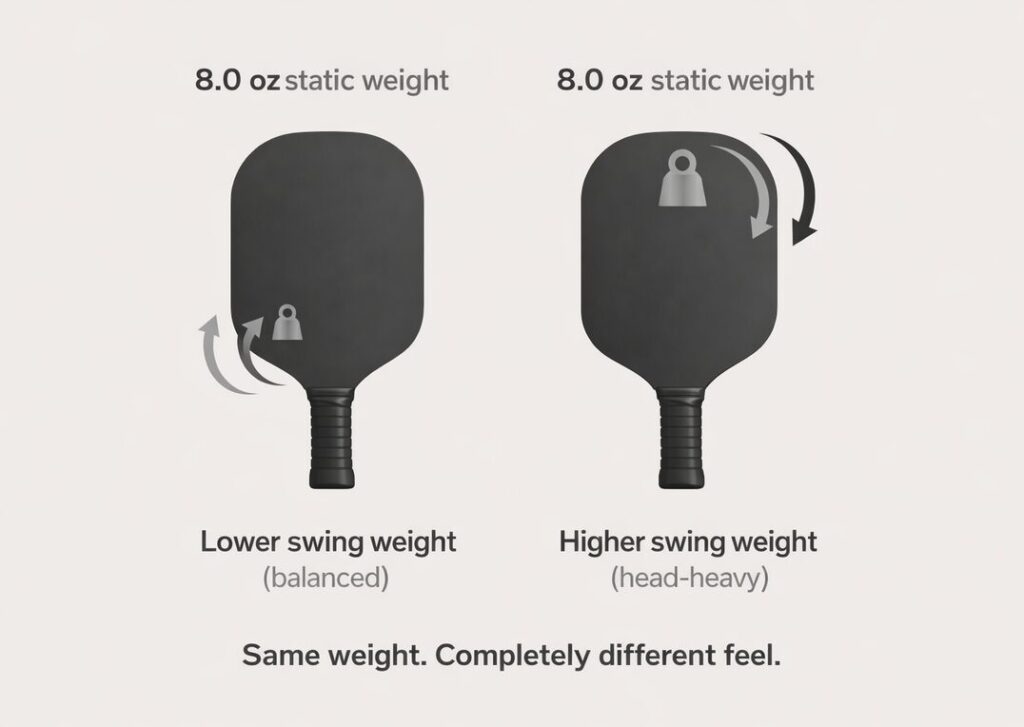
That is why current gear analysis keeps pushing players beyond static weight alone: swing weight captures how hard the paddle is to start, stop, and redirect during actual play.
For rec players, that matters in all the places where fatigue shows up first:
- hands battles
- reaction volleys
- flicks
- counters,
- late-session serves
- and those annoying in-between balls where you are a little jammed and need the paddle to move now, not after a committee meeting
Selkirk’s swing-weight explanation says it plainly: excessively heavy swing weights can hurt maneuverability and make it harder to react quickly in fast play.
That is why I think swing weight deserves way more attention from rec players than it gets.
Why does this matter even more for tired or aging hands?
Because aging hands usually do not just lose strength. They lose tolerance.
That is an important difference.
A lot of players in their 50s, 60s, and beyond can still generate plenty of pace. That is not always the issue. The issue is often that the hand, wrist, forearm, or elbow does not love repeated strain the way it used to. Overuse problems — especially tendinitis and elbow pain — are common in pickleball and other paddle sports.
Mayo Clinic and UChicago Medicine both note that tendon-related pain is a common result of repetitive stress, while Mayo’s pickleball injury coverage has specifically pointed to overuse and hand/wrist issues as common concerns.
So when a paddle feels demanding, it is not just an inconvenience. For some players, it becomes the thing that shortens sessions, tightens the grip, and slowly starts a cycle of soreness.
That is why the wrong paddle can feel okay in game one and awful by game five.
And that is why the right paddle is not always the one with the most power, spin, or hype. Sometimes it is the one that lets you keep playing your game without your hand or arm staging a revolt.
Why is static weight such a misleading number?
Because static weight is real, but incomplete.
Two paddles can both say 8.0 oz and play nothing alike. One may feel fast and easy in the kitchen. The other may feel like you are swinging a frying pan by the end of the session. That is not because the scale lied. It is because the scale only told part of the story.
Current paddle analysts and manufacturers increasingly treat static weight, swing weight, and twist weight as a three-part picture.

Static weight tells you what the paddle weighs sitting there. Swing weight tells you how heavy it feels moving. Twist weight tells you how stable it is when you miss the sweet spot.
Multiple 2025–2026 paddle-education sources now explicitly argue that players are too focused on static weight and not focused enough on the mass distribution that actually determines feel.
This matters because a lot of rec players say things like:
- “I need a lighter paddle.”
- “Heavy paddles hurt my elbow.”
- “This 8-ounce paddle feels too slow.”
Sometimes they are right. But often what they really mean is: “I need a lower swing weight or a better swing-weight/twist-weight balance.”
That is a much better question.
So what swing-weight range usually feels friendlier?
There is no perfect universal number, but there are practical ranges that make sense.
Current paddle-metric guides commonly describe low swing weight as roughly below 110, with faster handling and easier maneuverability, and higher swing weights as more powerful but slower and more demanding to move. Meanwhile, another source shows the current multi-brand average around 114.3, which gives you a useful baseline: average is already not exactly feather-light.
For tired or aging hands, a useful general framework is:
- Below ~110: very quick, easy to maneuver, often kinder on tired hands, but may give up some plow-through and stability.
- Around 110–114: a sweet spot for many rec players who still want enough stability without making the paddle feel cumbersome. This is often where “easy but still solid” lives.
- 115+ and up: can feel great for players who want more put-away power and plow-through, but the paddle often asks more from the hand, forearm, and reaction speed. For tired hands, that is where caution should increase.
That does not mean every older player needs an ultra-light, ultra-fast paddle. Some players actually hit more comfortably with a little extra mass because the paddle helps drive through the ball.
But for a lot of rec players with fatigue or elbow irritation, high swing weight is where the problems start quietly showing up.
Is lower swing weight always better?
No — and this is where the conversation gets more interesting.
A very low swing weight can make the paddle feel fast and easy, which is great for reaction speed and hand comfort. But if it gets too low for your game, you may start overswinging to create pace, lose stability on blocks, or feel the paddle getting bullied on off-center contact. That can create a different kind of strain.
This is why twist weight matters too.
Twist weight is basically the paddle’s resistance to twisting on off-center hits. It’s a measure of torsional stability, and current data sets show an average twist weight around 6.5 across a very large sample of paddles.
For tired or aging hands, that creates the real equipment goal: not the lightest paddle possible, but the easiest paddle to swing that is still stable enough to protect you from mishits.
That is a very different target.
It means you are not chasing “light.”
You are chasing efficient.
What’s the real goal for aging hands: speed, stability, or comfort?
All three — but in the right order.
For most rec players dealing with fatigue, soreness, or aging joints, I would rank the paddle priorities like this:
1. Comfort in motion
If the paddle feels like work every time you speed up, reset, or counter, that matters.
2. Enough stability to survive imperfect contact
Because if the paddle twists hard every time you miss slightly, your wrist and forearm will notice.
3. Enough power that you do not have to overswing
Too little help from the paddle can be a problem too.
That is why I would not tell most aging players, “Just buy the lightest paddle you can find.” What feels light is not just about static weight but about how the paddle is balanced and how easy it is to manage during real play.
The best setup for tired hands is usually a paddle that feels easy without feeling flimsy.
That is the sweet spot.
What other paddle specs matter if your hands get tired?
Swing weight may be the headline, but it is not acting alone.
Grip size matters more than many players think
The right grip should feel secure without making you squeeze too hard. If the grip is too small, a lot of players tighten their hand just to feel in control, which can tire the fingers, forearm, and elbow faster. If the grip is too large, the handle can feel bulky, awkward, and slower to move in quick exchanges.
For most rec players — especially those with tired or aging hands — the goal is a grip that feels comfortable, stable, and easy to hold with light pressure.
If you are death-gripping the paddle, the problem may not just be your hand — it may be your handle. Sometimes a simple overgrip is enough to make the paddle feel much better.
Shape matters
Elongated paddles often bring more reach and a little more head-heaviness, while hybrid and standard shapes often feel easier to maneuver. Hybrids are often described as a middle ground that keep much of the power of elongated shapes while lowering swing weight and improving forgiveness.
For an aging player, that can be huge. Sometimes dropping from elongated to hybrid changes the whole day.
Vibration and feel matter
Even when the raw metrics look good, a paddle that feels harsh can still annoy your arm. This is harder to quantify cleanly, but brands and gear testers increasingly talk about damping, plushness, and comfort because players do feel those differences.
And when tendons are irritated, “feels harsh” stops being a cosmetic complaint.
What kind of paddle setup usually works well for older rec players?
Here is my honest, practical take.
For most rec players with tired or aging hands, a strong starting profile looks something like this:
- swing weight around the low-to-mid 110s
- enough twist weight for off-center stability
- hybrid or standard shape, unless you truly need elongated reach
- comfortable grip size with overgrip adjustments if needed
- a paddle that feels plush or stable, not overly head-heavy and harsh
That setup often gives you:
- quicker reactions,
- less late-session fatigue,
- easier hand speed at the kitchen,
- and fewer “why does my forearm feel cooked?” moments.
That does not mean every 60-year-old should use the same paddle. But it does mean there is a pattern: paddles that are a little easier to swing, a little more stable on mishits, and a little easier on the grip tend to age better with the player.
Quick-Buy Cheat Sheet for Tired or Aging Hands
If you want the shortest possible shopping shortcut, start here before worrying about brand names, pro endorsements, or marketing buzzwords.
| Spec | Good Starting Range | Caution Zone | Why It Matters |
|---|---|---|---|
| Swing Weight | 108–114 | 115+ | Lower-to-mid swing weight is usually easier on tired hands, quicker at the kitchen, and less fatiguing over long sessions. |
| Twist Weight | 6.3–6.8+ | Below 6.2 | Higher twist weight usually means better stability on mishits and less paddle twisting in the hand. |
| Static Weight | 7.7–8.1 oz | Very light or very heavy without testing | Static weight matters, but not as much as swing weight. This is a solid comfort range for many rec players. |
| Shape | Hybrid or standard | Elongated if hand speed already feels slow | Hybrid and standard shapes are often easier to maneuver and less demanding in fast exchanges. |
| Grip Size | Comfortable, secure, not squeeze-inducing | Too small = extra gripping | If the grip is too small, many players tense up and over-squeeze, which can tire the hand and forearm faster. |
| Feel | Plush / stable / dampened | Harsh or jarring feel | A paddle that feels harsh can become annoying fast if your wrist, forearm, or elbow is already sensitive. |
What are the warning signs your paddle may be too demanding?
A lot of rec players blame themselves for equipment problems.
Sometimes that is fair.
Sometimes it is not.
If you notice these things, your paddle may be asking too much from your hand or arm:
- your hands feel noticeably slower in game three or four
- kitchen counters start feeling late
- your forearm feels worked after routine play
- your wrist notices mishits more than it used to
- you squeeze harder as sessions go on
- your serve starts losing shape because your arm is tired, not because your mechanics disappeared
- you love the paddle for 20 minutes and hate it after 90
That last one is a big clue.
A good paddle for tired or aging hands should still feel playable after the fun part of the session is over.
What should players with elbow pain or hand soreness avoid?
In general, avoid paddles that combine high swing weight, harsh feel, and a grip that makes you squeeze.
That combination is where things can go sideways fast.
Of course, pain is individual, and if someone has ongoing elbow or hand symptoms they should treat that as a medical issue, not just a shopping problem. But from an equipment standpoint, players managing soreness should be cautious about:
- very head-heavy setups
- very small grips that force extra squeezing
- shapes that feel sluggish for their hand speed
- and paddles that feel unstable enough on mishits that the wrist has to absorb too much
Mayo and UChicago both emphasize that repetitive overuse and tendon irritation are major culprits in elbow pain, and HSS also frames pickleball injuries through the lens of repetitive stress and cumulative load.
That makes the equipment conversation simple: do not make the body do extra work your paddle could have made easier.
How should rec players shop differently after reading this?
Stop shopping by ounces alone. That is the big practical shift.
When you demo or compare paddles, ask:
- What is the swing weight?
- What is the twist weight?
- Does this paddle feel easy to move late in the session?
- Do I need to squeeze to control it?
- Does it still feel solid when I miss slightly?
- Is the shape helping me, or just giving me theoretical reach?
That is a much smarter way to shop for comfort than just saying, “I want something under 8 ounces.”
Because under 8 ounces can still feel like work.
And 8.1 ounces can still feel easy.
One easy shortcut: if you want to compare numbers like swing weight and twist weight without guessing, check out JustPaddles’ free Paddle Lab pages. They’ve got data on many of the most popular paddles, and it is one of the easiest ways to see how different models may really feel before you buy.