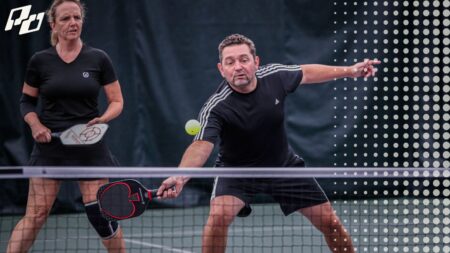
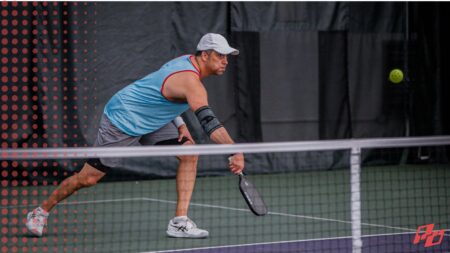
If you’ve ever watched pros like JW Johnson glide through a soft dink exchange and suddenly drop a feathered shot with surgical precision, odds are you’ve seen the scoop dink in action.
This move looks subtle. Almost casual. But if you’ve ever tried it yourself and ended up either popping the ball up or dumping it into the net, it’s pretty common.
So let’s unpack what the scoop dink is, when it shines, why it often fails, and—most importantly—how to make it work without sabotaging your control.
What Is the Scoop Dink, Exactly?
The scoop dink is a specific forehand technique where you set your wrist at a 90-degree angle, take a slight lunge back, and let the shoulder swing through, maintaining that locked wrist angle throughout the motion.
It’s designed to take pace and height off the ball, helping you drop it low and soft over the net. The name “scoop” comes from the paddle path—it gently glides under the ball, almost like you’re scooping soup from a bowl.
When done right, it’s magic.
Here it is:
Why Pros Can Pull It Off (And Most of Us Can’t)
Pros like JW Johnson have elite timing, hand speed, and body positioning. When they scoop, it’s not a lazy flick—it’s a highly controlled, compact motion powered by their shoulders, not their wrist or elbow.
Here’s the catch: most rec players see the scoop and mimic the look—but not the mechanics.
The Scoop Mistake Most Players Make
According to teaching pro Tony Roig from In2Pickle, one of the most common dink errors is trying to scoop the ball by slicing underneath it too much.
Instead of lifting through the ball, many players mistakenly “cup” or “carve” it, creating too much spin and not enough control.
This kind of scoop:
- Adds unpredictable spin
- Cuts through the ball’s natural path
- Often results in mishits, pop-ups, or net errors
“You’re not following the trajectory of the ball—you’re going through it,” Roig explains. That’s a fast track to inconsistency.
Tony Roig
When (and How) to Use the Scoop Dink
The scoop dink can be effective when:
- You’re slightly off balance but still want to redirect with control
- You need to take pace off a fast dink exchange
- You’re adding subtle deception by disguising your target
To execute it well:
- Lock your wrist at a 90° angle
- Use your legs—a small backward lunge keeps you low and stable
- Let your shoulder, not your wrist, guide the swing
- Focus on a soft contact point, letting the ball “ride” the face of the paddle
Our friend William East shows you exactly how it’s done:
@the_prince_of_pickleball Mastering the Forehand Scoop Dink in Pickleball We discuss how top pros like JW Johnson can execute the forehand scoop dink in pickleball. The technique involves getting the wrist at a 90-degree angle, taking a lunge back, and letting the shoulder swing through while maintaining that 90-degree angle. This helps take off height and pace on the dink shot. The viewer is encouraged to give it a try. #pickleball #pickleballislife #pickleballtips #pickleballplayers #pickleballers #pickleballdrills #pickleballhighlights #pickleballtraining #pickleballplayer ♬ Make It Better (Instrumental) – Anderson .Paak
When NOT to Scoop
Here’s when to ditch the scoop and go back to a classic lift:
- You’re losing control or popping balls up
- You’re dinking under pressure and need a safer, more consistent stroke
- You’re scooping from too far underneath, which adds spin but removes accuracy
Remember: when your dinks are consistently off target, netted, or bouncing too high, it’s a sign to re-center your technique—not double down on a scooping habit.
The Fix: Dink With Purpose, Not Style
Instead of trying to scoop every shot, develop a repeatable, neutral dink stroke that follows the trajectory of your target. Push through the ball gently, keeping your paddle face stable. If you want to add finesse later, great—but control comes first.
The scoop should be a variation, not your default.
Scoop Smart!
The scoop dink is like adding a soft drop to your baking recipe—delicate, impressive, and easy to mess up.
Done right, it’s a fantastic tool that adds softness and disguise. Done wrong, it becomes a spinny, pop-up machine that feeds your opponent’s putaway dreams.
So train it with intention. Lock your wrist, stay low, and use your shoulder—not your hand—to guide the shot. And if it’s not working? Go back to basics.
Because in pickleball, the simplest dink is often the most effective.