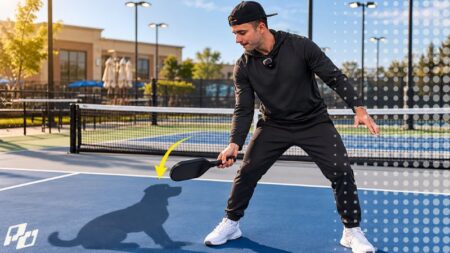

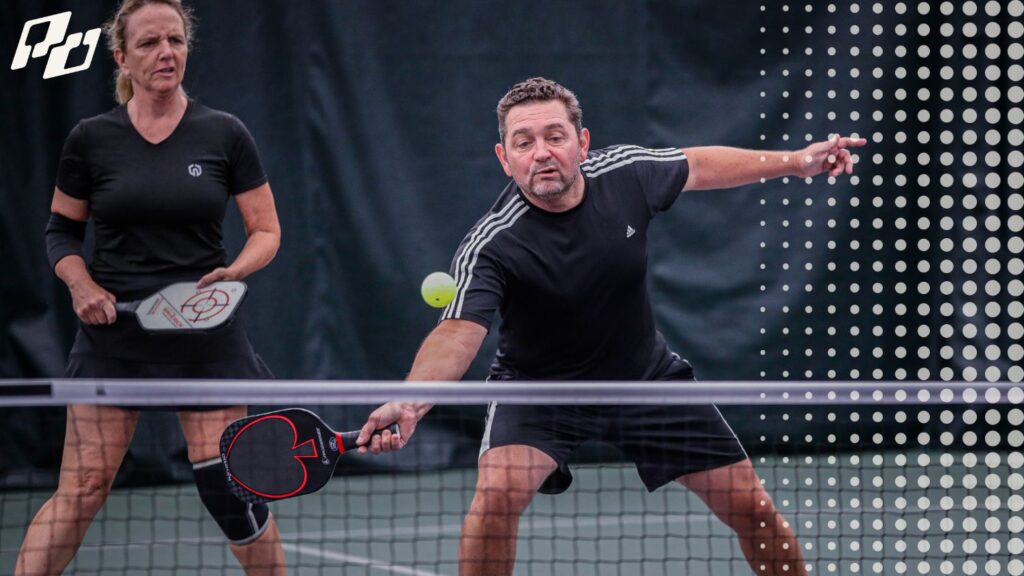
For most pickleball dinks, the best contact point is near the top of the bounce, when the ball is high enough to guide cleanly but no longer springing upward. Letting it fall lower can help if you are late or stretched, but waiting too long often makes the dink harder to control.
A lot of 3.5–4.0 rec players know they are supposed to dink with control, patience, and purpose.
But then the real question shows up in the middle of a rally:
Do you take the ball near the top of the bounce while it is still high and manageable? Or do you let it fall more and hit it later?
That sounds like a tiny detail. It is not.
That one timing choice changes your contact height, your pressure, your margin, your disguise, your recovery time, and the kind of problems you create for the player in front of you.
And when you zoom out and look at how good instructors teach dinking, a clear pattern shows up:
For most neutral dinks, the top of the bounce is the best default contact point.
Letting the ball fall lower is usually more of a situational adjustment, not your everyday setting.
That is the big idea here. Not:
- “Earlier is always better.”
- “Wait longer for more control.”
- “More patience means more delay.”
But this: Take the ball as early as you comfortably can after the bounce without forcing bad contact.
For a lot of dinks, that means right around the top of the bounce.
Why this matters more than most rec players realize
At the rec level, players often think of dinking as just soft touch. It is not. Dinking is really about managing your contact point.
If you take the ball too early, while it is still springing upward, the ball can feel a little jumpy and harder to control.
If you wait too long and let it fall too low, you often have to lift from underneath it, which is where a lot of floaters and attackable balls are born.
That is why the apex matters so much.
At or near the top of the bounce, the ball is often at its most manageable:
- it has lost some of its upward energy
- it is still high enough to contact cleanly
- and you usually do not need to scoop it
That is a very comfortable window.
And for 3.5–4.0 players, comfortable contact is a huge deal because so many dink errors are not really “touch” errors at all. They are timing and geometry errors.
The player thinks:
“I just need softer hands.”
But the real issue is often:
“I took that ball too low, too late, and had to rescue it.”
That is a completely different problem.
The basic difference between the two timings

Taking the ball near the top of the bounce usually gives you:
- a higher contact point
- a calmer, more manageable ball
- a cleaner paddle path
- more freedom to guide the ball instead of lifting it
- better chances of keeping the dink low
- slightly earlier pressure on your opponent
Letting the ball fall lower usually gives you:
- a little more time
- a little more room if you were late or stretched
- a lower contact point
- more need to lift upward
- a greater chance of floating the ball
So right away, you can see the real tradeoff:
⮕ Top of the bounce usually gives you better geometry.
⮕ Letting it fall gives you more time, but often worse geometry.
That is why “wait longer” is not automatically safer.
Sometimes it helps.
Sometimes it just makes the shot harder.
For most rec players, the top of the bounce should be your default
This is the cleanest conclusion for most 3.5–4.0 players.
If the ball has already bounced and you are balanced enough to take it comfortably, the top of the bounce is usually your best default contact point.
Why?
Because that is where you get the best mix of:
- control
- margin
- shot shape
- and quiet pressure
⮕ You are not rushing it.
⮕ You are not letting it die.
⮕ You are not scooping up from your socks.
You are meeting the ball in the most stable part of its post-bounce life. That is why this should be your home base.
What “Top of the Bounce” Actually Looks Like in a Real Rally
A lot of rec players misunderstand this phrase. Taking it at the top of the bounce does not mean:
- freezing and waiting for a perfect science-lab moment
- or short-hopping the ball while it is still bursting upward
It usually means this:
- the ball bounces
- you read the bounce
- you let it rise into a comfortable strike zone
- you meet it near its peak or just as it stops climbing
That is the useful window.
The ball is calmer there. And calmer usually means cleaner.
So when should you let it fall more?
Letting the ball fall is not wrong. It just needs to be purposeful. It makes sense when:
- you got pulled a little wide
- you are slightly late
- the bounce is awkward at your feet
- you need one more beat to organize
- the ball is still too lively on the rise
- or you want a different kind of shot shape
But here is the key distinction: Let it fall only as much as you need.
Not because waiting is automatically better.
Not because “more time” always helps.
Just because in that rally, a slightly later contact gives you a cleaner, more stable strike.
That is a big difference.ly later contact gives you a cleaner swing and a more stable body position.
The Technical Difference in the Swing
This is where a lot of players get into trouble.
When you take the ball near the top of the bounce:
Your swing can stay:
- compact
- quiet
- stable
- more forward than upward
The ball is already in a nice window, so you can guide it.
When you let it fall lower:
The swing often needs:
- more lift
- more upward motion
- more body adjustment
- more hand feel
That is where the scoopy dink shows up:
You can still hit a good dink from lower contact, but now the shot requires more precision.
The Easiest Decision Rule for 3.5–4.0 Players
Here is the cleanest rule I would give most rec players:
If you are balanced and the bounce is reachable, take the dink near the top of the bounce.
If you are late, stretched, jammed, or rushed, let it fall a little more — but not all the way into your shoelaces.
That is the rule.
Simple. Practical. Match-usable.
The 4.0 Twist: Taking the Ball on the Fall for Disguise, Reading, and Manipulation
Now here is where the topic gets more interesting. For a lot of 3.5 players, “take it near the top” is already enough to clean up a lot of dinks.
But once you move into the 4.0-ish range, taking the ball on the fall can become something more than just a late adjustment. It can become a tool.
Not your default.
Not every time.
But a real tool.
1. It can give you an extra beat to read your opponent
That tiny extra fraction of a second matters, because if you let the ball fall just a little, you may get a better read on whether your opponent is leaning middle, cheating crosscourt, loading for a speed-up, or drifting too early.
That extra read can help you choose:
- crosscourt
- middle
- push dink
- counter-pressure
- or a disguise speed-up:
So sometimes taking the ball later is not passive at all.
Sometimes it is informational.
You are buying time to make a better choice.
2. It can improve disguise
This is a big one.
When you take every dink at the exact same timing, good opponents start to feel your rhythm.
They start reading not just your paddle face, but your tempo.
Taking one dink slightly later can break that rhythm.
That can help hide:
- a middle redirect
- a push dink behind movement
- a sudden speed-up
- or a change of shape
In other words: the delayed contact is not just later — it is less readable.
3. It can help you manipulate pace instead of just absorb it
At 4.0, dinking is not just about surviving. It is about managing the emotional and physical tempo of the rally.
Taking the ball on the fall can sometimes soften the exchange and make the rally feel slower to the player across from you. That can be useful when:
- the opponent wants chaos
- they are itching to speed up
- or you want to change the rhythm without obviously changing the shot
That is subtle, but it matters.
4. It can create better shape on certain off-balance replies
Sometimes a slightly later contact gives you a cleaner angle to:
- brush underneath and shape crosscourt
- take pace off
- or add a little more arc without floating the ball too much
Again, this is not your default. This is a situational manipulation tool.
The important point is this:
For a 4.0 player, taking the ball on the fall is not always about being late.
Sometimes it is about seeing more, hiding more, and shaping more.
That is a completely different mindset.
But Here Is the Important Warning
This is where some players misapply the idea. Once they hear that later contact can help with disguise or reading, they start letting too many balls fall.
That is where the wheels come off.
Because taking the ball on the fall only works when:
- you are still balanced
- the contact is still above a manageable height
- and you are using the delay on purpose
If the ball has already dropped so low that you now need a lifting rescue swing, you have probably missed the useful version of “later.”
You are no longer being clever. You are just late.
Practical Cues That Actually Work
Here are the cues I would give rec players:
For 3.5 players:
- “Top by default.”
- “Do not rush the rise.”
- “Do not let it die.”
- “Higher contact, easier dink.”
For 4.0 players:
- “Delay with purpose, not by accident.”
- “Use later contact to see more.”
- “Break the rhythm, not your posture.”
- “If it drops too low, you waited too long.”
Those cues are easy to carry into real matches.