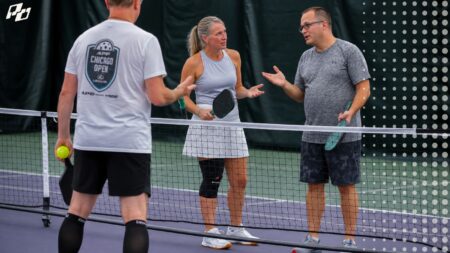


Picture this: you’ve just finished warmups at your local league night. The coin (or paddle spin) decides possession, and the ref asks: “Serve or side?”
Your partner doesn’t hesitate—“We’ll take serve.”
That’s what most of us do, right? Serving first feels like control. You start with the ball, you dictate the opening tempo, and maybe—just maybe—you’ll grab a point or two before your opponents even touch the scoreboard.
But here’s the twist: the analytics don’t agree.
Mathematical modeling, including Markov chain analysis published on arXiv (2023) and simulation studies highlighted by the Mathematical Association of America, show that the first serve isn’t always the advantage we think it is. In fact:
- In a game to 11 (the standard in most formats), the first server is at a slight disadvantage.
- In a game to 15, the tables turn—the first server gains a small but real advantage.
The numbers are subtle—fractions of a percent—but the lesson is clear: what feels like a no-brainer choice is actually far more nuanced.
Why the First Server Is “Half a Server”
To understand this quirk, we need to step back to pickleball’s origins.
When the game was invented in the 1960s, the creators realized something: if the first team to serve had both partners serve before the other team touched the ball, matches could snowball unfairly. They introduced a balancing mechanism—the first team only gets one server to start the game.
That little adjustment, meant to level the playing field, is still with us today. And it’s exactly why serving first can be a liability in short games. You’re essentially starting the match with half a chance compared to every other side-out.
Why 11 Plays Differently Than 15
So why does the math change between 11 and 15?
It comes down to proportional impact.
- In a shorter game to 11, the missing “half serve” is more costly because every rally carries more weight. If you burn your first serve, you’ve wasted 1/11 of the game’s available points.
- In a longer game to 15, that effect smooths out. Over more rallies, the benefit of “serving first” starts to outweigh the initial handicap.
Think of it like poker: in a short game, one bad hand can doom you. In a longer session, the odds balance out.
The Psychology of First Serve
Of course, pickleball isn’t just math—it’s psychology. And the psychology of serve order is powerful.
- Loss Aversion: Humans feel the sting of a loss twice as strongly as the joy of a gain. In an 11-point game, missing your very first serve feels catastrophic. You don’t just fail to score—you feel like you’ve lost something. That can tighten players up from the start.
- Anchoring Bias: In a 15-point game, the first serve feels like setting the tone. Even if the statistical edge is small, starting with the ball creates a sense of ownership. You anchor your mindset in control, which can boost confidence.
- Momentum Illusion: Many players swear that “scoring first gives momentum.” But the data says momentum is mostly perception. Still, if players believe it matters, their behavior changes. Confidence, aggression, and focus all rise when players think they’re “ahead of the math.”
In other words: even when analytics say the edge is tiny, psychology can magnify—or flip—the outcome.
What the Data Actually Shows
Here’s a simplified snapshot of the numbers (DeFord & Ethier, Wright & Figary, 2023):
| Game Format | Serve First Win Probability | Advantage/Disadvantage |
|---|---|---|
| Game to 11 | ~49.7% | Slight disadvantage |
| Game to 15 | ~50.3% | Slight advantage |
A swing of 0.6%. That’s the statistical equivalent of a few rallies across hundreds of games.
On its own, it’s tiny. But at high levels of play—where matches are decided by razor-thin margins—players and coaches care about every decimal point.
Analytics vs. Reality: What Matters More?
Here’s the catch: while the math is cool, other factors often dwarf the serve-order edge.
| Factor | Impact Estimate | Practical Takeaway |
|---|---|---|
| Serve-first (11 pts) | –0.3% | Negligible, pick side instead |
| Serve-first (15 pts) | +0.3% | Tiny edge, take if sides are neutral |
| Playing into sun/wind | 5–10% | Always prioritize side |
| Weak first server | –3–5% | Receiving may be safer |
| Dominant power serve | +3–7% | Serve-first becomes a weapon |
This is where strategy gets real: the court conditions and player skill profiles usually matter far more than the analytics of serve order.
Advanced What-If Scenarios
The Nervous Starter: Some players tighten up serving first. If that’s you (or your partner), you might prefer to start receiving. Think psychology over math.
The Monster Server: If your team has one player whose serve consistently produces weak returns, serve first—even in an 11-point game. The math is overwhelmed by the real-world weapon.
Best-of-Three Matches: Many pros choose side in Games 1 and 2 (where serve-first isn’t advantageous), but flip to serve in Game 3 when fatigue and momentum matter more than micro-percentages.
Rally Scoring (MLP, rec formats): Serve order advantage virtually disappears because every rally counts. In rally scoring, the toss is almost always about side.
Flowchart: What to Choose at the Toss
TOSS WON → Check conditions
↓
Is one side worse? (sun/wind/glare/crowd noise)
↓ Yes → Choose SIDE
↓ No
Game to 11?
↓ Yes → Usually choose SIDE
↓ No
Game to 15 or 21?
↓ Yes → Choose SERVE
A Folklore Twist: Why the Myth Persists

Ask around your local courts, and plenty of players will swear: “We want the first serve—momentum matters.”
So why does this belief live on, even when the math says otherwise? Because it feels true. Scoring first feels like momentum. Starting with the ball feels like control. And humans are wired to trust feelings and stories over decimals and probabilities.
That’s how pickleball folklore is born. A habit, repeated often enough, becomes “common sense.” But once you check the analytics, you see the story differently: the first serve isn’t destiny—it’s just perception dressed up as fact.
Strategic Takeaways for Competitive Players
- In 11-point games: Don’t sweat serve-first. Prioritize side, unless you or your partner has a huge serve.
- In 15 or 21-point games: The first serve offers a small but real edge. Take it when sides are neutral.
- Tournament play: Court conditions almost always outweigh serve-order math. Sun in your eyes is worth way more than a 0.3% probability swing.
- Mindset: Use the data to inform your choice, but don’t let it become superstition. Serve order isn’t destiny—it’s just one lever in your toolkit.
Final Rally: Play Smart, Not Just First
So, is serving first a mistake?
- In games to 11, it’s not exactly a mistake—but it’s not the advantage everyone thinks. You’re better off picking the good side.
- In games to 15 or 21, there’s a small edge to serving first. Worth taking if conditions are neutral.
The beauty of pickleball is that it sits at the intersection of math, psychology, and folklore. The analytics tell us the edge is tiny, the psychology tells us it feels big, and the folklore keeps the debate alive at courts everywhere.
“Serve-first isn’t about winning the match—it’s about knowing the math, then playing the smarter hand.”