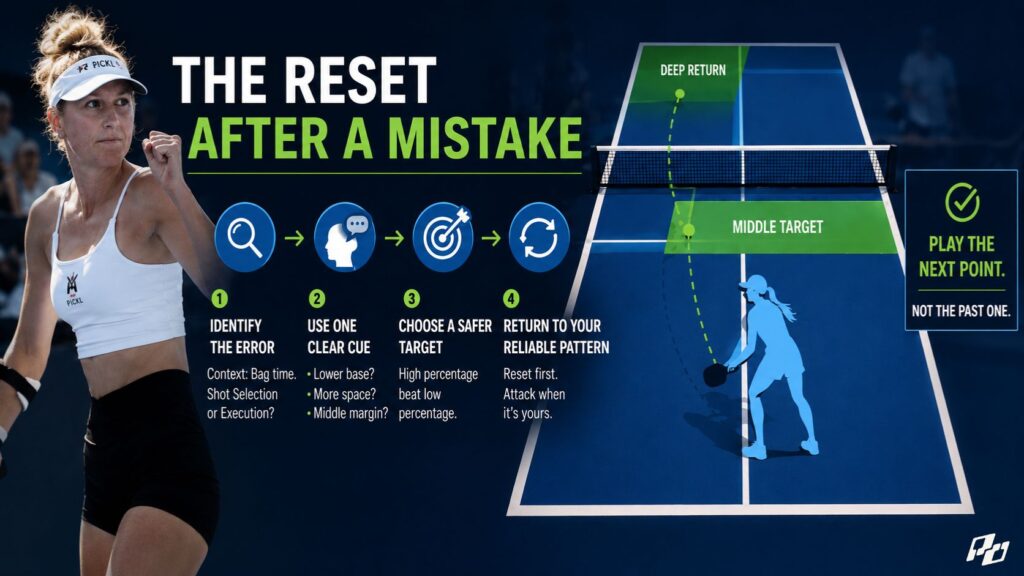
Anger hurts pickleball performance by increasing tension, rushing decisions, and encouraging low-percentage shots. To reset, identify whether the error came from contact, balance, shot selection, or execution. Then use one clear cue, choose a safer target, and return to a reliable pattern before attacking again.
You miss an easy dink, question a line call and dump the next return into the net. Now you are not simply losing points. You are trying to get the points back immediately.
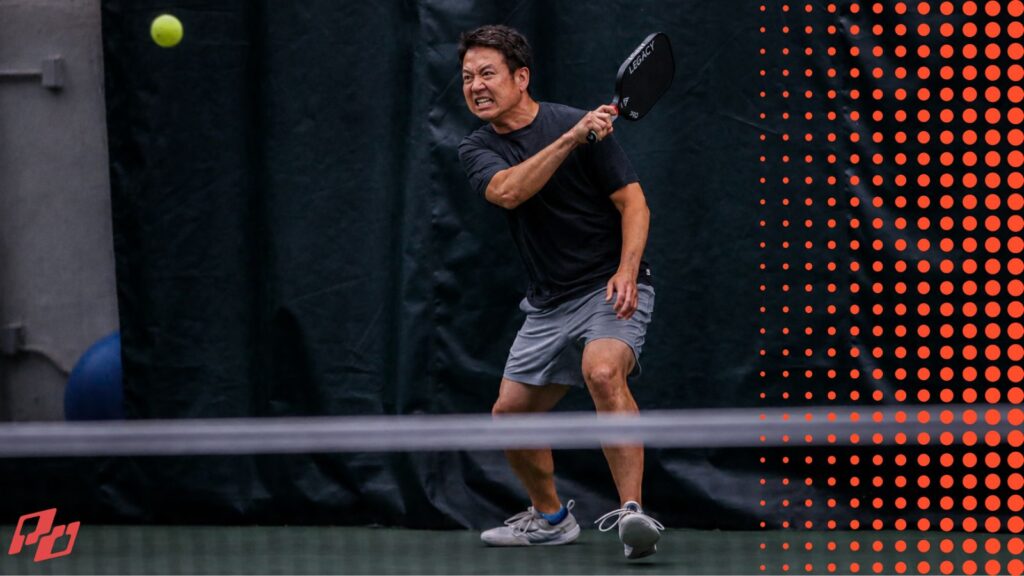
That is when recreational players start driving balls they should drop, speeding up from below the net and aiming closer to the lines. Anger feels like competitive intensity, but in pickleball it often produces the opposite of effective competition: tighter muscles, shorter patience and worse decisions.
The goal is not to become emotionless. It is to stop letting one emotional reaction choose your next shot.
Why anger feels useful
Anger is an activating emotion. It can raise energy, increase determination and push people toward difficult goals. Research outside pickleball has found that anger can sometimes improve persistence when a task requires forceful effort toward a clear objective.
That explains why players sometimes say:
“I play better when I get mad.”
They may serve harder, move more aggressively or stop playing timidly. But pickleball is not a bench press. Most points are decided by a combination of precision, inhibition and judgment:
- Should I attack or reset?
- Is this ball actually above the net?
- Is the middle open?
- Can my partner cover the counter?
- Do I need more pace—or more margin?
Anger may supply energy, but it does not guarantee good shot selection. Athletes perform best within an individual emotional and arousal range; once intensity moves outside that range, self-regulation becomes necessary.
For many recreational players, the problem is not anger itself. It is what anger makes them do next.
The four ways anger changes your game
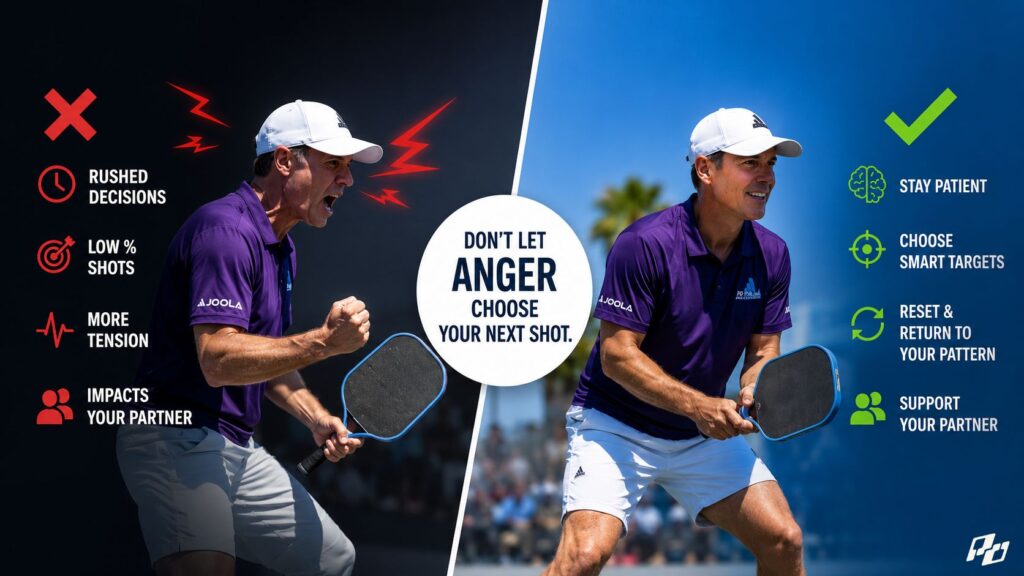
1. It turns patience into urgency
After a frustrating miss, players often feel pressure to repair the situation immediately. That creates “make-up shot” pickleball:
- forcing a third-shot drive after missing a return
- attacking the next dink regardless of height
- trying to hit a winner down the line
- abandoning a pattern that was working
- increasing pace without improving position
The player is no longer solving the rally. They are trying to erase the previous point.
That distinction matters. The previous point cannot be repaired. It can only be followed by a better decision.
2. It changes your mechanics before you notice
Anger commonly appears in the body before the player consciously recognizes it. Watch for:
- a harder grip
- raised shoulders
- a rushed ready position
- bigger backswing
- faster walking between points
- contacting the ball farther from the body
- swinging before the feet are set
In pickleball, small increases in tension can have large effects. A firm wrist may help on a block, but unnecessary tension through the fingers, forearm and shoulders makes touch shots less adaptable. Dinks become more rigid, resets sit higher and speed-ups become easier to read.
Your first warning may not be the emotion. It may be the paddle.
3. It replaces observation with judgment
There is a major difference between these two reactions:
“How could I miss that?”
and
“Why did I miss that?”
The first question is usually not a real question. It is a disguised accusation. The second can produce usable information:
- I contacted it late.
- I was moving through the shot.
- The ball had more topspin than I expected.
- I aimed too close to the sideline.
- I attacked from below net height.
This is why curiosity is so valuable. It converts the mistake from a verdict into evidence.
Research on self-talk supports the general principle that self-criticism is less useful than goal-directed, instructional language. Sport-psychology interventions commonly use self-talk, imagery, goal setting and arousal regulation to improve performance.
“Idiot” gives your body no instruction.
“More space,” “lower base” or “middle margin” does.
4. It spreads to your partner
In doubles, anger is not private.
Eye-rolling, muttering, paddle slapping and dramatic body language tell your partner that mistakes are dangerous. That can make them play cautiously, overthink routine shots or stop communicating.
Pickleball coaches frequently emphasize between-point routines, process cues, partner communication and avoiding emotional spirals for exactly this reason.
In recreational play, the damage can extend beyond the score. People may stop inviting a player who makes every mistake feel like a crisis.
In tournaments, the effect is more tactical: your opponents can see when you are rushing, blaming or unraveling. They may simply keep one more ball in play and wait for you to force the next attack.
Stop trying to “calm down”
“Calm down” is usually bad advice during competition.
It asks you to eliminate an emotion without giving you a performance task. It can also create a second problem: now you are angry and angry at yourself for being angry.
A better goal is functional anger.
You may still feel irritated, but your behavior remains useful:
✅ your grip stays adjustable
✅ your pace between points remains deliberate
✅ your next target gets larger, not smaller
✅ your partner receives clear information
✅ you choose a high-percentage pattern until your timing returns
You do not need to feel calm before you can play intelligently.
Use the one-point quarantine
After an emotionally charged mistake, place the next point under tactical quarantine.
For one rally:
✖️ do not attempt a low-percentage speed-up;
✖️ do not aim near a sideline;
✖️ do not change your normal return target;
✖️ do not try to “send a message” with pace.
Choose your most reliable pattern.
For example:
Deep return through the middle, get established at the kitchen, then attack only a clearly elevated ball.
This is not passive play. It prevents the emotional residue from one point from contaminating the next one.
The quarantine ends after one point, provided your decisions feel normal again.
Diagnose the miss by category
Do not conduct a full technical lesson during a match. Classify the error into one of four categories:
- Contact: late, crowded, too far in front.
- Balance: reaching, drifting, falling away.
- Selection: wrong ball to attack, wrong target, too little margin.
- Execution: correct choice, ordinary miss.
Then use one correction only.
Examples:
- Contact: “More space.”
- Balance: “Set first.”
- Selection: “Wait for green.”
- Execution: “Same shot.”
The final category is important. Not every miss requires a change. Sometimes the decision was correct and the ball missed by two inches. Constantly fixing sound decisions can destroy confidence and create technical clutter.
Install an anger speed limit
Most frustrated players do not merely hit harder. They make decisions faster.
Create a rule before the match:
After two rushed errors, I cannot speed up a ball unless contact is above net height and my feet are stable.
That rule removes negotiation during the emotional moment. You can also use a target speed limit:
For the next three rallies, every dink target must be at least two feet inside the sideline.
This gives the emotion somewhere safe to go. You can still play assertively, but the court becomes larger.
Change the question
Curiosity works only when the question is specific.
Avoid:
“Why am I playing so badly?”
That is too broad and usually produces more frustration.
Ask:
“What changed on the last two balls?”
Possible answers might include:
- I started taking the ball too early.
- I stopped moving my feet.
- They are targeting my right hip.
- Their roll dink is jumping higher than before.
- I am trying to attack from a neutral position.
Now you have an adjustment. A useful three-word cue is:
Notice. Name. Choose.
Notice what happened.
Name the cause without insulting yourself.
Choose one response.
Separate emotional release from tactical control
Some athletes benefit from a brief physical release; that doesn’t mean every player should shout or throw equipment. Recreational courts and tournaments have conduct expectations, and aggressive displays can affect partners and opponents.
The useful principle is this:
Release briefly. Decide deliberately.
A short physical reset might be pressing your thumb against the paddle grip, loosening the fingers and walking to a fixed position behind the baseline. The release should last seconds. It should not become a performance that keeps the anger active.
Research on self-distancing suggests that athletes may regulate anger more effectively when they step back from the immediate emotional perspective.
One practical version is to coach yourself by name:
“Chris, higher margin.”
That sounds unusual, but it creates separation between the emotion and the instruction.
Use your partner as a tactical circuit breaker
Agree on a neutral phrase before play:
“Back to pattern.”
It should not mean “stop being emotional.” It should mean something concrete, such as:
- return middle
- third-shot drop
- crosscourt dink
- attack only above the net
This keeps the conversation tactical instead of personal. Avoid saying:
❌ “Relax.”
❌ “You’re rushing.”
❌ “Stop getting mad.”
❌ “Just make the ball.”
Even when accurate, those phrases often sound like criticism. A better partner exchange is:
“Crosscourt for two. Then look middle.”
That gives the frustrated player a job.
Tournament anger is different from recreational anger
In recreational play, frustration often comes from expectations:
- believing you should beat a lower-rated player
- getting annoyed by an unconventional style
- resenting repeated lobs, slices or body shots
- feeling embarrassed in front of regular partners
In tournaments, anger often grows from consequence:
- tight scoring
- questionable calls
- long waits between matches
- unfamiliar balls or courts
- fatigue
- fear of wasting the entry fee or opportunity
The solution should match the trigger. If the trigger is ego, ask:
“What is this opponent making uncomfortable?”
If the trigger is conditions, ask:
“What adjustment does this court require?”
If the trigger is officiating or line calls, decide your response policy before the event. Know what can be appealed, what cannot and when discussion ends. Do not invent your policy at 9–9.
Train frustration on purpose
Players usually practice technique in calm conditions and expect emotional control to appear automatically in tournaments.
Instead, add consequences to drills.
Try a three-ball recovery drill:
- Begin each sequence with a deliberately difficult feed.
- If you miss, the next ball must be played to a large middle target.
- The third ball may be attacked only if it is genuinely attackable.
The drill teaches a critical competitive skill: the shot after the mistake.
Another option is a bad-call simulation. During practice, your partner occasionally announces an intentionally disputed call. You do not argue. You immediately run your reset pattern on the next rally.
You are not practicing acceptance of bad calls. You are practicing preventing one call from costing three points.
The practical rule
Anger is not proof that you care more. It is simply information that something you expected has not happened. Use that information.
Do not ask:
“How could I miss that?”
Ask:
“Was it contact, balance, selection or execution?”
Then make one adjustment, enlarge your next target and return to a known pattern.
The strongest competitors are not the players who never become angry. They are the players who prevent anger from selecting the next shot.