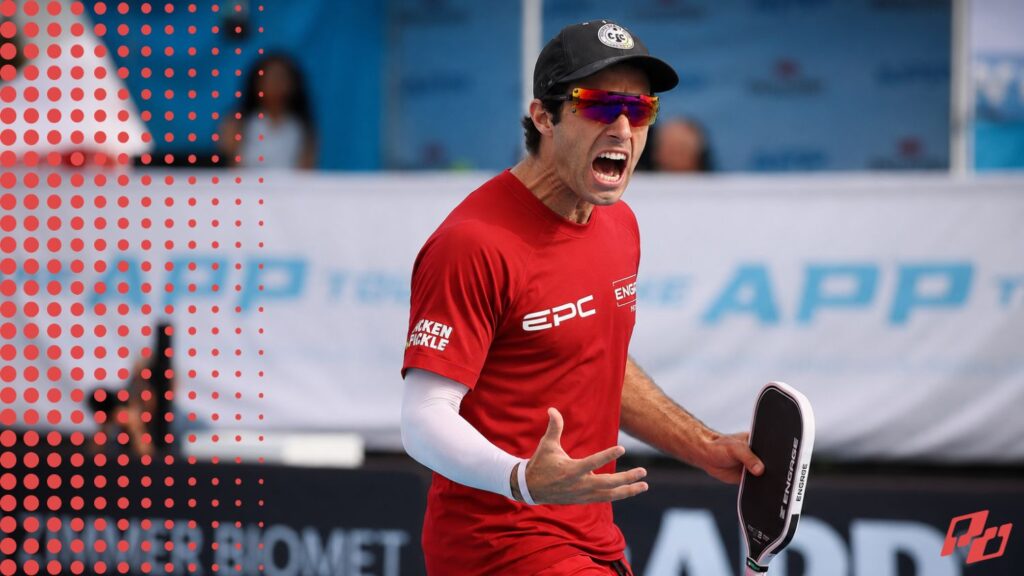
Getting angry at yourself in pickleball is common, but constant yelling or harsh self-talk can make you tighter, distract your partner, and lead to more mistakes. Use a quick reset: name the error, choose one correction, breathe, reconnect with your partner, and move on to the next point.
Yes, it is normal to get frustrated in pickleball.
But constantly yelling, swearing, or beating yourself up after every mistake? That is not just a “personality thing.” It can hurt your game, make your partner uncomfortable, and turn a fun rec match into a tense little drama nobody signed up for.
And here is the tricky part: most players who do this are not trying to be jerks.
They are usually competitive. They care. They want to improve. They feel embarrassed when they miss an easy ball. They hate feeling like the weak link. And because pickleball gives you so many quick, visible mistakes — missed returns, pop-ups, dumped dinks, balls at your feet, bad speedups — the frustration can build fast.
But frustration has two paths.
One path helps you learn.
The other path makes you tighter, louder, worse, and harder to play with.
So the question we’re discussing today is: Can you turn frustration into useful feedback without wrecking your game or the court vibe?
That is what better players learn to do.
First, Let’s Be Honest: Pickleball Is Emotionally Sneaky
Pickleball looks casual from the outside.
Small court. Funny name. Plastic ball. People laughing between points.
Then you miss three easy drops in a row and suddenly your brain acts like you just lost Wimbledon.
That emotional overreaction is common because pickleball creates a perfect storm:
- points happen quickly
- mistakes are obvious
- partners are close by
- opponents can target weaknesses
- rallies can swing from control to chaos instantly
- and rec players often compare themselves to people with more experience
So if you feel frustration, you are not broken. The problem is what you do with it.
One player saying “ugh, too much” after an error is very different from someone repeatedly screaming, swearing, slamming paddles, or dragging the whole court into their emotional spiral. In rec play discussions, the biggest concern players raise is not frustration itself — it is the way repeated outbursts affect partners, opponents, and the social experience of the court.
That matters because pickleball is not a solo sport.
Even when you are mad only at yourself, everyone else still has to stand inside your emotional weather.
The Biggest Misunderstanding: “I’m Only Mad at Myself”
A lot of players say this: “I’m not mad at my partner. I’m only mad at myself.”
That may be true. But your partner may not feel that way.
If you explode after your own missed dink, your partner may wonder what you are thinking when they miss one. If you curse after every error, they may start playing tighter because they do not want to trigger the next reaction. If you look disgusted after your own mistake, they may assume mistakes are unacceptable on your side of the court.
That is how self-criticism becomes team pressure. Even if your words are aimed inward, the energy spreads outward.
A good doubles partner does not just hit good shots. A good doubles partner makes the other person feel like they are still safe after a mistake.
That does not mean fake positivity. It means emotional control.
Why Anger Usually Makes You Play Worse
Here is the sports psychology part.
Anger can feel powerful in the moment. It gives you a jolt. It releases tension. It makes you feel like you “care.”
But pickleball is a fine-motor, decision-heavy sport. You need soft hands, small adjustments, relaxed grip pressure, clear shot selection, and quick recovery between points.
Anger fights all of that. When you get angry, you tend to:
- squeeze the paddle harder
- breathe shallower
- rush the next shot
- swing bigger
- stop seeing patterns
- attack too early
- tighten your shoulders
- and replay the mistake instead of reading the next ball
Research on self-talk in sport consistently points in this direction: negative self-talk is associated with worse performance, while instructional self-talk can help athletes focus attention on technical and tactical cues. A 2023 systematic review found that negative self-talk decreases athletes’ performance, while instructional and motivational self-talk can support motor performance depending on the task.
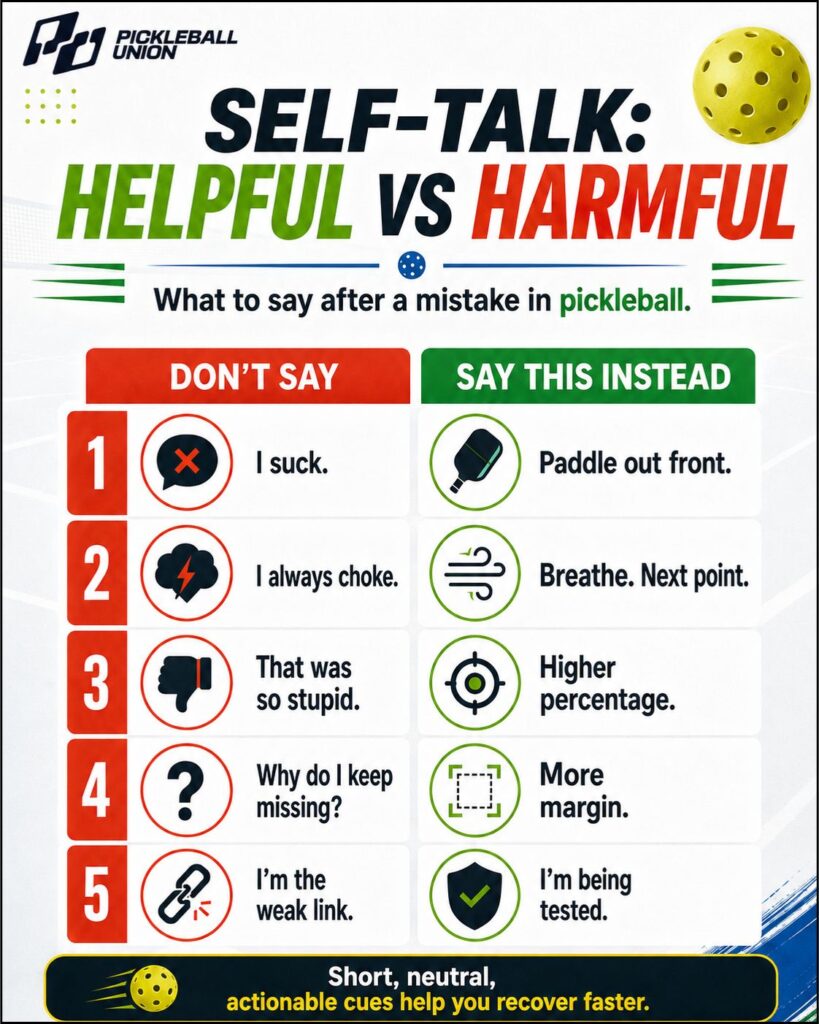
Translated to pickleball: “I suck” does not help you hit a better reset.
But:
“Paddle out front.”
“Lower base.”
“More margin.”
“Watch the ball.”
Those can help.
The goal is not to become emotionless. The goal is to replace judgment with instruction.
The Inner Critic Is Not a Coach
A lot of competitive rec players think harsh self-talk is accountability.
It feels like: “If I get mad enough, I’ll stop making that mistake.”
But that is not usually how skill learning works.
If you missed a third shot drop because your contact point was late, calling yourself terrible does not fix the contact point. If you popped up a dink because your grip pressure was too tight, yelling does not soften your hand. If you missed a return because you were still moving, shame does not improve your footwork.
It just adds noise.
A useful coach gives you one correction. The inner critic gives you a character attack.
That is the difference.
Instead of: “I can’t believe I missed that. I’m awful.”
Try: “Late contact. Get there earlier.”
Instead of: “Stop being stupid.”
Try: “Higher percentage. Crosscourt.”
Instead of: “I always choke.”
Try: “Breathe. Next point.”
This is not soft. It is practical. You are turning emotion into information.
The 5-Second Rule After a Mistake
Here is a simple rule every rec player can use.
After a mistake, you get five seconds to react. Make a face. Tap your paddle. Say “too much.” Exhale. Smile. Whatever.
Then it is over.
Not because the mistake does not matter. Because the next point matters more. A mistake has useful information, but only if you extract it quickly.
Ask:
- What happened?
- What is the adjustment?
- What is the next job?
Example:
You dump a third shot drop into the net.
Bad version: “I’m terrible. I always miss easy drops.”
Better version: “Too low. More lift. Move after contact.”
Then play. That is the whole reset.
Five seconds is enough time to learn. More than that often becomes emotional self-indulgence.
What You Should Actually Say to Yourself
The best self-talk during a match is usually short, neutral, and actionable.
Not motivational speeches. Not therapy sessions. Not “come on, you got this, believe in yourself, unlock your greatness.”
In the middle of a rally or between points, your brain needs a cue it can actually use. Good self-talk sounds like:
- “Split.”
- “Paddle up.”
- “Breathe.”
- “Crosscourt.”
- “Reset middle.”
- “More margin.”
- “Soft hands.”
- “Let it go.”
- “Move first.”
- “Next ball.”
This lines up well with sport psychology research distinguishing instructional self-talk from negative self-talk. Instructional self-talk helps direct attention toward the technical cue or task, while negative self-talk adds doubt and emotional load.
For pickleball, that matters because the game gives you very little time.
A useful cue has to be short enough to survive under pressure.
The Difference Between Frustration and a Tantrum
This is important. Frustration is normal. A tantrum is a choice pattern.
Frustration might look like:
- “Ah, too much.”
- a quick groan,
- a paddle tap,
- a short exhale,
- laughing at a bad miss,
- or quietly saying the correction.
A tantrum looks like:
- repeated screaming,
- loud profanity after every miss,
- slamming paddles,
- hitting balls away in anger,
- making everyone stop and notice,
- arguing with yourself out loud,
- or creating tension for your partner.
In tournaments, player conduct is not just etiquette. USA Pickleball conduct expectations emphasize sportsmanship, respect, and behavior consistent with proper etiquette and the spirit of the game; code violations can include warnings, technical fouls, forfeits, ejections, or expulsions depending on severity.
Even if you are in open play, the principle still applies. People remember how it feels to share a court with you.
Why “I’m Just Competitive” Is Not Enough
Being competitive is not the problem. Competition is great. Wanting to improve is great. Caring about your performance is great.
But being competitive does not give you permission to become unpleasant.
The best competitors are not the ones who feel nothing. They are the ones who can feel pressure and still make the next smart decision.
That is the goal.
Not calm because you do not care.
Calm because you care enough to stay useful.
There is a big difference.
If frustration makes you focus harder, communicate better, and choose smarter shots, fine.
If frustration makes you louder, tighter, riskier, and harder to play with, it is not competitiveness anymore.
It is leakage.
Your emotions are leaking into your mechanics, your decision-making, and your partnership.
The “Weak Link” Trap
A lot of rec frustration comes from one thought: “I’m the weak link.” That thought is brutal because it turns every mistake into evidence.
Missed return? Weak link.
Pop-up? Weak link.
Bad speedup? Weak link.
Partner gets targeted? Weak link.
Once your brain enters that story, you stop playing the point in front of you. You start defending your identity.
That is a terrible mental state for pickleball. Instead, reframe it.
You are not the weak link.
You are the player currently being tested.
That is different.
If opponents hit at you, that is useful information. They are showing you what you need to train:
- returns
- resets
- balls at your feet
- backhand dinks
- speedup defense
- transition movement
- patience under pressure
That is not humiliation. That is a scouting report.
The mentally strong rec player says: “Good. Now I know what to work on.”
Get Angry at the Right Thing
This is a more advanced mental shift. Do not get angry because you missed. Everyone misses.
Get curious about whether the mistake came from a bad decision or a skill gap. Those require different responses.
Skill mistake
You chose the right shot but missed execution.
Example: You picked a good crosscourt dink, but popped it up.
Response: Train the skill. Use a simple cue. Move on.
Decision mistake
You chose the wrong shot.
Example: You attacked a ball below net height while off balance.
Response: Fix the decision rule.
That second one is where frustration can become useful.
Not: “I’m bad.”
But: “That was the wrong ball to attack. Next time, reset.”
This turns anger into strategy.
A good player does not expect zero errors. A good player tries to reduce repeatable, preventable errors.
The Mistake Script: What to Do After an Error
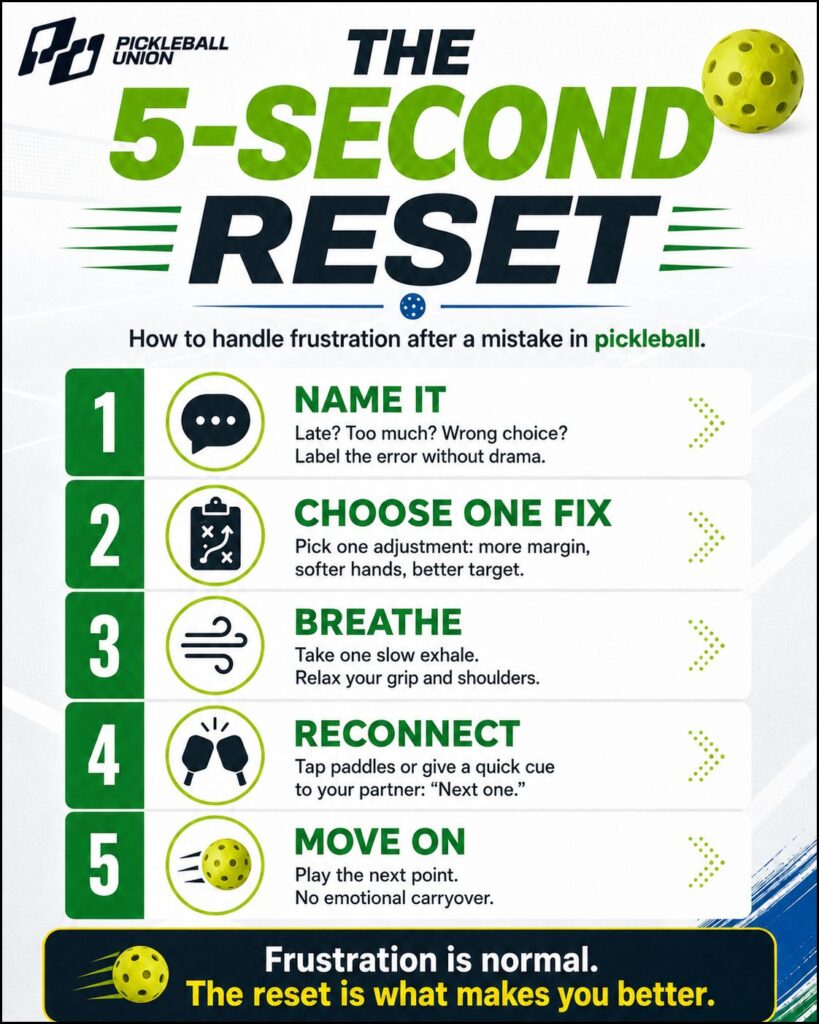
Use this after any unforced error.
Step 1: Name it neutrally
“Late.”
“Too high.”
“Wrong target.”
“Bad decision.”
“Rushed.”
No drama. Just the label.
Step 2: Choose one correction
“More margin.”
“Paddle out front.”
“Let it bounce.”
“Dink crosscourt.”
“Reset middle.”
One correction only.
Step 3: Reset the body
Exhale. Relax the grip. Drop the shoulders. Look at your partner.
Step 4: Reconnect
Say something simple:
“I’m good.”
“Next one.”
“My bad — better target.”
“Let’s make them hit up.”
This matters because doubles is relational. You are not just resetting yourself. You are telling your partner the team is still stable.
How Your Partner Experiences Your Anger
Your partner may not hear your internal explanation. They just hear the outburst.
You may think: “I’m mad at myself.”
They may feel: “I need to avoid making mistakes around this person.”
You may think: “I’m just venting.”
They may feel: “This game is getting uncomfortable.”
You may think: “I care about improving.”
They may feel: “This person is making rec play too intense.”
This does not mean you have to become fake-cheery. But you do need to manage your output.
A good rule: If your reaction makes your partner play tighter, it is costing your team points.
The “PG Replacement” Trick
This sounds silly, but it works for some players. If you have a habit of swearing after errors, replace the word with something ridiculous.
Instead of screaming profanity, say:
“Pineapple.”
“Banana bread.”
“Not today.”
“Too spicy.”
“That was ambitious.”
Why does this help? Because it interrupts the emotional pattern.
You still get a release, but you remove the hostility. Sometimes the court laughs, the tension breaks, and you move on faster.
This does not solve the deeper issue by itself, but it is a good bridge habit.
Use a Physical Reset, Not Just a Verbal One
The body drives the mind. After a mistake, use the same physical reset every time:
- Turn away from the net.
- Take one slow exhale.
- Relax your grip.
- Tap paddle with partner.
- Say the score clearly.
- Play the next point.
This works because routines reduce decision clutter. Instead of negotiating with your anger, you run the program.
A routine says: Mistake happened. Information received. Next point begins.
That is exactly what you want.
The “Three-Ball Memory” Rule
Here is another useful tool. Do not carry any mistake longer than three balls.
Not three games.
Not three points.
Three balls.
If you miss a dink, your job over the next three balls is to return to solid pickleball:
- make the return
- keep the dink low
- reset middle
- hit the high-percentage target
- or simply avoid the next bad decision
This gives your brain a job. You are not trying to “feel better.” You are trying to stabilize your game.
Confidence often returns after behavior changes, not before.
When You Should Apologize
If you have one quick reaction, you probably do not need a dramatic apology. But if you yell loudly, curse repeatedly, slam equipment, or make the court uncomfortable, own it.
Keep it short: “Sorry, that was too much. I’m good.”
Then actually change the behavior.
Do not apologize five times and keep doing the same thing. That just makes the court manage your emotions for you.
One clean apology plus a visible reset is enough.
The Rec Player Mental Reset Plan
Here is the full plan.
Before you play
Pick one mental goal.
Not “play perfect.”
Try:
“No emotional carryover.”
“One cue after mistakes.”
“Encourage partner after errors.”
“Reset before every serve.”
During the game
After a mistake:
- Label it.
- Cue it.
- Exhale.
- Reconnect.
- Play.
After the game
Ask:
- What error repeated?
- Was it skill or decision?
- What should I drill?
- Did my reactions help or hurt?
- Would I want to partner with myself today?
That last question is powerful.
Would you want to partner with yourself?
Not your skill level. Your energy.
Care More Skillfully
Getting frustrated does not make you a bad person. It usually means you care.
But if your frustration turns into constant yelling, harsh self-talk, or visible anger, it stops being harmless. It can tighten your body, damage your decision-making, distract your partner, and make rec play less enjoyable for everyone around you.
The better goal is not to stop caring. The goal is to care more skillfully.
Replace judgment with information.
Replace yelling with a cue.
Replace shame with adjustment.
Replace emotional carryover with a reset routine.
You are going to miss shots. That is pickleball.
The players who improve fastest are not the ones who never get frustrated. They are the ones who recover faster, learn cleaner, and stay good to share a court with.