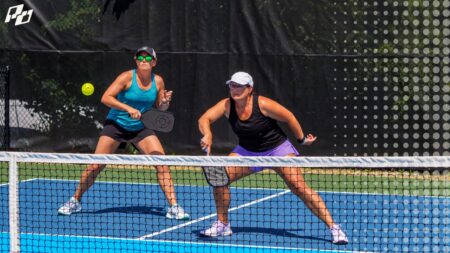
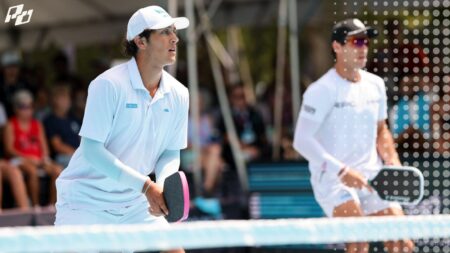
If you’ve ever wondered why your dinks feel great one day and like a lottery draw the next, pro player Jill Braverman just dropped one of the most helpful explanations I’ve ever seen. Her video (we’ll embed it here) breaks down something players never think about:
Your movement pattern — not your hands — is what’s ruining your dinks.
And honestly? She’s right.
Most rec players think their “touch” or “paddle angle” is the problem. But Jill argues that your legs, posture, and foot positioning determine 80% of your consistency. If your feet aren’t in the right spot, you literally cannot use good touch, no matter how soft your hands are.
This article breaks down Jill’s big ideas in simple language so you can start fixing your dinks (and, honestly, your entire soft game) starting today.
Why You Favor One Side — and Why It Messes Up Your Dinks
Jill says a lot of us unknowingly rely on one “favorite leg.”
You might:
- explode faster off your right or left leg
- naturally lean your weight onto one side
- slide better in one direction
This creates a predictable pattern: you’re quick when moving one way, clunky when moving the other.
You think you have a “weak backhand dink.” In reality, your legs just didn’t beat the ball to the spot.
This is where Jill drops one of the most important facts:
“Your knee is the backstop to your dink.”
If your knee doesn’t get to the ball, the ball ends up outside your body line…And when that happens?
Your touch is gone.
Your control is gone.
Your options shrink to zero.
The #1 Rule Pros Follow That Most Rec Players Ignore
Jill and her coach Scott put it simply:
If you hit the ball outside your foot, your touch disappears.
Pros don’t let that happen.
When a ball pulls them wide, they don’t reach.
They move their feet first, beat the ball to the spot, and make sure the contact point stays between their feet — never outside them.
Why this works:
- When the ball stays centered, your paddle angle stays stable
- You can soften your hands
- You can reset better
- You don’t accidentally pop balls up
- And you stay balanced for the next shot
Reaching is the enemy.
Reaching kills control.
Reaching is what makes dinks feel hard.
The “Cone of Power”: The Most Beginner-Friendly Concept Jill Teaches
Jill uses a simple visual:
Your cone of power = the imaginary triangle between your chest, paddle, and belly button.
If the ball enters that zone, you can control it. If the ball pulls you out of it — you’re in trouble.

Most rec players do this:
- ball comes
- they reach
- their paddle drifts to the side
- their posture collapses
- they lose stability
- they dink from their shoulders instead of their legs
Pros never do that.
They move their feet so the ball comes to the cone, not the other way around.
Key No. 1: Move Early (The Pro–Amateur Difference)
Jill says most amateurs “watch the ball too much.”
We stare at it…
Stare at it…
Stare at it…
Take one big step…
And then hit.
Pros do the opposite.
They move the second the ball leaves the opponent’s paddle.
By the time the ball crosses the net, they’re already in position.
Why it works:
- You avoid last-second lunges
- Your steps stay small and fast
- Your balance stays neutral
- You don’t reach
- You stay athletic instead of reactive
It’s not about speed — it’s about being early.
Key No. 2: Paddle Up (The Most Underrated Habit in Rec Play)
90% of recreational players dink with the paddle too low.
Here’s why it’s a problem:
- You’re not protected
- You get attacked easily
- You can’t counter
- You can’t reset fast enough
“You should assume every shot is coming at your body.”
This single mindset fixes almost all slow hands.
Paddle goes down → up, never down → stay down.
Key No. 3: Posture (Your Secret Dink Superpower)
This is the part beginners ignore but intermediates really need.
“Get your eyes to ball level.”
That means lowering your posture — not bending your back, but dropping with your legs.
Why it works:
- Lower center of gravity = better balance
- Easier to move sideways
- Cleaner contact on low balls
- Softer touch automatically
- More control in hands battles
Jill even says she improves mid-tournament by reminding herself:
“Get my head to the level of the ball.”
Try it. It’s shocking how instantly your control improves.
Watch Jill’s video — she explains all three keys with super clear, helpful detail.
The Proper Dink Sequence (Tattoo This Into Your Brain)
Most people do:
Paddle → Move → No Pause → Hit
That sequence is chaos.
The pro sequence is:
- Legs
- Pause
- Paddle
Why it works:
- Feet get to the spot first
- Pause stabilizes your balance
- Paddle acts last so you stay in control
- No reaching
- No drifting paddle
- No panic pops
This tiny pause is everything.
If you remove it, your dinks fall apart.
The Drill Jill Uses Before Pro Tournaments
It’s incredibly simple.
- Toss a ball with no paddle.
- Take lots of little steps to “beat the ball” with your feet.
- Catch it between your feet inside the cone of power.
- Bring your hand up as if you’re holding a paddle.
This builds:
- early movement
- centered contact
- paddle readiness
- posture coordination
- soft hands
Jill says missing dinks in tournaments usually ties back to skipping this warmup.
The Outside Foot Rule (Huge for Both Sports Converts and Beginners)
This comes from tennis coach Scott, and it’s gold:
“Your outside foot has to beat the ball.”
When moving sideways:
- If your left leg is outside, beat the ball left
- If your right leg is outside, beat the ball right
Why?
Because catching the ball between your feet gives you:
- stability
- power
- accuracy
- clean contact
- balanced recovery
And again:
“The second you hit outside your foot, your touch is gone.”
Memorize that.