

Most rec players treat serve positioning like background noise: walk to the baseline, pick a random spot, toss the ball, hope for the best.
But once you hit the intermediate level, where you stand on the serve becomes a strategic weapon. It shapes your angles, your third shot, your coverage — and, honestly, your stress level.
Serve placement matters. Serve mechanics matter. But serve positioning is the part almost no one talks about.
Let’s fix that.
The Core Principle: Serve From Where You Want Your Third Shot
This is the money concept most intermediate players never learn:
Stand in a position that sets up the third shot you want to hit.
- Want a forehand third? Serve closer to the middle.
- Prefer backhand? Stand wider.
- Want more time? Stand farther behind the line.
- Want sharper angles? Position slightly off-center.
Your serve isn’t just a delivery — it’s a setup play.
DOUBLES: Where You Should Stand (And Why)
1. Start 1–2 Feet From the Center Line — The Smart Default
Standing near the middle:
- Gives you both serve angles
- Hides your intent
- Sets you up for a cleaner forehand third
- Keeps footwork simple and predictable
If you’re serving from the sidelines every time, you’re telegraphing your entire plan before the point even starts.
2. Stand a Few Feet Behind the Baseline
Serving ON the line causes:
- Rushed third shots
- Foot faults
- Panic-feet syndrome (“Oh no, it’s already at my ankles!”)
Standing 2–3 feet back gives:
- More time to load
- More serve power
- Cleaner contact
- Saner third shots
This one adjustment alone makes intermediates instantly calmer.
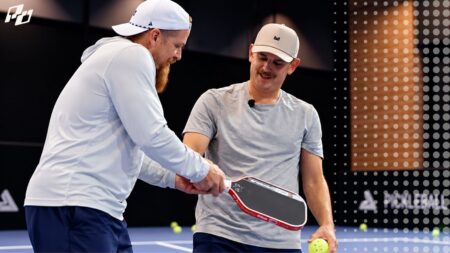
Coach Shea Underwood makes an excellent point about how standing a little farther back from the line gives you more power and advantages:
3. Want a Forehand Third? Serve More Centered.
This is especially helpful if:
- You like driving or rolling your third
- You want to run around your backhand
- The returner tends to return middle
Standing near the center line gives you more real estate to work your forehand into the rally.
4. Prefer a Backhand Third? Serve Slightly Wider.
This helps when:
- Your backhand is more stable
- The returner loves going crosscourt
- You want predictable footwork
Standing wider doesn’t mean “stand on the sideline” — it just means “shift your default.”
5. Avoid Serving Too Wide
Serving from the edge of the court:
- Reduces your angles
- Creates predictable serves
- Makes deep serves harder
- Forces awkward third-shot footwork
Wide serving is a tactic, not a lifestyle.
✅ Simplified Serve Positioning Cheat Sheet
| Goal / Situation | Where to Stand | Why It Works | What to Avoid |
|---|---|---|---|
| Best All-Around Default | 1–2 ft from center line | Balanced angles, hides intent, easier forehand thirds | Standing on the sideline (telegraphs direction) |
| More Time & Power | 2–3 ft behind baseline | Fuller swing, deeper serves, calmer third shots | Standing on the line → rushed, foot faults |
| Prefer Forehand Third Shot | Closer to center | Gives more forehand space, easier run-around | Standing too wide, losing forehand access |
| Prefer Backhand Third Shot | Slightly wider from center | Predictable footwork, better backhand setups | Going all the way to the sideline |
| Trying to Be “Sneaky Wide” | Only shift a little wider | Adds angle without giving up positioning | Serving from the edge → predictable, poor angles |
Partner Positioning: The Overlooked Doubles Advantage
Most intermediates have NO idea where their partner should stand during their serve. Here’s the cheat sheet:
Your partner should stand halfway between the baseline and NVZ.
Not on the line. Not at the kitchen. Halfway.
Why?
- They can cover deep middle
- They can move forward or back quickly
- They avoid blocking your third shot
- They’re in position to defend drives
- They’re not a sitting duck for body shots
If YOU stand wider, THEY should slide with you.
Partners should shift together like a sliding door — not two random pieces of furniture.
If you serve from the middle, your partner should guard the center.
If they stand off to the side, congratulations — you just created a giant middle gap, also known as “rec players’ favorite target.”
SINGLES: Completely Different Positioning
1. Serve More From the Middle
This reduces your opponent’s angles and lets you recover faster. Singles is about coverage, not deception.
2. Use Wide Serves Sparingly
Only use wide serves when you can:
- Hit behind the player
- Attack their recovery
- Take advantage of their weaker movement pattern
Otherwise, you’re pulling yourself off the court.
3. Stand Farther Back
Singles serves need depth. Backing up:
- Adds power
- Adds consistency
- Pushes your opponent into defensive positions
- Gives you more time to move into the court
Common Myths About Serve Positioning
Myth #1: “Stand on the line for a deeper serve.”
Actually, standing back gives you more room to accelerate the ball and more time to read the return.
Myth #2: “Wide serving creates better angles.”
Sometimes — but it also removes YOUR angles and makes your intentions obvious.
Myth #3: “Where you stand doesn’t matter, the serve does.”
Your position determines your third shot. Your third shot determines your whole point.
Myth #4: “Pros stand center because it’s safer.”
They stand there because it unlocks their forehands and simplifies footwork, not because it’s “safe.”
Try This in Your Next Match
1. Serve from 2–3 feet behind the baseline for a whole game.
Watch how much calmer your third shot becomes.
2. Serve from near the center line. Count how many more forehands you get.
(You’ll be pleasantly shocked.)
3. Make your partner match your horizontal position.
If you shift right, they shift right. If you shift left, they shift left.
4. For one game, decide your serving position before you walk back.
Notice how intentional positioning changes your entire rally structure.
Your Serve Position Is Your First Advantage — Use It
Serve positioning isn’t some tiny technical footnote. It’s the very first strategic choice you make in every rally, and—here’s the onus part—it’s completely in your control.
If you start standing with intention…
If you set yourself up for the third shot you want…
If you and your partner slide together like you actually planned it…
If you stop falling into those predictable “I always stand here” habits…
…you’re going to look like a different player. A calmer one. A smarter one. The kind of player people quietly ask, “When did they get so good?”
Own your serve position, and suddenly everything that happens after it feels easier, smoother, and way more purposeful.
This is the simplest upgrade you can make — and the one most players never do.